
 FA+
FA+ Shop
Shop

Regarding Upload Policy 2.7
2 years ago
General
Regarding Upload Policy 2.7 (UP 2.7) and Its Recent Update
If you’ve been on FurAffinity during the past week or so, you’ve likely seen a lot of discussion regarding the recent update to FurAffinity’s Upload Policy 2.7, as well as the policy as a whole.
I knew I had to write a journal about it, but I waited a while because I wanted to hear other user's opinions on it, wait for further clarification from FA administration on the policy, and receive a reply to a trouble ticket I sent in on May 19, the day the recent update to the policy was announced.
I wanted to get my two cents in because I think good rules about content moderation are crucial for any social media site, and they can be the hill that sites live or die on ( source: Tumblr ).
There’s three main points to address when it comes to this policy:
(1) UP 2.7 fails to functionally accomplish its ostensible purpose.
(2) The real reason for the currently ineffective implementation of UP 2.7 is the lack of a blacklisting function on FurAffinity.
(3) If FurAffinity continues to exist without a blacklisting function, there will likely be more ineffective policies like UP 2.7 in the future.
Background Information
If you’re planning on reading this journal (and especially if you’re planning on joining the sitewide conversation on this policy either here or elsewhere), I strongly suggest having first read the current wording of UP 2.7 in the FA Upload Policy ( https://www.furaffinity.net/aup ) and the three recent journals posted by FA explaining the updates to the policy:
J1: https://www.furaffinity.net/journal/10552819/
J2: https://www.furaffinity.net/journal/10557600/
J3: https://www.furaffinity.net/journal/10560608/
None of these sources on its own explains the full scope of UP 2.7, which is why it’s important to read all of them. It will be hard to follow what I’m saying if you haven’t. I’ll be referring to these journals as J1, J2, and J3 in the text that follows.
Lastly, and very importantly: I’m not trying to personally attack FurAffinity’s admin staff here. I want to have a discussion about policy, and why UP 2.7 is a bad one.
I’m sure the admin staff knew the update to the policy would result in a lot of controversy (especially since many FA users who joined after 2015 are just now learning UP 2.7 even exists), and I doubt the decision was made flippantly. I think both the recent update and the original policy are bad, but I don’t think they’re intentionally bad. I want to think of the FA administration as allies for users to work towards a better policy with, and I hope others who are upset with the recent decisions will share that sentiment.
With that out of the way, let’s get into it.
The Case Against UP 2.7
UP 2.7 is fundamentally flawed.
It fails to effectively accomplish its own goal and threatens a lot of collateral damage in the process, so it is objectively a bad policy whether or not you agree with its intent.
It’s not just the recent update affecting fictional species I disagree with. I think the policy has been poorly implemented ever since it was redefined to suit the third-party interests of IMVU, who owned FurAffinity in 2015.
Why UP 2.7 Just Doesn’t Work, Explained Using Apples
A policy to ban certain content (let’s say apples, for example) from being posted to the site should generally meet three requirements in order to be effective:
(1) Accuracy: If the policy is supposed to ban apples, it shouldn’t accidentally ban oranges in the process. Even red oranges are still oranges, not apples.
(2) Completeness: If the policy is supposed to ban apples, it should ban ALL apples. (I’m looking at you, Red Delicious apples, your name is a lie.)
(3) Transparency: Users should be able to generally understand what counts as an apple without needing to consult a moderator. A user should be able to read the no-apple policy as written and know whether this (link) is okay to post or not.
Transparency is important because it allows for users to mostly self-moderate when deciding what to post, reduces the amount of manual moderator intervention necessary to keep the site in line with the policy, and reduces user anxiety about being unfairly penalized for failing to abide by a policy that’s too vaguely-defined.
The current implementation of UP 2.7 fails at all three of these.
Why UP 2.7 Fails on Accuracy
UP 2.7 is an overgeneralization. In its attempt to cover all potential cases it wants to target, it risks targeting several categories that it presumably is not meant to. These include:
- Humanoid or semi-humanoid fictional characters and species that have small proportions even as adults.
Consider the infamous “old ass Treecko” (link) from the episode “Tree’s a Crowd” (link) in the Pokemon anime.
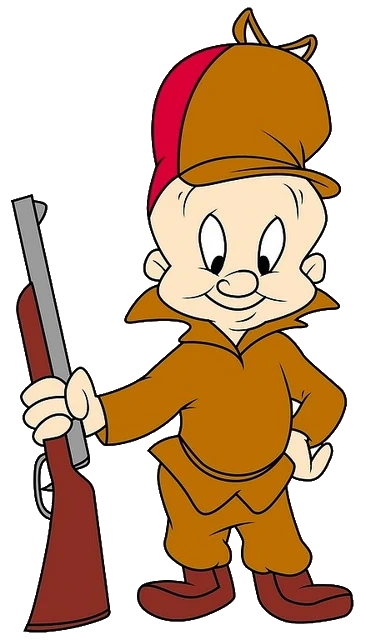
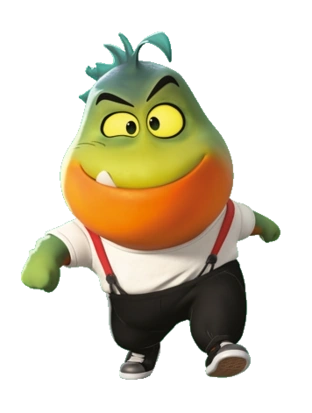
Consider also Elmer Fudd, Mr. Piranha, pretty much the entire cast of any Paper Mario game, and way too many other Pokemon and Digimon to possibly list here.
This point is the main problem with the recent update to UP 2.7 announced in J1: The body proportions of these characters have literally nothing to do with their physical age or emotional maturity.
- Non-humanoid fictional species that do not visibly show their age like humans or any real-life animals.
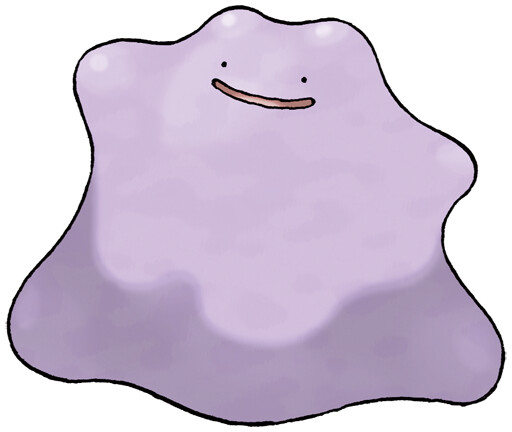
UP 2.7 bans adolescent fantasy creatures, but who can possibly be an authority on what exactly visually indicates that a non-humanoid fantasy creature is an adolescent? What possible visual indicator am I meant to be looking for when deciding whether this thing (link) is 18 years old or not?
- Fictional species or characters that reach maturity in less than 18 years.
Consider Grunt from Mass Effect (link). He was genetically engineered and rapidly aged in a laboratory so he technically has been alive less than 18 years, but you would be hard-pressed to call him a minor. And even krogans who mature normally are stated to reach maturity in about 10 years.
- Art styles that draw all characters with smaller proportions.
This one’s self-explanatory, and sadly not just fearmongering. J2 states that chibi (and presumably similar cartoon styles) may not be allowed in certain circumstances.
UP 2.7 tries to apply real-life human visual indicators of age to all species and art styles. This simply doesn’t make sense, given that the vast majority of characters depicted on the site are not human, and a great many of them are clearly not meant to mimic the real-life body proportions of humans.
Why UP 2.7 Fails on Completeness
Despite its over-broadness, UP 2.7 actually fails to even properly encompass the content it’s trying to ban.
J2 states that the policy is “not concerned with whether or not a character is emotionally mature”.
…What? …Did I read that right?
Correct me if I’m wrong, but isn’t the entire basis for arguing against minors in NSFW content the idea that they aren’t psychologically mature and thus cannot make properly informed decisions regarding consent?
Why in the world would a policy seeking to ban NSFW depictions of minors not be concerned with this?
Going by this, you could design a fictional species of adult-proportioned characters that are over 18 but still psychologically infants and draw NSFW of them without any problems. I somehow suspect that some users who have been thus far praising UP 2.7 would probably take issue with that.
By exaggerating the significance of body proportions and entirely disregarding emotional/psychological maturity in its definition of minors, UP 2.7 misses the point and is thus an ineffective rule.
Why UP 2.7 Fails on Transparency
What the various recent journals by FA, particularly J2, present as a solution to the ambiguity of the policy is “context”. Moderators will take context into account when making decisions regarding UP 2.7.
The problem is that context is largely up to interpretation, and there’s no way to predict how a moderator will read the context of a piece.
The same day the update to UP 2.7 was announced, I submitted a trouble ticket linking various pieces from my gallery that I thought might be at risk of ending up on the wrong side of the policy. The response from a moderator arrived a few days later:
“All of the images you have linked will not be in violation of the update when it goes live.”
Well. I’m pleasantly surprised, but the fact that I’m surprised points to the issue at hand.
How context is used in making these decisions is not clear to users, which makes it hard to predict what call a moderator will make and creates anxiety for users who fear that they may get penalized quite severely for ending up on the wrong side of a subjective evaluation of “context”.
It’s no big surprise then, that artists have been making journals linking their other social media sites, and a couple of artists popular enough to be considered influential have now stated that Itaku will be their primary gallery going forward.
So. UP 2.7 is not a sound, functional policy. It never has been since 2015, but the recent update to it really serves to both highlight and further worsen its flaws.
So… why did such a flawed policy come to be, and what should the solution be?
The Real Problem Is the Lack of a Blacklist Function
As a content creator myself, I tend to prefer more liberal content policies. Generally, I would argue that only content that causes a real, tangible harm to someone should be banned. (“Someone” in this case meaning a real, physical, living being on planet Earth, not a fictional character in a drawing.) This would include things like harassment, threats, hate speech, doxxing, dangerous misinformation, spam, etc. If something doesn’t cause this kind of tangible harm, I think it’s generally fine to let it be.
Some users who support the current UP 2.7 may be very uncomfortable seeing any character that even remotely resembles a minor through body proportions, even if there’s no real reason to assume the artist had that in mind. But this falls short of being a tangible harm, and when we police content just because it makes someone uncomfortable, we do a disservice to artistic expression.
Of course, most people don’t want to make anyone uncomfortable. Most people want their content to reach people that enjoy it and be unseen by those that don’t want to see it. And most people don’t mind the existence of content they don’t like, as long as they can avoid seeing it.
This is why FA’s lack of a blacklisting function is a major impairment to the site, and the administration should be prioritizing implementing one.
I think very few users actually like UP 2.7 exactly as it currently exists. But given the lack of a blacklisting function, the only way for users to reliably avoid seeing content they don’t want to see is to push for it to be banned sitewide, so for many, UP 2.7 is the lesser evil.
So, although I can understand why some users having been pushing for this ban, and I can understand why FA made the decision to implement it, I don’t think this all-or-nothing approach to handling contentious content will serve FA well in the long term.
Because what happens when the loud minority saying all NSFW of small characters is pro-pedophilia decides that all feral art is pro-bestiality? Or all vore is pro-cannibalism? Or all bondage is pro-rape?
And what happens when there’s still no blacklist function and enough people are uncomfortable with these types of content to jump on the bandwagon calling for a sweeping ban on them?
As long as FA lacks a blacklisting function, we’re going to eventually have more UP 2.7’s.
The Conclusion
FA administrators might disagree with my opinion on content moderation. They might simply not want certain content on the site, irrespective of whether it causes any tangible harm.
And they’re allowed to! They own the site, after all, and are genuinely trying their hardest to juggle the competing demands of an extremely diverse audience. And as much as we bash them when things go wrong, they generally keep the ship running and deserve praise for that.
But this recent policy update is a chunk of ice the ship just bumped into. If the captain doesn't change course, we'll hit the iceberg eventually.
I think all of FA’s users probably agree that the policies that exist, whatever they are, should be effective. And the current implementation of UP 2.7 is not.
But again, UP 2.7 is mainly a symptom of the more problematic lack of a blacklisting function, which I hope is the main takeaway here.
So What Can You Do?
In J3, FA has invited users to share their feedback through the ticket system here: https://www.furaffinity.net/control.....roubletickets/
Numbers matter here. Even if someone else has already voiced your thoughts, you yourself sending them in counts for something. So if you have strong feelings about UP 2.7, I’d encourage you to say your part. You don’t have to be an artist or someone who posts a ton (or at all) in your gallery to have a say here.
If you feel that a post someone else has already made (cough, cough) accurately addresses the issues with UP 2.7, you can always just send in a ticket in that links that post and let mods know you agree with its sentiment to make your opinion heard while saving yourself some time.
And if you want to comment on this journal, I welcome you to! If you want to add to what I’ve said, point out any errors I’ve made, or just simply voice your agreement or disagreement, it’s all good discourse. Some people feel more comfortable sending notes than making comments, and that’s good too! If you’ve got thoughts, I’d like to hear them.
Please keep it civil if you reply to other comments, though. It’s good to express your opinion, and it’s okay to voice your disagreement with someone else’s, but don’t make anyone else feel like they’re not allowed to be a part of the conversation.
That’s it for now. Cheers, everyone, and here’s hoping for better policies and better browsing in the future.




There is, of course, a discussion to be had about how that will be enforced. But if nothing else, the substance of that change shows that the FA admin team has heard the complaint you brought up here -- it's been a rather common complaint, after all -- and is now trying to address it.
In addition, the rolling out of tickets telling people with their chibi styles, or short stack characters that they WOULD be banned for the art they draw is incredibly horrendous, and tells us how they WERE planning to roll this out.
Maybe internal policy has changed. Maybe artists like StripedCrocodile, Radasus, Argon_Vile, etc. are in the clear now. But we don't KNOW that, because they haven't SAID anything. That's really what we need. It's been 5 full days of silence, 3 of those days with a feedback channel up that supposedly was going to only end when an announcement was made. All lies.
Regarding the statement about vore and TF, I think it's probably reasonable to assume what moderators had in mind were non-sexual examples of things that could be considered vore and TF. Disney's Pinnochio includes minors involved in examples of both, but is clearly not sexual in nature.
The phrase "non-sexualized interests, such as vore and transformation" in J2 could certainly have been worded better to make this intent clear, but I'd rather debate the substance of the policy than nitpick poor wording.
EDIT: Also, the update to the wording Monroe mentions in his reply above shows an attempt to clarify this ambiguity. Thanks, Monroe :3
The debate about having younger users on the site is too complex to lay out entirely here, but I think it's mostly a moot point at the end of the day. The FA Terms of Service also state the following:
"Although Fur Affinity can display artistic renditions of adult content, the feature is disabled by default and may only be enabled via your account settings if you are legally allowed to view it in the United States (18 years of age). If we determine that you may not be legally allowed to access this content, we will restrict your access to mature and adult content until you can verify your age via government photo identification. Any attempt to bypass this measure may result in all current and future accounts registered by you to be permanently banned."
There's really no reasonable method available to verify all users' ages (requiring manual government ID verification by moderators for every single user at the time of registration would simply be unfeasible) so changing the permitted age in the terms of service wouldn't functionally change anything. I'd rather focus on policies that will actually affect people.
I think that's a big part of the problem in debating decisions like this. Making a bad proposal like "Let's just ban all child-proportioned characters!" is short, easy to grab onto, and catchy. Making the argument as to why that doesn't work is long, wordy, time-consuming, and requires the other person to be arguing in good faith and not dismiss you outright.
It's also a lot easier to rile people up than to calm them down, so angrier arguments tend to spread more. :P
I think that the actual change in the text of UP § 2.7 is perfectly fine. The change is quite minor as I understand: the addition of the phrase "or fantasy creatures" to the end of the paragraph defining what a minor is. Such a clarification is rather minor indeed, no pun intended. Note here that when I describe the change as "perfectly fine", I am focusing exclusively on the text of the Upload Policy itself and not the myriad journals providing guidance for how FA's administrative team intends to apply UP § 2.7.
The concerning bit, as you rightly prioritise, is the guidance laid out in the journals you've referred to as J1, J2, and J3. The FA admin team has, it seems to me, over-explained what is realistically going to be a highly contextualised, snap judgement that makes use of hundreds of different criteria. People do not serially consider each of the different bodily proportions to arrive at a conclusion of whether a Treecko looks like a child; to pretend that people consume visual media in this way is antithetical to the reality of how people determine whether a figure appears adult-like or childlike. These journals have verbally narrated the act of viewing artwork and established pseudo-objective criteria for how staff shall make visually-guided determinations, when the real process is neither verbal nor based on objectively balanced criteria.
It's true: unconscious evaluations and subjectivity are built into the process of deciding what art looks like. If someone draws a smile, how do I know it's a smile? It's a snap judgement on my part. If I were somehow pressed to point to specific qualities, I might refer to the upturned lips, the baring of teeth, and the narrowing of the character's eyes -- yet these same descriptors could just as well describe a snarl as a smile. Similarly, it's a fool's errand to try and describe how one determines if a character "looks young".
I shall repeat myself here, this time expressing my opinion in different words: I think the policy would be fine if the FA admin team did not over-specify their intentions for enforcement. That is the truest error here, in my opinion. The process will be vague and difficult to describe. That should be recognised. To end with an analogy, I will turn to e621's successful implementation of a "tag what you see" policy. On e621, users just tag what they see. If there's a dispute, a third party steps in. If someone wants to dispute that third party's determination, it can be escalated once more. This policy is successful because it relies upon those indescribable common-sense notions of what art looks like without asking anyone to list out the specific qualities on which they made their judgement. Similarly, FA would be best served to recognise the realities of how humans make visual judgements, and focus instead on developing the safeguards to protect artists from errors in judgement: quicker Trouble Ticket decisions, greater transparency and community involvement, and administrative oversight whenever a moderator decision is subject to appeal.
The reason why I state that it's a small textual change to add the phrase "or fantasy creatures" to the paragraph defining minors is that previously, a "minor" was defined as only a humanoid or an adolescent animal. I think it's agreeable to most people to state that, indeed, fantasy species can be depicted as minors.
That's why it's a minor change to the existing rule. It simply recognises that insofar as an anthro fox can be depicted as a minor, so too can an anthro unicorn.
Actually, an earlier draft of this journal was largely about this. I was going to point out how the process described in J1-3 sets out specific objective observations that make art pieces potentially problematic, and only uses context as a means of making corrections when images that clearly aren't problematic end up caught in the net.
In reality, as you say, the process should be (and realistically likely will be) the other way around, where the decision to consider pieces problematic is mostly made based on the overall contextual "feel" of the image. People generally know cub art when they see it without needing to use a ruler and a checklist, so there's no reason to overcomplicate this sort of policy.
I couldn't figure out how to word those thoughts in a non-confusing way in a journal so it ended up changing into the current journal. x3 But I think you've explained it really well.
And yup, once again e621 shows itself to be a role model on policy design. Maybe one day other sites will finally start taking notes, ha ha. x3
While the actual effect of the recent update is likely to be small, I worry that the ineffective process described in these recent FA journals will shorten the gap between the current policy and future worse ones by leading people who aren't thinking too hard about it into believing the process described in J1-3 makes sense.
Publicly editable tags work great on sites like e621, but they open up possibilities for tag abuse and I'm not sure if FA has enough mod manpower to effectively control that.
Itaku does a really good in-between and allows people to tag their own stuff, but also lets others suggest tag edits which can be approved by the OP.
Even just a basic blacklisting system on top of the current tagging system and a basic requirement that more niche/extreme kinks be tagged would be a huge improvement already though.
Of course, the week after it was announced was a shit-show. The discord was really in shambles. They tried putting all the criticism into a single channel for discussion, but the way mods were interacting only made the situation worse. I won't name names, because I'd get banned lol. But there is one mod in particular who seemed to be talking the most, and making things ever more confusing.
They put up a feedback channel in the discord, with a 6 hour cooldown, encouraging longer, more well written posts without it turning into a fighting match. A good idea. We were told our feedback would be considered, and this channel would exist until a policy change was made and announced.
Well, for a little over 3 days, there were close to a thousand messages from hundreds of different individuals. The sentiment was EXTREMELY clear, and well worded. However, those days were spent basically screaming into the void. No communication from devs, mod criticism getting deleted, reaction numbers on posts getting reset when it didn't look good for staff. People started to realize this was doing nothing.
Out of nowhere, a mod came in and closed the channel, saying this:
"After reviewing the feedback we have received from unique users, we have decided that this thread has fulfilled its purpose at this time and we will be closing it; however, if you have not been able to provide feedback yet on this topic, you may still do so by opening a trouble ticket on the website under "feedback". This will give us the time necessary to compile everyone's thoughts. Thank you."
The reactions on that post are currently 255 X's as opposed to only 13 checkmarks.
They closed the feedback channel, and promptly banned anyone on the discord from discussing the subject. I got a 24 hour timeout for saying that it felt like they were trying to throw a blanket on the discussion in hopes everyone would forget about it.
It's been 3 days since then, and still not a PEEP from the mods. I sent in a ticket, heard nothing there either. I made about 8 or 9 very long, well worded, kindly written posts. Hundreds did. There was almost no personal attacks. And even those "personal attacks" were just criticizing the suppression of discourse.
I really do just have 0 faith in the FA staff to actually address this. I really think they're done talking about it, and that's it. We will hear not but a single peep. I hope I'm wrong, but I really don't think I am.
Maybe you have a perspective or information that could provide a more optimistic view. I've just spent too long seeing how it's been handled already to have any hope. I hope FA survives. This is where I learned to draw, made friends, first started to build a platform. It would suck to see it go.
I can't really comment on the communication on the Discord since I'm not on there myself, but I can understand people wishing for a quick resolution.
My only communication with mods regarding this has been the one trouble ticket mentioned in my journal, which received a reply in a few days and fully addressed the question I'd asked, so I've got no complaints there. My past tickets have always been resolved satisfactorily within a day so their track record in my personal experience has been a good one.
I think there's a benefit to taking things a bit slower here. A lot of user feedback is still coming in, and there's only so many admins to make decisions at the highest level. Rushing a decision or response is more likely to make things worse, so I can't blame admins for wanting to be slow and steady here. I'd much prefer an eventual good decision than a rushed "kind of okay" or bad one.
The fact people are still able to send in tickets with feedback about this shows that this is a process that's still ongoing, and if admins made a decision before everyone's had their say, they couldn't really claim that the decision took everyone's feedback into account, right?
I really want to avoid bashing admins here because I don't think anyone's being intentionally malicious. As I mentioned in my reply to
I also agree with
While I recognize that art of fictional minors doesn't have any tangible real world harm, it feels like a very slippery slope that people shouldn't even go near. My other issue is that in my personal experience, I've seen several artists who do draw cub, it can be found on e621 and Inkbunny, who have used the excuse of "It's just a chibi artstyle" to draw minors in an excusable way. I know it's not always the case, but more often than not if someone explicit states "They're chibi" or "They're aged up" then they know what they are doing and are disputing the claims that they know are going to be made.
It's probably impossible to define a single place where the line should get drawn in a way that'll keep everyone happy. I think that's the reason why having the option to blacklist is really important, since it allows for people to individually avoid seeing grey-area content they'd rather not without having to vilify anyone who's just creating content they like with no ill intent or harm behind it.
You're allowed disagree of course, but the problem with a "there's no fixing this" mentality is that, well... it doesn't fix anything. So if you truly believe that, then there's nothing to do but leave.
If I notice a building I'm in doesn't have a fire extinguisher, I'd rather advocate for getting one (while keeping in mind where the fire exits are in case I need to use them) than prematurely burn the building down because I think it'll happen eventually.
I think that a very significant problem with any content policy like that, is that it puts into consideration the wrong thing: the content, instead of the goal of the author.
What makes a picture problematic is not its content, but the intention behind it.
Any material has people that would jack off to it, but what really matters there is whether the author has intentionally produced something, that say, sexualizes minors while avoiding detection.
I used to be a part of an administration team of a community server in a multiplayer game, and the more people who intentionally were doing harm, while staying within our rules, the more we started enforcing them by intention, rather than whether they actually broke the rules. It was a highly effective strategy, as we all shared common values and were able to enforce our judgement uniformly against people who tried using loopholes or exploiting edge cases to cause malice, but there is no good way to implement something like that on a social media site.
The problem with that is that while my and your values may agree, and we may accurately be able to tell whether a piece is intentionally avoiding being classified as pedophilia, as in the "1000 year old loli vampire" case, it is still fundamentally subjective, and even different moderators on this site could judge the same piece differently, or be fooled into allowing something they should not.
Not to mention that there is always a possibility of bad actors on the enforcement side...
I'm not saying that having a general set of rules is bad, but it definitely should be possible to report a piece/creator based on "malicious intent" whenever rules aren't exactly being broken.
But I think "intent" or "goal" might not be the best word to use to explain this to a userbase, since those words imply some kind of mind-reading by mods that obviously isn't possible. It also turns moderator interventions into evaluations of the creator's character rather than the content in question. If a piece gets taken down, rather than the meaning being "this post is close enough to X to not be allowed on the site", it's "you, the user, have been judged to be the type of person that posts X", which is much more inflammatory. You can create a lot of bad blood between admins and users very quickly this way when honest mistakes inevitably occur.
But the idea that content policies like this are more effective when decisions are made based on the contextual "vibe" of a piece is probably true so I'm with you on that. :3
This is why open communication and trust in the admin staff is really important, since a lot of decisions are ultimately going to be judgement calls. It's also why, as Monroe also mentions above, prompt replies to trouble tickets and neutral oversight/intervention from admins when individual moderator decisions are called into question are really beneficial.
I suppose I'm thought dumping more than providing solutions, for which I apologize. It would be good to have some kind of tag system that can limit exposure on a broad spectrum both for user preference and for younger individuals stumbling onto this site. That said, I am still concerned about the outcomes currently and the upending of this site as a tool completely. I know everyone hates on FA about something, often times with legitimate arguments, but it is still a pillar of furry content on the internet. I really don't want to go back to a world of downloading JPGs from hidden BBSes or listservs with invite privileges. I suppose that's the postulate I have, given the potential real world threat towards this and other sites like it, would that level of security proposed be any more likely to prevent a bad outcome?
I think it's important to acknowledge and separate legal and moral considerations in this case.
We shouldn't roast admins over an open fire for doing what's necessary to abide by the law and keep FA safe. In order to facilitate that, I think the discourse on the site would benefit from admins openly talking about which parts of FA policy exist due to legal reasons and which are moral decisions about what kind of site the admins want FA to be.
We should also be able to acknowledge that some of the content certain artists create might not be able to be hosted on the site for legal reasons, without necessarily vilifying artists that produce that content as being inherently morally corrupt. I think a lot of the anger from content creators right now isn't about being told "some of your content can't be here" but rather the feeling that they're being told "your content makes you the kind of person we don't want here", and more openness about the motivation behind certain policies has the potential to do a lot of healing.
So, yeah, co-signed!
But jokes aside, I 10000% agree with everything you said in the Blacklist paragraph. Banninig art just because it is cartoon-ish or the characters may be minors because they *look like one* is just such a weird way around and the main problem is, as you mentioned, the mental state of a character matters in that case, because it is really hard to judge sometimes if that character is an adult or not, with so many characters in furry world, artstyles and storybuilding, that simply saying that what looks like a child and has a child proportions is forbidden cuz they are a minor - is just a bad take and really causes more problems than it solves.
I do love that you included a lot of images to prove your point and that is like the most awesome thing one can do in an argument. You pointed really well the flaws of the 2.7 rule and I wanna thank you actually for explaining it more to me. I was thinking when would FA add Blacklist to finally hide stuff I just don't wanna see but I think if they were to add one, it would be far from perfect. I am 100% sure, it would be just based on Tags, and as we all know, some artists don't even tag their works. People would need a good reason to tag their art, so that the Blacklist would have easier job in filtering it all.
Anyways, I just hope it gets resolved and FA mods just use all of this and put lots of effort to really improve. I don't really feel like leaving FA for other sites, because this one is really nice, better than Twitter at least lol
I do often hear the complaint that "a blacklist wouldn't work because people don't tag properly", and while it's true that the blacklist wouldn't help IF people were to *continue* to tag poorly after it's implemented, I think the blacklist itself would be an incentive to better tagging.
A big part of the reason people on FA don't tag properly is because the functions that would make use of tags are either missing (blacklisting) or not great (searching).
If blacklisting was added and the search function was improved, I think a lot of people would be incentivized to do better tagging. Especially artists who want to be discovered more easily by people who are into their type of content.
There would also be a good reason for mods to start manually enforcing tagging when it comes to more extreme kink/gore/etc. content, and/or have penalties for people who fail to tag that kind of content.
We could follow e621's lead and create a mod role of "tag janitors" that clean up and add tags to images when needed, as well as resolve reports of mistagged content. We could also follow Itaku's lead and allow any user to submit tag suggestions that the OP can deny or approve.
Having the blacklist system and an improved search function would create both the incentive and the means to substantially improve the tagging culture on FA. So rather than seeing the poor tagging on FA as a reason not to bother implementing blacklisting, I think we should see implementing blacklisting as part of the solution to the poor tagging.
Lastly, I agree with you that FA's got a good thing going, and that's why I'm not joining the bandwagon of people leaving FA or saying it's beyond repair. There's a reason it's survived and thrived when almost every other attempt at a furry social site barely makes it off the ground. I'd rather build up what we have here than toss it out when there's no other comparable option available.
But yeah, as a community we can give feedback and hope that the admins will listen and also try their best to impvore and push FA to a better future and moderation~
But Itaku's in between approach would be doable, I think. :3
Yeah, here's hoping cooler heads prevail and things will improve!
Ironically this broken system is exactly what drives content creators to be more active, since it's an extremely easy way to inflate engagement numbers by shifting the maximum possible burden off the content creator and prohibiting viewers from using any sort of functional search system to filter by subject rather than author.
Regarding blacklisting and tagging,
For your second paragraph, I'm not sure if I completely follow what you're saying. If you're saying that a bad search function encourages "high quantity, low quality" posting by content creators, I agree with that. If it's nearly impossible to be found based on the nature of your content, then increasing the *amount* of content you put out is what people tend to do, hoping to boost their odds of being found by chance.
I don't think most content creators feel that this makes things easy for them, that this system takes the burden off of content creators, or that most content creators prefer this kind of system. I think most content creators would prefer to put out quality rather than quantity, and have a system that fosters success for creators that operate that way.
As a site dedicated to a subject that some would consider taboo, to make statements in j1/2, where they basically open the doors to say, "huh, this has adult proportions, of a real dog... Ban?" Where do they see it stopping.
Btw, excellent take on the blacklist, most sites would be far better with one, or at least a better filter system in general. Anyways, enough of my sleep deprived rambling.