
 FA+
FA+ Shop
Shop
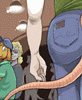
"Want to go at it in the truck?"
4 years ago
General
In the Peanut Gallery with Mystery Science Theater 3000: Essays on Film, Fandom, Technology and the Culture of Riffing edited by Robert G. Weiner & Shelley E. Barba (McFarland, 2011, 978-0786445325)
https://www.amazon.com/dp/0786445327?psc=1&ref=ppx_pop_dt_b_product_details
The fish-nor-fowl nature of MST3K makes life difficult for critics, some of whom can't decide if it's really a TV series at all. One book celebrating the best of American television opines that the show's an umbrella title for an anthology that "consists of maybe 90% annotated film-watching and 10% character-based comedy," a neat way of saying "It's brilliant, but on the binary choice of sitcom/sketch comedy, we don't know what it is."
The essays in this collection are attempts to tell us exactly what it is, in terms that even a cultural studies researcher can understand. So, imagine Adorno's worst nightmare: a pop culture product that turns its audience into passive, mute, smug, lazy, gullible consumers -- say, a mad scientist's weapon of choice in their plan for world domination. Never mind that the plan is consistently foiled by a quick-witted janitor and his robot friends: Adorno and his ilk didn't give pop culture audiences any credit for thinking critically about anything.
The essays get a lot of mileage from Susan Sontag's 1964 "Notes on Camp," itself indebted to lines from the novelist Christopher Isherwood: "You can't camp about something you don't take seriously. You're not making fun of it, you're making fun out of it." Thus MST3K invents a new kind of television comedy, one that lampoons the banality of poorly executed pop culture products with jokes that reference everything from Sophocles to SANFORD & SON, from PETTICOAT JUNCTION to Paul's letter to the Philippians; jokes loaded with the full force of (Western) cultural memory. It's a show, many of these essays argue, whose fans become active participants -- co-creators -- in repurposing the cinematic detritus of the past into texts that speak to the frustrations (the "contradictions and self-parody") of the present. The term "hegemonic culture," referring to a past that tries to control the future, gets used a lot, but why shouldn't it? Just think of the licensing issues that continue to keep eleven episodes of the original series in legal limbo.
I won't pretend that this is an easy book to read if you're not comfortable with academic writing, but it's worth thinking critically about this show, 'cause MST3K is the FINNEGANS WAKE of television comedy: dense, allusive, playful, profoundly weird, and very funny.
EDIT: The actual lines from episode #313, EARTH VS. THE SPIDER are:
Sheriff: Wanna go for it in the truck, Simpson?
Joel, Crow, Servo: Kinky!
https://www.amazon.com/dp/0786445327?psc=1&ref=ppx_pop_dt_b_product_details
The fish-nor-fowl nature of MST3K makes life difficult for critics, some of whom can't decide if it's really a TV series at all. One book celebrating the best of American television opines that the show's an umbrella title for an anthology that "consists of maybe 90% annotated film-watching and 10% character-based comedy," a neat way of saying "It's brilliant, but on the binary choice of sitcom/sketch comedy, we don't know what it is."
The essays in this collection are attempts to tell us exactly what it is, in terms that even a cultural studies researcher can understand. So, imagine Adorno's worst nightmare: a pop culture product that turns its audience into passive, mute, smug, lazy, gullible consumers -- say, a mad scientist's weapon of choice in their plan for world domination. Never mind that the plan is consistently foiled by a quick-witted janitor and his robot friends: Adorno and his ilk didn't give pop culture audiences any credit for thinking critically about anything.
The essays get a lot of mileage from Susan Sontag's 1964 "Notes on Camp," itself indebted to lines from the novelist Christopher Isherwood: "You can't camp about something you don't take seriously. You're not making fun of it, you're making fun out of it." Thus MST3K invents a new kind of television comedy, one that lampoons the banality of poorly executed pop culture products with jokes that reference everything from Sophocles to SANFORD & SON, from PETTICOAT JUNCTION to Paul's letter to the Philippians; jokes loaded with the full force of (Western) cultural memory. It's a show, many of these essays argue, whose fans become active participants -- co-creators -- in repurposing the cinematic detritus of the past into texts that speak to the frustrations (the "contradictions and self-parody") of the present. The term "hegemonic culture," referring to a past that tries to control the future, gets used a lot, but why shouldn't it? Just think of the licensing issues that continue to keep eleven episodes of the original series in legal limbo.
I won't pretend that this is an easy book to read if you're not comfortable with academic writing, but it's worth thinking critically about this show, 'cause MST3K is the FINNEGANS WAKE of television comedy: dense, allusive, playful, profoundly weird, and very funny.
EDIT: The actual lines from episode #313, EARTH VS. THE SPIDER are:
Sheriff: Wanna go for it in the truck, Simpson?
Joel, Crow, Servo: Kinky!

Regardless, MST3K is a Great Show. 'nuff said.