FA+
FA+ Shop
Shop

Discovering Neofolkfurs
General | Posted 12 years agoHail neofolk furs,
Out of curiosity, how did you discover this group?
Out of curiosity, how did you discover this group?
Music for the Month of June
General | Posted 12 years agoBecause this is the month of June, what better way to enjoy it than to listen to some music by Death in June. Thus, here are some great songs by one of the pioneers of neofolk:
Rose Clouds of Holocaust - https://www.youtube.com/watch?v=vjWacM9s7rE
Little Black Angel - http://www.youtube.com/watch?v=--7bemJNeG4
Idolatry - https://www.youtube.com/watch?v=6ELqqpnrmAs
She Said Destroy - http://www.youtube.com/watch?v=myzNWd-Pp2g
Fall Apart - http://www.youtube.com/watch?v=F_S8bPXK8ao
Touch Defiles - http://www.youtube.com/watch?v=j2Gy7eC5fsI
Break the Black Ice - http://www.youtube.com/watch?v=a3jJ8Vr6aAg
All Pigs Must Die - http://www.youtube.com/watch?v=bbssmkuB0-c
Unconditional Armistice - http://www.youtube.com/watch?v=ZCACNC2E9mo
Peaceful Snow - http://www.youtube.com/watch?v=P31nQWMA2e8
Enjoy!
Rose Clouds of Holocaust - https://www.youtube.com/watch?v=vjWacM9s7rE
Little Black Angel - http://www.youtube.com/watch?v=--7bemJNeG4
Idolatry - https://www.youtube.com/watch?v=6ELqqpnrmAs
She Said Destroy - http://www.youtube.com/watch?v=myzNWd-Pp2g
Fall Apart - http://www.youtube.com/watch?v=F_S8bPXK8ao
Touch Defiles - http://www.youtube.com/watch?v=j2Gy7eC5fsI
Break the Black Ice - http://www.youtube.com/watch?v=a3jJ8Vr6aAg
All Pigs Must Die - http://www.youtube.com/watch?v=bbssmkuB0-c
Unconditional Armistice - http://www.youtube.com/watch?v=ZCACNC2E9mo
Peaceful Snow - http://www.youtube.com/watch?v=P31nQWMA2e8
Enjoy!
1000 Page Views
General | Posted 12 years agoHail neofolk furs,
I am happy to announce that Neofolkfurs has reached 1000 page views. This is an important milestone considering its obscurity compared to other groups on Fur Affinity. I would like to thank everyone who has joined the group. It is because of your support that neofolk can gain the recognition it deserves. Furthermore, it shows a growing interest in the music genre.
I am happy to announce that Neofolkfurs has reached 1000 page views. This is an important milestone considering its obscurity compared to other groups on Fur Affinity. I would like to thank everyone who has joined the group. It is because of your support that neofolk can gain the recognition it deserves. Furthermore, it shows a growing interest in the music genre.
New Group Members
General | Posted 12 years agoHail neofolk furs,
I would like to welcome all the new members who have been joining this group so far. It is wonderful to see that there are many who are fans of neofolk or simply interested in it.
I would like to welcome all the new members who have been joining this group so far. It is wonderful to see that there are many who are fans of neofolk or simply interested in it.
Say No to Nazi Neofolk
General | Posted 12 years agoHail neofolk furs,
I think it is important to mention that the Neofolkfurs group does not support Nazi neofolk bands. Sadly, like other genres of music, neofolk has its share of bands that support this ideology, causing people to think all neofolk music supports such political and social views. Of course, that is not true. It is my hope this group will help to show neofolk in a positive light where everyone is welcome and respected. Anyone who wishes to spread hate here will be blocked. I feel the following quote sums up the group's feelings towards such people:
"Whilst you enjoy our art and music please have in mind that we're not involved in political issues, especially no right-winged. So, if you're a kind of nazi-scum: fuck off and die!" ~ Sonne Hagal
I think it is important to mention that the Neofolkfurs group does not support Nazi neofolk bands. Sadly, like other genres of music, neofolk has its share of bands that support this ideology, causing people to think all neofolk music supports such political and social views. Of course, that is not true. It is my hope this group will help to show neofolk in a positive light where everyone is welcome and respected. Anyone who wishes to spread hate here will be blocked. I feel the following quote sums up the group's feelings towards such people:
"Whilst you enjoy our art and music please have in mind that we're not involved in political issues, especially no right-winged. So, if you're a kind of nazi-scum: fuck off and die!" ~ Sonne Hagal
Discovering Neofolk
General | Posted 12 years agoHail neofolk furs,
With the increase in people joining this group, I am curious. How did you first learn about neofolk? What is it about the music genre that you like?
With the increase in people joining this group, I am curious. How did you first learn about neofolk? What is it about the music genre that you like?
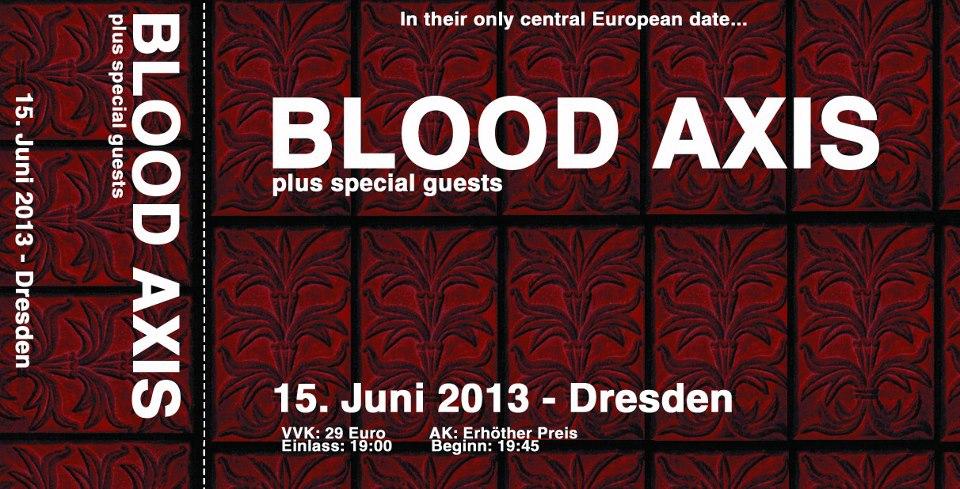
Blood Axis Live in Dresden, Germany
General | Posted 12 years agoHail neofolk furs,
Today, I updated our journal with some information and concert details featuring Blood Axis.
Concert flyer:
http://666kb.com/i/cd60hyxrx4fv5zrf1.jpg
Info:
Michael Jenkins Moynihan - Coup De Grace, Blood Conspiracy, Boyd Rice And Friends, Knotwork, Sleep Chamber, Witch-Hunt
Annabel Lee - Alraune, Amber Asylum, Knotwork, Witch-Hunt
Robert Ferbrache - Changes, The Czars, Boyd Rice And Friends, The Haters, Human Head Transplant, Slim Cessna's Auto Club, Soul Merchants, We Never Sleep
Blood Axis is a martial neofolk project composed by journalist and author Michael Moynihan and musician and author Annabel Lee.
Emerging officially in 1989, Blood Axis is the result of much earlier foundations. Created and directed by Michael Moynihan, it has been and remains a sincere and uncompromising expression of his often controversial thoughts and instincts.
The first recordings by Blood Axis consisted of “Lord of Ages” and “Electricity,” two songs appearing on a German sampler CD. Thoroughly unique in their sound, the first of these tracks is a stirring orchestrated hymn to the ancient Persian sun deity Mithras, a god later adopted for a cult of subterranean worship by the legionnaires of the Imperial Roman army. Although appearing on a relatively obscure release, these two initial efforts resulted in extensive radio airplay, dance club rotation, as well as mail from hundreds of enthusiastic listeners living as far away as Scandinavia, Malta, Eastern Europe and Thailand. Blood Axis had made its mark.
The band again inspired a rapturous response with the contribution of a pair of further songs to the acclaimed collection Im Blutfeuer,demonstrating more highly involved recording techniques and the ability to hypnotize listeners with subtle yet forceful atmospherics. “The Storm Before the Calm,” the second of the two tracks on this CD, utilized winding piano loops, lilting choirs and the eerie sounds of early nature recordings (a thunderstorm from 1935) along with earnest vocals and historical samples to create a sound that is more than the sum of it parts, possessing an ineffable power.
In the last days of 1995, more than six years since its formation, Blood Axis unveiled the first full-length CD, The Gospel of Inhumanity. This long-awaited album has more than fulfilled all expectations, demonstrating that Blood Axis is proudly distinct from any other modern musical groups in both sound and presentation. Sealed within a stunningly aesthetic digipak, The Gospel… is a shape-shifting soundtrack which reveals more and more depth with repeated listening. Spanning from neo-classical reveries to guitardriven aggression, the sonic incisions of Blood Axis provide a haunting backdrop for vocal elucidations from Ezra Pound, Charles Manson, as well as Moynihan’s own demanding voice. The Gospel of Inhumanity falls into no easy category, requiring a highly attuned level of intelligence and a mind free of pre-conception to appreciate its vast scope.
The Gospel of Inhumanity sold out two pressings for its initial release on German cult label Cthulhu Records, ensuring a fanatical following from Russia to Ireland, Norway to Portugal and everywhere in between. With virtually no promotion to speak of, the CD received rave reviews in Europe and America, and was even voted one of the 10 best albums of 1996 by UK extreme music glossy Terrorizer. Now powerfully remastered and re-issued on Misanthropy, the Gospel is destined to be heard by an even wider audience.
In November of 1997, Blood Axis played its first proper live show in Sweden at a special 10 year anniversary celebration for the legendary death industrial music label Cold Meat Industry. This special concert was attended by fans who came from as far away as Germany, Belgium, Austria and Latvia, and drew a rabidly enthusiastic reception from the crowd. In 1998, following the release of the planned second album, Ultimacy, the band will embark on a European tour. But until then, The Gospel of Inhumanity will continue seeping its way into the subconscious of the worldwide underground.
Blood Axis answers to nothing and no one but itself. It offers a frightening and honest expression of the souls of its creators, refusing to cater to either popular opinion or the approval of the music industry. At the same time Blood Axis continues to proudly shun popular trends and the mainstream, legions of listeners respond in growing numbers to a music presented with such undiluted care and willpower.
Moynihan collaborated with Boyd Rice from 1989, and in 1990 the two moved into an apartment in Denver. Like Rice and Thorn, Moynihan was a member of the Church of Satan at this time. Moynihan appeared as a guest with Rice on Bob Larson’s “Manson Maniacs”, a special for Larson’s Christian radio talk show. During the summer of 1991, Moynihan states that he was visited at his apartment by agents of the United States Secret Service about an alleged plot to assassinate then President of the United States George H. W. Bush.
Moynihan agreed to a polygraph test and no charges were filed. Moynihan stated that it was a simple case of intimidation stemming from his correspondence with Charles Manson and visits to Sandra Good. Moynihan stated that he felt that the he had been being monitored by the Federal Bureau of Investigation since 1984, that they had taken his luggage on an occasion, and that they had once called his father, admitting to him that they had taken a parcel from his mail. Moynihan cited his then-friendship with Peter Sotos as a potential cause.
Differences between Boyd Rice and Michael Moynihan led to an acrimonious split between the two in the mid-1990s, though Rice would later remember their time together fondly and refer positively to Moynihan. After the split, Moynihan disassociated himself with Rice and was no longer involved with the Abraxas Foundation. Moynihan has been a member of the small Asatru collective Wulfing Kindred since 1994.
More about Blood Axis:
http://www.bloodaxis.com/
http://www.facebook.com/BloodAxisMusic
http://www.myspace.com/bloodaxisofficial
http://www.discogs.com/artist/Blood+Axis
http://en.wikipedia.org/wiki/Blood_Axis
http://www.last.fm/music/Blood+Axis
Music:
Storm of Steel - https://www.youtube.com/watch?v=4y9nqHbRinU
Lord of Ages - https://www.youtube.com/watch?v=nax8l4vnrP4
The Vortex - http://www.youtube.com/watch?v=S0kf9zgGCUo
Today, I updated our journal with some information and concert details featuring Blood Axis.
Concert flyer:
http://666kb.com/i/cd60hyxrx4fv5zrf1.jpg
Info:
Michael Jenkins Moynihan - Coup De Grace, Blood Conspiracy, Boyd Rice And Friends, Knotwork, Sleep Chamber, Witch-Hunt
Annabel Lee - Alraune, Amber Asylum, Knotwork, Witch-Hunt
Robert Ferbrache - Changes, The Czars, Boyd Rice And Friends, The Haters, Human Head Transplant, Slim Cessna's Auto Club, Soul Merchants, We Never Sleep
Blood Axis is a martial neofolk project composed by journalist and author Michael Moynihan and musician and author Annabel Lee.
Emerging officially in 1989, Blood Axis is the result of much earlier foundations. Created and directed by Michael Moynihan, it has been and remains a sincere and uncompromising expression of his often controversial thoughts and instincts.
The first recordings by Blood Axis consisted of “Lord of Ages” and “Electricity,” two songs appearing on a German sampler CD. Thoroughly unique in their sound, the first of these tracks is a stirring orchestrated hymn to the ancient Persian sun deity Mithras, a god later adopted for a cult of subterranean worship by the legionnaires of the Imperial Roman army. Although appearing on a relatively obscure release, these two initial efforts resulted in extensive radio airplay, dance club rotation, as well as mail from hundreds of enthusiastic listeners living as far away as Scandinavia, Malta, Eastern Europe and Thailand. Blood Axis had made its mark.
The band again inspired a rapturous response with the contribution of a pair of further songs to the acclaimed collection Im Blutfeuer,demonstrating more highly involved recording techniques and the ability to hypnotize listeners with subtle yet forceful atmospherics. “The Storm Before the Calm,” the second of the two tracks on this CD, utilized winding piano loops, lilting choirs and the eerie sounds of early nature recordings (a thunderstorm from 1935) along with earnest vocals and historical samples to create a sound that is more than the sum of it parts, possessing an ineffable power.
In the last days of 1995, more than six years since its formation, Blood Axis unveiled the first full-length CD, The Gospel of Inhumanity. This long-awaited album has more than fulfilled all expectations, demonstrating that Blood Axis is proudly distinct from any other modern musical groups in both sound and presentation. Sealed within a stunningly aesthetic digipak, The Gospel… is a shape-shifting soundtrack which reveals more and more depth with repeated listening. Spanning from neo-classical reveries to guitardriven aggression, the sonic incisions of Blood Axis provide a haunting backdrop for vocal elucidations from Ezra Pound, Charles Manson, as well as Moynihan’s own demanding voice. The Gospel of Inhumanity falls into no easy category, requiring a highly attuned level of intelligence and a mind free of pre-conception to appreciate its vast scope.
The Gospel of Inhumanity sold out two pressings for its initial release on German cult label Cthulhu Records, ensuring a fanatical following from Russia to Ireland, Norway to Portugal and everywhere in between. With virtually no promotion to speak of, the CD received rave reviews in Europe and America, and was even voted one of the 10 best albums of 1996 by UK extreme music glossy Terrorizer. Now powerfully remastered and re-issued on Misanthropy, the Gospel is destined to be heard by an even wider audience.
In November of 1997, Blood Axis played its first proper live show in Sweden at a special 10 year anniversary celebration for the legendary death industrial music label Cold Meat Industry. This special concert was attended by fans who came from as far away as Germany, Belgium, Austria and Latvia, and drew a rabidly enthusiastic reception from the crowd. In 1998, following the release of the planned second album, Ultimacy, the band will embark on a European tour. But until then, The Gospel of Inhumanity will continue seeping its way into the subconscious of the worldwide underground.
Blood Axis answers to nothing and no one but itself. It offers a frightening and honest expression of the souls of its creators, refusing to cater to either popular opinion or the approval of the music industry. At the same time Blood Axis continues to proudly shun popular trends and the mainstream, legions of listeners respond in growing numbers to a music presented with such undiluted care and willpower.
Moynihan collaborated with Boyd Rice from 1989, and in 1990 the two moved into an apartment in Denver. Like Rice and Thorn, Moynihan was a member of the Church of Satan at this time. Moynihan appeared as a guest with Rice on Bob Larson’s “Manson Maniacs”, a special for Larson’s Christian radio talk show. During the summer of 1991, Moynihan states that he was visited at his apartment by agents of the United States Secret Service about an alleged plot to assassinate then President of the United States George H. W. Bush.
Moynihan agreed to a polygraph test and no charges were filed. Moynihan stated that it was a simple case of intimidation stemming from his correspondence with Charles Manson and visits to Sandra Good. Moynihan stated that he felt that the he had been being monitored by the Federal Bureau of Investigation since 1984, that they had taken his luggage on an occasion, and that they had once called his father, admitting to him that they had taken a parcel from his mail. Moynihan cited his then-friendship with Peter Sotos as a potential cause.
Differences between Boyd Rice and Michael Moynihan led to an acrimonious split between the two in the mid-1990s, though Rice would later remember their time together fondly and refer positively to Moynihan. After the split, Moynihan disassociated himself with Rice and was no longer involved with the Abraxas Foundation. Moynihan has been a member of the small Asatru collective Wulfing Kindred since 1994.
-More about Blood Axis:
http://www.bloodaxis.com/
http://www.facebook.com/BloodAxisMusic
http://www.myspace.com/bloodaxisofficial
http://www.discogs.com/artist/Blood+Axis
http://en.wikipedia.org/wiki/Blood_Axis
http://www.last.fm/music/Blood+Axis
-Music:
Storm of Steel - https://www.youtube.com/watch?v=4y9nqHbRinU
Lord of Ages - https://www.youtube.com/watch?v=nax8l4vnrP4
The Vortex - http://www.youtube.com/watch?v=S0kf9zgGCUo
Favorite Neofolk Bands
General | Posted 13 years agoHail neofolk furs,
Out of curiosity, what are everyone's favorite neofolk bands?
Out of curiosity, what are everyone's favorite neofolk bands?
Of the Wand & the Moon Concert and More
General | Posted 13 years agoHail neofolk furs,
Of the Wand & the Moon will be performing in Zagreb, Croatia on January 26, 2013. I hope to meet you there.
Foxpiper asked me in the past if I could write an article about Of the Wand and the Moon. I will write it now and publish it in the next few days.
There is new stuff all about your interests and mainly Neofolk, the way we do.
Also, I am searching for a full honored moderator who is interested in updating this group, so that we can rise and push it with all the infos of the neofolk lifestyle. If someone is interested, please feel free to write me a note.
Now, enjoy neofolk and I hope to see you soon!
Of the Wand & the Moon will be performing in Zagreb, Croatia on January 26, 2013. I hope to meet you there.
-Foxpiper asked me in the past if I could write an article about Of the Wand and the Moon. I will write it now and publish it in the next few days.
There is new stuff all about your interests and mainly Neofolk, the way we do.
-Also, I am searching for a full honored moderator who is interested in updating this group, so that we can rise and push it with all the infos of the neofolk lifestyle. If someone is interested, please feel free to write me a note.
Now, enjoy neofolk and I hope to see you soon!
Forseti - Dunkel die Walder (2007 Bootleg Download)
General | Posted 13 years agoHail neofolk furs,
Time for a journal entry, but with music for all of us. A bootleg from the German neofolk band, Forseti, Dunkel die Wälder. It was released in 2007 somewhere in Russia, limited to 200 copies without labels and such. Enjoy!
Tracks:
1. Verlorenes Land
2. Unaufhörliches Neuentstehen
3. Waffengang
4. Ostara
5. Ewigkeit
6. Am Abend
7. Europa
8. Dunkel Die Wälder
9. Sei Nun Still
10. Gleichung
11. Im Abendrot
Download here:
http://tinyurl.com/aav4rzf
Check out my blog:
http://www.neo-folk.blogspot.de/
Time for a journal entry, but with music for all of us. A bootleg from the German neofolk band, Forseti, Dunkel die Wälder. It was released in 2007 somewhere in Russia, limited to 200 copies without labels and such. Enjoy!
Tracks:
1. Verlorenes Land
2. Unaufhörliches Neuentstehen
3. Waffengang
4. Ostara
5. Ewigkeit
6. Am Abend
7. Europa
8. Dunkel Die Wälder
9. Sei Nun Still
10. Gleichung
11. Im Abendrot
Download here:
http://tinyurl.com/aav4rzf
Check out my blog:
http://www.neo-folk.blogspot.de/
Arcana / Empusae / Desiderii Marginis / Peter Bjärgö Live
General | Posted 13 years agoNox Music presents in Athens, Greece: Arcana / Empusae / Desiderii Marginis / Peter Bjärgö (Sunday 31st, March 2013)
More Info:
http://666kb.com/i/caju1eyyx1yecg66y.jpg
https://www.facebook.com/groups/172472506136245/
More Info:
http://666kb.com/i/caju1eyyx1yecg66y.jpg
https://www.facebook.com/groups/172472506136245/
Band Spotlight: Graumahd
General | Posted 13 years agoHail neofolk furs,
Today, I want to update you with some facts about the neofolk band, Graumahd. I like their music in some way.
Their discography consists of an Untitled 7" (2004) and a full-length album titled Cheru (2006), both released by Albin Julius’ Hau Ruck! label.
Members:
Georg O. - Guitars
Wolf L. - Guitars, Lyrics
Jörg B. - Guitars, Voice
Releases:
Untitled (7", Ltd), Hau Ruck! (2004)
Cheru (CD, Album), Hau Ruck! (2006)
Untitled (7", Ltd.) (2004)
Graumahd was one of the positive surprises for me at the WGT festival in Leipzig. Though far from faultless (it was only their second live appearance), I enjoyed their dynamic concert with six people on stage. I don’t know much from Graumahd, except that they come from Austria and that they have musical relationships with other acts from that country like Allerseelen and Sturmpercht. They also participated on the “Wir Rufen Deine Wolfe” compilation (they played their version live).
This four track 7″ single was released in 2004. There’s no information whatsoever about track titles or credits on the cover. The band uses guitars, drums, flutes and cello to create an accessible kind of neo-folk. The music of Graumahd resembles other dark folk acts, but leaves a positive impression because of the energy and spontaneity that the songs convey. The music seems also to be influenced by older psychedelic folk.
The compositions vary nicely between tranquil and uptempo parts. Especially the (classical) guitars come to the foreground, which are played more sophisticated than many other neofolk acts do. The vocals are a little raw, but that’s no rare thing with this type of music.
This single is over before you know it, so it’s time for an album of Graumahd.
http://www.funprox.com/reviews/graumahd-st/
I bought the album, Cheru, at home where I heard very traditional and typical nature sounds. They are relatively unknown, but I discovered a review about their first album, Cheru.
Cheru (2006)
Graumahd’s cd looks like another neo-folk release and is perhaps labelled as such, but has much more in its core. The label concludes it was partly inspired by the psychedelic sounds of the 60ies/70ies. I can only say their guitar styles show a rather open style. Sometimes they are drifting (“Die Letzte Nacht”, “Cheru”), but there are also original layers of fingerpickings or guitar themes (“Ohne Welt”). "..und dann kam Ruhe vor dem Sturm" goes almost psychedelic in their drift, with additional percussion, following in "Jahreskreis 2005", with nice tempo changes, flute and melodically-sliding double bass. Also "Umwelschatten" received extra percussion and flute colouring the music beautifully. Nice. "Ausklang" is a surprise outro track, with harmonium and other sounds.
The lyrics (in German) are according to Wolf "about alpine mysticism, and about never-ending cycles such as the one of life and death." "Die letzte Nacht" for instance are about someone's last night, using some metaphors that should help to overcome the fear of death. Another such cycle is a remaining source of subconscious wisdom (on "Ohne Welt"), about the power of nature (...und dann kam Ruhe...), about the seasonal cycle ("Jahreskreis"). "We use local legends and are inspired by nature itself." "Auwaldschatten" for instance is inspired by a visit to the Danube river. "We use philosophical thoughts and reflect them in the lyrics. We also used parts of medieval lyrics from farmer songs. Mostly it has a quite romantic side on a higher- or metalevel." The lyrics of "Cheru" sounded to me like an old poem from the Romantic period. Wolf : "The first stance is from Cythraw by Soulsearch. We read about the myths of the Nibelungs and there was a theory that Siegfried was Arminius, who defeated the Romans in the Teutoburger Forrest. So we connected the myth with the cheruskian people, whose leader was Arminius. That's why the album is called Cheru. The song is about this tragic figure Siegfried, who fought the dragon in a great battle, but was killed shortly after that." I guess it worked as another metaphor of overwhelming powers of nature in some ancient areas that still belong to nature itself, something which I guess will also have inspired a certain underlying power in the music.
Grahmahd is a guitar trio consisting of Georg O. (Guitars), Wolf L. (Guitars, Lyrics), Jörg B. (Guitars, Voice). Guests on this album are Albin Julius (from Der Blutharsch, Harmonium), Martin T. (Drums, percussion), Iris F. (Cello), Christine K. (Clarinet), Karin St. (Flute) and Thomas R. (Piano, Guitar, voice).
The members were also collaborations before with a few other Austrian neo-folk bands like Der Blutharsch, Allerseelen and Sturmpercht. After one single this is their awaited debut album.
http://www.psychedelicfolk.com/Graumahd.html
More about Graumahd:
http://www.myspace.com/graumahd
http://www.discogs.com/artist/Graumahd
http://www.last.fm/music/Graumahd
Music:
Wir Rufen deine Wölfe - http://www.youtube.com/watch?v=inXmXgcqY10
Ohne Welt - https://www.youtube.com/watch?v=F4OU2nYhTEw
Today, I want to update you with some facts about the neofolk band, Graumahd. I like their music in some way.
Their discography consists of an Untitled 7" (2004) and a full-length album titled Cheru (2006), both released by Albin Julius’ Hau Ruck! label.
Members:
Georg O. - Guitars
Wolf L. - Guitars, Lyrics
Jörg B. - Guitars, Voice
Releases:
Untitled (7", Ltd), Hau Ruck! (2004)
Cheru (CD, Album), Hau Ruck! (2006)
-Untitled (7", Ltd.) (2004)
Graumahd was one of the positive surprises for me at the WGT festival in Leipzig. Though far from faultless (it was only their second live appearance), I enjoyed their dynamic concert with six people on stage. I don’t know much from Graumahd, except that they come from Austria and that they have musical relationships with other acts from that country like Allerseelen and Sturmpercht. They also participated on the “Wir Rufen Deine Wolfe” compilation (they played their version live).
This four track 7″ single was released in 2004. There’s no information whatsoever about track titles or credits on the cover. The band uses guitars, drums, flutes and cello to create an accessible kind of neo-folk. The music of Graumahd resembles other dark folk acts, but leaves a positive impression because of the energy and spontaneity that the songs convey. The music seems also to be influenced by older psychedelic folk.
The compositions vary nicely between tranquil and uptempo parts. Especially the (classical) guitars come to the foreground, which are played more sophisticated than many other neofolk acts do. The vocals are a little raw, but that’s no rare thing with this type of music.
This single is over before you know it, so it’s time for an album of Graumahd.
http://www.funprox.com/reviews/graumahd-st/
-I bought the album, Cheru, at home where I heard very traditional and typical nature sounds. They are relatively unknown, but I discovered a review about their first album, Cheru.
-Cheru (2006)
Graumahd’s cd looks like another neo-folk release and is perhaps labelled as such, but has much more in its core. The label concludes it was partly inspired by the psychedelic sounds of the 60ies/70ies. I can only say their guitar styles show a rather open style. Sometimes they are drifting (“Die Letzte Nacht”, “Cheru”), but there are also original layers of fingerpickings or guitar themes (“Ohne Welt”). "..und dann kam Ruhe vor dem Sturm" goes almost psychedelic in their drift, with additional percussion, following in "Jahreskreis 2005", with nice tempo changes, flute and melodically-sliding double bass. Also "Umwelschatten" received extra percussion and flute colouring the music beautifully. Nice. "Ausklang" is a surprise outro track, with harmonium and other sounds.
The lyrics (in German) are according to Wolf "about alpine mysticism, and about never-ending cycles such as the one of life and death." "Die letzte Nacht" for instance are about someone's last night, using some metaphors that should help to overcome the fear of death. Another such cycle is a remaining source of subconscious wisdom (on "Ohne Welt"), about the power of nature (...und dann kam Ruhe...), about the seasonal cycle ("Jahreskreis"). "We use local legends and are inspired by nature itself." "Auwaldschatten" for instance is inspired by a visit to the Danube river. "We use philosophical thoughts and reflect them in the lyrics. We also used parts of medieval lyrics from farmer songs. Mostly it has a quite romantic side on a higher- or metalevel." The lyrics of "Cheru" sounded to me like an old poem from the Romantic period. Wolf : "The first stance is from Cythraw by Soulsearch. We read about the myths of the Nibelungs and there was a theory that Siegfried was Arminius, who defeated the Romans in the Teutoburger Forrest. So we connected the myth with the cheruskian people, whose leader was Arminius. That's why the album is called Cheru. The song is about this tragic figure Siegfried, who fought the dragon in a great battle, but was killed shortly after that." I guess it worked as another metaphor of overwhelming powers of nature in some ancient areas that still belong to nature itself, something which I guess will also have inspired a certain underlying power in the music.
Grahmahd is a guitar trio consisting of Georg O. (Guitars), Wolf L. (Guitars, Lyrics), Jörg B. (Guitars, Voice). Guests on this album are Albin Julius (from Der Blutharsch, Harmonium), Martin T. (Drums, percussion), Iris F. (Cello), Christine K. (Clarinet), Karin St. (Flute) and Thomas R. (Piano, Guitar, voice).
The members were also collaborations before with a few other Austrian neo-folk bands like Der Blutharsch, Allerseelen and Sturmpercht. After one single this is their awaited debut album.
http://www.psychedelicfolk.com/Graumahd.html
-More about Graumahd:
http://www.myspace.com/graumahd
http://www.discogs.com/artist/Graumahd
http://www.last.fm/music/Graumahd
-Music:
Wir Rufen deine Wölfe - http://www.youtube.com/watch?v=inXmXgcqY10
Ohne Welt - https://www.youtube.com/watch?v=F4OU2nYhTEw
A Tribute to Andreas Ritter
General | Posted 13 years agoYou know that Andreas Ritter survived a heart attack. He will never be able to sing, but we will never forget Andreas Ritter of Forseti. Forseti lebt!
The best wishes for you in the next day, master of neofolk.
And for you all, have a happy New Year!
The best wishes for you in the next day, master of neofolk.
And for you all, have a happy New Year!
Art Abscons - Spektral Magik (Free Download)
General | Posted 13 years agoDownload here:
http://artabscons.bandcamp.com/albu.....-free-download
Before you start to download, read this:
http://bandcamp.com/faq_downloading
Immediate download of 7-track album in your choice of MP3 320, FLAC, or just about any other format you could possibly desire. Buy now and name your price.
Tracks:
1. Somnium I (3:44)
2. Somnium II (3:41)
3. Somnium III (4:00)
4. Somnium IV (4:42)
5. Somnium V (5:16)
6. Somnium VI (3:15)
7. Somnium VII (13:52)
Free download album released on ParaLucid.
"Irony is the clear consciousness of eternal agility, of an infinitely teeming chaos." ~ Friedrich Schlegel
I come from the abyss of time and space. Life is abscons. Why not art? If a question is asked with the aim of confusing, the answer must disconcert the questioner. Each particle has its doppelganger at the other end of the universe to which it is linked by abscons forces. These particles act like mirror images. If one is capable of detecting the invisible strings which connect them, they can be brought together just by pulling those strings. Once they meet at the mirror surface, they become one, and the energy we so far obtain from thermo-nuclear fusion is ten times nothing in comparison to the energy obtained from the fusion of doppelganger entities. Such is the force of contradiction. Since the energetic strings which tie the universe together do not only run through space, but also through time, everything you do or think in the present is not only affecting the future but also the past. Each time you read a book, no matter how old, it will be written afresh and change its meaning. Each time you behold a flower it is you who creates it and who lends it beauty. It is the constant awareness of this creative capacity which constitutes the basis for Spektral Magik to which the correlation of spectral colours, musical notes, the visible objects in the solar system and the days of the week is an essential key.
Credits:
Released September 6th, 2008
Featuring: Art Abscons, Véra W'r..H, Patricia Rubio
http://artabscons.bandcamp.com/albu.....-free-download
Before you start to download, read this:
http://bandcamp.com/faq_downloading
Immediate download of 7-track album in your choice of MP3 320, FLAC, or just about any other format you could possibly desire. Buy now and name your price.
Tracks:
1. Somnium I (3:44)
2. Somnium II (3:41)
3. Somnium III (4:00)
4. Somnium IV (4:42)
5. Somnium V (5:16)
6. Somnium VI (3:15)
7. Somnium VII (13:52)
Free download album released on ParaLucid.
"Irony is the clear consciousness of eternal agility, of an infinitely teeming chaos." ~ Friedrich Schlegel
I come from the abyss of time and space. Life is abscons. Why not art? If a question is asked with the aim of confusing, the answer must disconcert the questioner. Each particle has its doppelganger at the other end of the universe to which it is linked by abscons forces. These particles act like mirror images. If one is capable of detecting the invisible strings which connect them, they can be brought together just by pulling those strings. Once they meet at the mirror surface, they become one, and the energy we so far obtain from thermo-nuclear fusion is ten times nothing in comparison to the energy obtained from the fusion of doppelganger entities. Such is the force of contradiction. Since the energetic strings which tie the universe together do not only run through space, but also through time, everything you do or think in the present is not only affecting the future but also the past. Each time you read a book, no matter how old, it will be written afresh and change its meaning. Each time you behold a flower it is you who creates it and who lends it beauty. It is the constant awareness of this creative capacity which constitutes the basis for Spektral Magik to which the correlation of spectral colours, musical notes, the visible objects in the solar system and the days of the week is an essential key.
Credits:
Released September 6th, 2008
Featuring: Art Abscons, Véra W'r..H, Patricia Rubio
Band Spotlight: Nebelung
General | Posted 13 years agoFunprox (02.05.2005)
A new German neofolk project always has my interest. Especially when they are released by Eis & Licht, who don't often add new artists to their roster. Nebelung comes from Bonn in the 'Ruhrgebiet', a grey industrial area which forms a sharp contrast with the forests depicted on the green digipack. The band is actually a duo, consisting of singer Stefan Otto who also plays most of the instruments (guitar, flutes, percussion) and guitarplayer Thomas List. They are supported by a few guest musicians on accordion, drums and strings).
Their style reminds me of acts like Forseti, Empyrium, Neun Welten and the early work of Orplid. That means rather traditional acoustic folk music, mainly carried by strumming guitar and further adorned by flutes and strings. The music has a romantic feeling, which is not only stressed by the melancholic vocals, but also by the lyrics taken from Baudelaire, Von Hofmannsthal and Nietzsche, dealing with nature, love and Sehnsucht.
The style of Nebelung is not highly original and they are not in the same league of Forseti or Orplid yet. Nevertheless this mini cd with six tracks leaves a positive impression. It is solid handwork and their intentions sound honest. The most convincing track is probably the warm and melodic, Forseti-like sounding 'Kain und Abel'. The uptempo instrumental 'Misteltein' is also worthwhile, this could appeal to fans of the acoustic folk-metal projects from the Prophecy label. I'm looking forward to see this new group live at this year's Wave Gotik Treffen.
Funprox (06.07.2006)
Nebelung is back with a new release. After their debut mcd ‘mistelteinn’ on Eis & Licht, the German neo-folk group now presents two new tracks on a vinyl single. Only 250 copies are available of ‘Reigen’. The title track is a pleasant romantic folksong. Nice acoustic guitar playing, a clear melody, sensitive male vocals in German, a down-to-earth, natural feeling. Like the label already admitted itself, the resemblance to Forseti is striking. But I don’t consider that to be a reproach, since it’s an attractive song and there are worse examples.
The B-side ‘Herbstwind’ is a bit less to my liking. It’s fully instrumental and contains a sort of elaborate acoustic guitar duet, a bit in line with later Empyrium releases.
All in all nothing extraordinary, just a nice single. I wonder if Nebelung would be capable of creating an interesting full-lenght album, perhaps time will tell.
Author: HD
Heathen Harvest (14.10.2005)
Eis & Licht has a firm reputation based on releasing highly anticipated and appreciated neofolk music from predominately-German musicians. When a new artist is showcased on the Eis & Licht label, it is definitely an occurrence that demands ones attention. Eis & Licht recently signed the newly formed German neofolk artists Nebelung for the release of the bands debut mini CD titled Mistelteinn. Nebelung are relative new comers to the genre though they bring a mature sound. Stationed in the German city of Bonn, Nebelung is comprised of multi instrumentalist singer Stefan Otto and fellow guitarist Thomas List. Four guest musicians who contribute string arrangements, drums and accordion respectively join the two founding members of Nebelung on Mistelteinn.
Mistelteinn is comprised of five neofolk / neoclassical compositions. The text of each song is comprised of lyricism taken from writers Friedrich Nietzsche, Charles Baudelaire, and Hugo Hofmannsthal. The lyrics grant the songs a textual reference to neo-romanticism that gently compliments the natural acoustic melodies of the music. The music featured on Mistelteinn is a thoughtful construction of neofolk and neoclassical elements with a strong infusion of standard neofolk song structures. Comparisons could be made with established neofolk musicians working within the context of neofolk / neoclassical fusion such as Dies Natalis, Forseti, and Empyrium. Though comparisons can be drawn, the music of Nebelung remains an original and mature offering.
Mistelteinn begins with a short instrumental introduction titled “Heimsuchung.” From the very first notes of the guitar and the long-winded cello, you recognize the talent and beauty of this release. The guitar and cello play in coordination creating a shimmering tapestry of acoustic music that strains with emotion and expression. Gentle male vocals sing over the instrumental duo with sensitivity conveying a romantic masculinity and introspection. The compositional elements are rather simple but the results are nothing short of mesmerizing. The cello plays a sad deep song while the guitar sparkles and drifts creating an uplifting juxtaposition to the deep lament of the cello. A flute joins the music floating across the guitar like a vagrant breeze blowing through a shade dappled forest. “Heimsuchung” achieves a delicate balance between instrumentation, sentiment, and beauty that so many bands strive for but often fall short of achieving. There is nothing forced or over emphasized within the music, rather the song flows like a gurgling stream free and uninhibited.
“Mistelteinn” is the fourth song on the album and it grants the listener an opportunity to hear the band play an all-acoustic composition free of vocals. The music is once again composed of entwining guitar and cello along with dramatic drums. The song begins with an enchanting and rather sophisticated guitar and cello arrangement that moves through several deep moods. Strong thunderous drumming disturbs the instrumental duo’s elaborate dance of nearly two minutes. The drums bear down upon the composition with a stern force that redirects the music from a lingering escapade into a driving force. The guitar and cello surge forward keeping pace with the deep drums while a second guitar flirts above the pulsing rhythm like a bird soaring above a battlefield.
The final track “Heimatlos” illustrates a different facet of the music of Nebelung as the romantic layers of instrumentation are drawn back in preference of a more forceful acoustic set that emphasizes heroic vocals and somber drumming. “Heimatlos” launches quite directly with hard guitar strumming, snare drums, and deep bass drumming. The impression is slightly martial though not quite bombastic. The glittering guitar and saddened cello that defined previous tracks is shelved as the band moves in the direction of bands such as Death In June or Barditus. The vocals are stern and masculine as the singer delivers a powerful song marked by a vocal restraint not shown in other songs. His voice is deep and slightly more monotone communicating a sense of purpose and directness. The guitar is linear as well, playing a very direct and simple role as the drums and voice tend to define the track with the accompaniment of a very rapidly played violin. The violin is played fast lending a sense of anxiety to the rather somber song. I was very excited to hear this side of Nebelung as previous songs showed the bands ability to engage beauty and delicacy, “Heimatlos” demonstrates a harder side of the band that really taps into the martial tone of neofolk music without compromising the bands identity or originality.
I was highly impressed with Nebelung’s debut offering. If Mistelteinn is any sign of what Nebelung has in store for us then I for one will be anxiously awaiting their full-length debut release. In an ever-growing genre, Nebelung has delivered an original and relevant album that is sure to please and seduce even the most demanding neofolk music listeners. If you have not yet obtained a copy of Mistelteinn act fast as the album has had time to circulate and it is a limited addition pressing. Act now or pay outrageous prices later when you realize what you missed and have to seek out a copy on EBay!
Author: Malahki Thorn
Chronicles of Chaos (10.10.2005)
Neo folk, and its German subdivision in particular, has always been obsessed with the untamed beauty of deep woods and mountains, so all the forest imagery in Mistelteinn's cover art comes as little surprise. And indeed, _Nebelung_ sounds as natural as it gets, employing acoustic instruments exclusively to deliver five songs that would fit a cozy fireplace during a winter night perfectly. The music itself is simple, stripped to the very bone, yet effective and memorable. The backbone of all tracks is formed by the dual acoustic guitars and Stefan Otto's clean chants -- which tend to be good, though far from distinguishing. Additional instruments involved include accordion, flute and cello, making tracks like "Mistelteinn" and "Heimatlos" quite similar to the more widely known sound of neo folk masters Orplid and Forseti. Lyrical inspiration has been sought in the usual places: classic European poetry and philosophy, namely Charles Baudelaire, Friedrich Nietzsche and Hugo von Hofmannsthal. All in all, _Mistelteinn_ is an enjoyable album, lacking distinctive personality though it might be.
8 out of 10
Author: Nikola Shahpazov
Music:
Reigen - http://www.youtube.com/watch?v=Iti1K50yUPQ
Abel und Kain - http://www.youtube.com/watch?v=s-6PwFsA7FY
Hoffnung - https://www.youtube.com/watch?v=4_C23IZJSzY
A new German neofolk project always has my interest. Especially when they are released by Eis & Licht, who don't often add new artists to their roster. Nebelung comes from Bonn in the 'Ruhrgebiet', a grey industrial area which forms a sharp contrast with the forests depicted on the green digipack. The band is actually a duo, consisting of singer Stefan Otto who also plays most of the instruments (guitar, flutes, percussion) and guitarplayer Thomas List. They are supported by a few guest musicians on accordion, drums and strings).
Their style reminds me of acts like Forseti, Empyrium, Neun Welten and the early work of Orplid. That means rather traditional acoustic folk music, mainly carried by strumming guitar and further adorned by flutes and strings. The music has a romantic feeling, which is not only stressed by the melancholic vocals, but also by the lyrics taken from Baudelaire, Von Hofmannsthal and Nietzsche, dealing with nature, love and Sehnsucht.
The style of Nebelung is not highly original and they are not in the same league of Forseti or Orplid yet. Nevertheless this mini cd with six tracks leaves a positive impression. It is solid handwork and their intentions sound honest. The most convincing track is probably the warm and melodic, Forseti-like sounding 'Kain und Abel'. The uptempo instrumental 'Misteltein' is also worthwhile, this could appeal to fans of the acoustic folk-metal projects from the Prophecy label. I'm looking forward to see this new group live at this year's Wave Gotik Treffen.
-Funprox (06.07.2006)
Nebelung is back with a new release. After their debut mcd ‘mistelteinn’ on Eis & Licht, the German neo-folk group now presents two new tracks on a vinyl single. Only 250 copies are available of ‘Reigen’. The title track is a pleasant romantic folksong. Nice acoustic guitar playing, a clear melody, sensitive male vocals in German, a down-to-earth, natural feeling. Like the label already admitted itself, the resemblance to Forseti is striking. But I don’t consider that to be a reproach, since it’s an attractive song and there are worse examples.
The B-side ‘Herbstwind’ is a bit less to my liking. It’s fully instrumental and contains a sort of elaborate acoustic guitar duet, a bit in line with later Empyrium releases.
All in all nothing extraordinary, just a nice single. I wonder if Nebelung would be capable of creating an interesting full-lenght album, perhaps time will tell.
Author: HD
-Heathen Harvest (14.10.2005)
Eis & Licht has a firm reputation based on releasing highly anticipated and appreciated neofolk music from predominately-German musicians. When a new artist is showcased on the Eis & Licht label, it is definitely an occurrence that demands ones attention. Eis & Licht recently signed the newly formed German neofolk artists Nebelung for the release of the bands debut mini CD titled Mistelteinn. Nebelung are relative new comers to the genre though they bring a mature sound. Stationed in the German city of Bonn, Nebelung is comprised of multi instrumentalist singer Stefan Otto and fellow guitarist Thomas List. Four guest musicians who contribute string arrangements, drums and accordion respectively join the two founding members of Nebelung on Mistelteinn.
Mistelteinn is comprised of five neofolk / neoclassical compositions. The text of each song is comprised of lyricism taken from writers Friedrich Nietzsche, Charles Baudelaire, and Hugo Hofmannsthal. The lyrics grant the songs a textual reference to neo-romanticism that gently compliments the natural acoustic melodies of the music. The music featured on Mistelteinn is a thoughtful construction of neofolk and neoclassical elements with a strong infusion of standard neofolk song structures. Comparisons could be made with established neofolk musicians working within the context of neofolk / neoclassical fusion such as Dies Natalis, Forseti, and Empyrium. Though comparisons can be drawn, the music of Nebelung remains an original and mature offering.
Mistelteinn begins with a short instrumental introduction titled “Heimsuchung.” From the very first notes of the guitar and the long-winded cello, you recognize the talent and beauty of this release. The guitar and cello play in coordination creating a shimmering tapestry of acoustic music that strains with emotion and expression. Gentle male vocals sing over the instrumental duo with sensitivity conveying a romantic masculinity and introspection. The compositional elements are rather simple but the results are nothing short of mesmerizing. The cello plays a sad deep song while the guitar sparkles and drifts creating an uplifting juxtaposition to the deep lament of the cello. A flute joins the music floating across the guitar like a vagrant breeze blowing through a shade dappled forest. “Heimsuchung” achieves a delicate balance between instrumentation, sentiment, and beauty that so many bands strive for but often fall short of achieving. There is nothing forced or over emphasized within the music, rather the song flows like a gurgling stream free and uninhibited.
“Mistelteinn” is the fourth song on the album and it grants the listener an opportunity to hear the band play an all-acoustic composition free of vocals. The music is once again composed of entwining guitar and cello along with dramatic drums. The song begins with an enchanting and rather sophisticated guitar and cello arrangement that moves through several deep moods. Strong thunderous drumming disturbs the instrumental duo’s elaborate dance of nearly two minutes. The drums bear down upon the composition with a stern force that redirects the music from a lingering escapade into a driving force. The guitar and cello surge forward keeping pace with the deep drums while a second guitar flirts above the pulsing rhythm like a bird soaring above a battlefield.
The final track “Heimatlos” illustrates a different facet of the music of Nebelung as the romantic layers of instrumentation are drawn back in preference of a more forceful acoustic set that emphasizes heroic vocals and somber drumming. “Heimatlos” launches quite directly with hard guitar strumming, snare drums, and deep bass drumming. The impression is slightly martial though not quite bombastic. The glittering guitar and saddened cello that defined previous tracks is shelved as the band moves in the direction of bands such as Death In June or Barditus. The vocals are stern and masculine as the singer delivers a powerful song marked by a vocal restraint not shown in other songs. His voice is deep and slightly more monotone communicating a sense of purpose and directness. The guitar is linear as well, playing a very direct and simple role as the drums and voice tend to define the track with the accompaniment of a very rapidly played violin. The violin is played fast lending a sense of anxiety to the rather somber song. I was very excited to hear this side of Nebelung as previous songs showed the bands ability to engage beauty and delicacy, “Heimatlos” demonstrates a harder side of the band that really taps into the martial tone of neofolk music without compromising the bands identity or originality.
I was highly impressed with Nebelung’s debut offering. If Mistelteinn is any sign of what Nebelung has in store for us then I for one will be anxiously awaiting their full-length debut release. In an ever-growing genre, Nebelung has delivered an original and relevant album that is sure to please and seduce even the most demanding neofolk music listeners. If you have not yet obtained a copy of Mistelteinn act fast as the album has had time to circulate and it is a limited addition pressing. Act now or pay outrageous prices later when you realize what you missed and have to seek out a copy on EBay!
Author: Malahki Thorn
-Chronicles of Chaos (10.10.2005)
Neo folk, and its German subdivision in particular, has always been obsessed with the untamed beauty of deep woods and mountains, so all the forest imagery in Mistelteinn's cover art comes as little surprise. And indeed, _Nebelung_ sounds as natural as it gets, employing acoustic instruments exclusively to deliver five songs that would fit a cozy fireplace during a winter night perfectly. The music itself is simple, stripped to the very bone, yet effective and memorable. The backbone of all tracks is formed by the dual acoustic guitars and Stefan Otto's clean chants -- which tend to be good, though far from distinguishing. Additional instruments involved include accordion, flute and cello, making tracks like "Mistelteinn" and "Heimatlos" quite similar to the more widely known sound of neo folk masters Orplid and Forseti. Lyrical inspiration has been sought in the usual places: classic European poetry and philosophy, namely Charles Baudelaire, Friedrich Nietzsche and Hugo von Hofmannsthal. All in all, _Mistelteinn_ is an enjoyable album, lacking distinctive personality though it might be.
8 out of 10
Author: Nikola Shahpazov
-Music:
Reigen - http://www.youtube.com/watch?v=Iti1K50yUPQ
Abel und Kain - http://www.youtube.com/watch?v=s-6PwFsA7FY
Hoffnung - https://www.youtube.com/watch?v=4_C23IZJSzY
An Interview with Jerome Reuter (Rome)
General | Posted 13 years agoAfter a year of silence, Luxembourgish Neofolk project ROME is back on tour and is to release its new trilogy in November. Reflections of Darkness met Jérôme Reuter in Brussels 17th, September 2011.
“Art is not about pleasing people.“
Reflections of Darkness (RoD): Would you tell us something about your new trilogy ‘Die Aesthetik Der Herrschaftsfreiheit’? What are we to expect?
Jérôme Reuter (Jérôme): Well, it has three albums… (laughs) ‘Flowers from Exile’ was a very personal record because of my family history. The family of my uncle was involved in the civil war and subsequently forced to go and live in exile in France; in that respect ‘Nos Chants Perdus’ was a natural sequel to it. But during the research I did for those albums, I felt that there were still some important things that were not yet addressed. There was this greater underlying theme, a historical undercurrent. While doing the research, I sensed this spirit of revolt, the joy of fighting for freedom. I found this revolutionary spirit in Spain and then I saw the same thing in France, so I wanted to get to the core of it, to see what it was really about.
RoD: You have referred to your first three albums on CMI as a trilogy, but this time you have decided to bring us all the parts as one package.
Jérôme: In a way, my first albums (‘Nera’, ‘Confessions d’un Voleur d’Âmes’, ‘Masse, Mensch, Material’) were a trilogy, yes. Moreover, ‘Confessions’ was recorded before ‘Nera’ was released, so I could not get any feedback on it, so in that respect the situation was not so different. In a way, those first albums are also reflected in the new trilogy: The first one is a very noisy, brutal one, mirroring the bleakness of ‘Nera’, it is like an uproar of a revolution. People who liked ‘Nera’ will probably like the first part of the trilogy. The second… …is the downfall. The third one has some hope to it, it is mellower. In fact, it reminded me of ‘Masse…’. It was like going back to ‘Masse…’ and starting to move onwards from there, but just in a different direction. It’s like following a path that I did not choose back then. And now I am ready to ignore all of it and the new stuff I am writing right now goes in a completely different direction entirely. So, anyway, fans of my earlier work will probably like the trilogy, but I have got some other things planned that they may not like… (laughs)
RoD: Was this music born over the years or during a shorter, more intensive period?
Jérôme: Both, actually. I think I had something like one third of the material ready before I started working on it. The first part was pretty much done already by the time I walked into the studio. But the idea of this trilogy has been in my head ever since 2008. Then I wanted it to be like a total audio book, with no actual songs on it, just a collage and spoken words. The longer intros and the excessive German spoken word parts are reminiscent of that.
RoD: You say you only used analogue equipment for the trilogy. What’s the thought behind this? Is it some kind of a dogma for music, like the one Lars von Trier and his colleagues announced for movies?
Jérôme: There’s a lot of pressure that you put on yourself, and a lot of the time that keeps it from being a really great record. For the music, it was more important to go into a “Do It Yourself” kind of spirit. All that mattered were the songs themselves. It wasn’t planned beforehand, though: I moved out of Germany and needed a new studio and called up a guy with whom I worked in Brussels when I was in a punk band fifteen years ago. He said he had moved to the countryside and had analogue equipment there. There was nothing there, a calm and quiet place. It was easy to keep going once you got the ball rolling, since there was nowhere to go to. (laughs)
Going back to your question, I must say that ‘Nos Chants Perdus’ was kind of overproduced. You know, you want every record to be the best you have ever done and always sound better than the previous one. ‘Nera’ was recorded in seven days. ‘Nos Chants Perdus’ took about seventy. It ruined me financially, but we brought it to a level where it could compete with the high end productions. But it just doesn’t make sense for us to try to compete with those kind of productions, because were not on those kind of budgets and we are subject to the consequences of people stealing music. I simply couldn’t afford to do this in the same way as ‘Nos Chants Perdus’, but at the same time I didn’t want to, artistically speaking. I also like the kind of working process that analogue technique forces upon you. I recorded two or three songs to try it and I liked the sound and the process: You record and that is it. You can’t go back all the time. It is very spontaneous. With digital recordings, there was extensive post-production. The work never stops. Now you have five hours to finish the song and there is no going back. So it was all handmade and hardly produced. I still use a lot of samples but they are kind of minimal, too.
RoD: You announced a campaign for a living room tour in Europe and US. Where did the idea come from?
Jérôme: We’ve noticed that on our concerts there are a lot of people from hundreds of miles away. They’re spending hundreds of euros on tickets, hotel bills and sometimes even flights for just one show. So I thought why not just get a couple of friends together who are willing to spend the same amount to have us pay in their living room. That is the idea. We’re going to do it in the US and we are definitely going to do it at some point in Europe, but I don’t know when. It simply is a lot of money to get the band moving.
“Beware of words and their power to charm.”
RoD: I don’t know if you have any formal background in history, philosophy or literature, but it appears you’ve studied them for the trilogy. Press release reads almost like an essay - or a manifesto.
Jérôme: I studied German and English literature at university, so I did learn how to do research during that - that’s what it’s all about. I like doing that before I start a project. It’s like doing a film: before you start to shoot you have to write a script, think about the cast and so on. There definitely is kind of preproduction process going on here, for instance researching what sort of sounds to use. It takes a lot of time.
RoD: You are a renown multi linguist. Do you actually still have one language that you consider as your mother tongue?
Jérôme: I clearly do have Luxemburgish as my mother tongue. I constantly switch languages, but as long as you keep dreaming in your mother tongue, it is ok, I guess. (laughs)
RoD: You mix strikingly many languages in your albums. What is the purpose of it? Is it that concepts can never be quite translated to another language?
Jérôme: Exactly that. I‘ve had an album with a Spanish focus and one with French focus and now most of the new trilogy is in German. All the things I read, all the voices I heard… everything that stuck with me while working on the trilogy was in German. I didn’t want to translate it because that was the way it was supposed to be and sounded most natural. I was inspired by the trilogy ‘The Aesthetics of Resistance’ by Peter Weiss. It is such an important book, but it has been sold out for years. When I finally got it in my hands by chance, I was amazed by the form of it. Every book has like seven hundred pages, every few hundred pages there is maybe a chapter number if you are lucky… Millions of words, how was I ever going to read it? I really liked that!
RoD: So you clearly aren’t going to give your listeners an easy time?
Jérôme: Well, it was planned to be much worse. (laughs) But it’s not actually a very difficult album for the most parts, except for those very long German passages. I tried to translate it but it just didn’t sound right. There was no way around it.
RoD: So in a way the listeners are forced to do their own research?
Jérôme: In a way, yes… Or maybe I‘m just lazy. (laughs)
“I renounce you…”
RoD: I perceive Luxembourg as a melting pot for cultures, where nearly everyone has roots somewhere else. Besides Luxembourg, I understand that you've been living at least in Germany, UK and Belgium. Your songs also appear to reflect some kind of alienation, yet simultaneously they reflect attachment.
Jérôme: I don’t believe in nations, nation states, anything like that. If anything, I identify myself as a European. I have roots in different countries. I feel like home everywhere in Europe. This doesn’t mean I would be advocating for the EU the way it is today or anything. That’s not what it’s about; it’s all about the cultural heritage. Also, every country is different and that’s what I like about it.
RoD: Would you say there’s an ideology behind ROME?
Jérôme: No. If there was, it would be a different one every week. This trilogy is the most political thing I’ve ever done. It reflects some early streams of the 20th century left-wing movements and thoughts – I share some of the views and I’ve always been outspoken about not liking the right-wing, but I don’t want ROME to be seen as a political project. It’s again like a movie you make, a subject you chose, a theme you decided to follow for a production. And in my private life, I’m not that much of a political person. I haven’t really found anything ideological that I’d put myself to service to.
RoD: We are lucky to live in a society where we have freedom. So what’s the fight we should be fighting in today’s world?
Jérôme: These records reflect specific times in history, specific fights one could justify. I’m not advocating that people should go to the streets and burn a bank or something, although there’s not that much to be said against doing that… (laughs) Of course one could have the same kind of fight today, but I‘m not going to tell people what’s the good fight. That’s up to people, really. I’m trying to include as many views as possible. The records are more about establishing characters. They may be very strong, but have their flaws and weaknesses, have failures, be traitors… There is beauty and pride and also in being frail.
So while it’s not about a specific fight, it’s inevitable that things are not going to stay like this forever. It’s a natural fact that it can’t go on. We are living in a corner of a world that’s eating everybody else’s food. Perhaps we’ll be fine for another fifty years, but there will be a lot of people suffering for our well-being. All this will be gone soon. It’s sad, but unavoidable. We don’t know what’s going to follow, but it definitely will not be the same again. I’m not going to say it would be bad, just different. It will be a lot worse at the start but maybe something good will come out of it… There will always be an end in everything. Do not get accustomed to things. Keep yourself busy, keep moving.
RoD: I recently stumbled across a little Nazi Goth boy who was quoting your lyrics. I found it rather surprising because if anything, I personally would've seen ROME as anti-war and anti-dictator of any kind, and definitely not one of far-right ideals.
Jérôme: People are stupid, you know. (laughs) Yes, you can write that down, everybody knows that. It’s not like I have an anti-right wing badge on the album covers, but if you read the lyrics, it should be quite clear. Sometimes you see people and are like, “whatta…” Maybe they should go and read a book or something. But everyone’s got the right to be interested in whatever they want. If someone really has a thing for that kind of things, they’ll find what they want from any kind of music. A lot of bands glorify war, and there is a lot of war in ROME, but I don’t portray it as something glorious and also I don’t see the point of singing about flowers…
RoD: Matt Howden from Sieben openly speaks against Nazist and racist ideas among Neofolk music fans. Do you have any thoughts on the alleged connection between neo-Nazism and Neofolk?
Jérôme: It’s revolting to see ROME to see linked to right-wing bands. There’s these bands that are openly or by causative factors linked to those ideals. Many artists state they aren’t political, but at the same time they’re dealing with very political issues. I’ve always been very clear that we aren’t right-wing and that we’re on the left side of things, even though we’re not a left-wing band as such. I do not want ROME to be a political band. But Nazis are scum, end of story.
RoD: Do you actually even perceive ROME as a Neofolk project? I can see this label arising from your CMI years, but lately, it has appeared somewhat unfitting: You seem to draw more from Leonard Cohen than a stereotypical Neofolk ensemble.
Jérôme: A year ago I’d have said to hell with Neofolk, ROME is not Neofolk. (laughs) Well, the last two albums weren’t Neofolk, but I started out sounding partially like some of the Neofolk bands, so I don’t mind being labelled as one and I’m used to that. Besides, stylistically, Neofolk is pretty difficult to describe anyway. But there’s more to ROME than just Neofolk and that’s what I like about it. That’s what people like about it. Rock’n’Roll, industrial, singer-songwriter, punk, all kinds of weird dark stuff… And I don’t really know how to label myself, and I don’t really care. For me, it’s just music.
“Compromise - is not possible!”
RoD: You’ve mentioned that you can get along with very little money. Is that simply out of necessity to be able to live on your music?
Jérôme: Well, yes, as a musician you kind of make that choice anyway before you start. Buying expensive cars has always been out of the question – certainly with the kind of music I do. Making music doesn’t generate a lot of money, and in recent years the global record sales have dropped to such an awful degree that all musicians, labels and fanzines suffer from the consequences of people stealing music. It’s generally played down, either by the bands and labels to keep their guard up and to keep up appearances, or by people who just go “oh, well, you can still play live and make money there”, and “downloading gets you more fans” and shit like that.
A record label invests tons of money into making a product and promoting it. Now we just took the customer out of the equation. The math is simple, if not enough people buy it, there won’t be a next record, because there are more fun ways to burn money for everybody involved. And playing live is hard if you want to make a living with it, because everybody has to tour now, so the fees are going down because of the competition. A lot of labels don’t have enough money to pay for advertising in the fanzines, so the fanzines don’t get any money anymore either. So it’s really tough right now. A lot of the underground culture is dying because of that. I don’t care if the major players struggle, they have been asking for it ever since they started, but it’s the small companies, the small idealists who find it harder by the day to get by. It is stuff like that people really don’t think about when they are stealing our work.
We aren’t pop stars who can find other ways to make money – I can’t release some stupid perfume or sneakers or whatever. And I don’t have another job waiting somewhere. At least, there’s still a lot of people out there who support the artists by buying merchandise and purchasing the albums. There’s – at the moment – still enough of those individuals who keep this going and make it possible for me to release another album. So, yes, living on very little money is a necessity more than a choice. I chose to become a musician, so I chose not to have a lot of bling bling. But on the other hand I don’t care a bit about the bling. I don’t even have a TV.
RoD: I keep repeating myself, but you’ve been amazingly productive. Do you have other interests in life that would have nothing to do with music?
Jérôme: I have a part in my life that is private and sacred, but pretty much everything else is ROME. As you can see, all my friends are in the band. Everything I like, people I meet, theatre, books I read, history, all that is combined in ROME.
RoD: Where are you planning to go from here? I’m not expecting to you to tell the details, I know you won’t. But do you know already yourself?
Jérôme: Before it’s done I can’t really speak about it, also because you never know what it’s really going be like in the end. Maybe you run into something you didn’t expect and venture that direction. I talked to a friend about ‘Flowers From Exile’ before it was released. I told him about this small mellow thing and by the time it was out and he heard it, it had turned out into this grand rock kind of thing. Every album is different. The next will be even more different. (laughs) I don’t want to reveal anything. All I can say is that I have a completely different approach to songwriting right now. My intention is to keep fresh. You easily get stuck recording the same album again and again. Most artists think they reached whatever they were striving for once they have found their sound. I don’t believe in that. Once you find your sound, change it! Art is not about pleasing people.
Titles are excerpts of ROME’s lyrics. ‘Die Aesthetik Der Herrschaftsfreiheit’ is out on Trisol 11th November 2011 and on sale via Infrarot.
Pictures by Achim Webel (www.nightshadow-photoart.de)
http://www.reflectionsofdarkness.co.....mber-2011.html
Music:
“Art is not about pleasing people.“
Reflections of Darkness (RoD): Would you tell us something about your new trilogy ‘Die Aesthetik Der Herrschaftsfreiheit’? What are we to expect?
Jérôme Reuter (Jérôme): Well, it has three albums… (laughs) ‘Flowers from Exile’ was a very personal record because of my family history. The family of my uncle was involved in the civil war and subsequently forced to go and live in exile in France; in that respect ‘Nos Chants Perdus’ was a natural sequel to it. But during the research I did for those albums, I felt that there were still some important things that were not yet addressed. There was this greater underlying theme, a historical undercurrent. While doing the research, I sensed this spirit of revolt, the joy of fighting for freedom. I found this revolutionary spirit in Spain and then I saw the same thing in France, so I wanted to get to the core of it, to see what it was really about.
RoD: You have referred to your first three albums on CMI as a trilogy, but this time you have decided to bring us all the parts as one package.
Jérôme: In a way, my first albums (‘Nera’, ‘Confessions d’un Voleur d’Âmes’, ‘Masse, Mensch, Material’) were a trilogy, yes. Moreover, ‘Confessions’ was recorded before ‘Nera’ was released, so I could not get any feedback on it, so in that respect the situation was not so different. In a way, those first albums are also reflected in the new trilogy: The first one is a very noisy, brutal one, mirroring the bleakness of ‘Nera’, it is like an uproar of a revolution. People who liked ‘Nera’ will probably like the first part of the trilogy. The second… …is the downfall. The third one has some hope to it, it is mellower. In fact, it reminded me of ‘Masse…’. It was like going back to ‘Masse…’ and starting to move onwards from there, but just in a different direction. It’s like following a path that I did not choose back then. And now I am ready to ignore all of it and the new stuff I am writing right now goes in a completely different direction entirely. So, anyway, fans of my earlier work will probably like the trilogy, but I have got some other things planned that they may not like… (laughs)
RoD: Was this music born over the years or during a shorter, more intensive period?
Jérôme: Both, actually. I think I had something like one third of the material ready before I started working on it. The first part was pretty much done already by the time I walked into the studio. But the idea of this trilogy has been in my head ever since 2008. Then I wanted it to be like a total audio book, with no actual songs on it, just a collage and spoken words. The longer intros and the excessive German spoken word parts are reminiscent of that.
RoD: You say you only used analogue equipment for the trilogy. What’s the thought behind this? Is it some kind of a dogma for music, like the one Lars von Trier and his colleagues announced for movies?
Jérôme: There’s a lot of pressure that you put on yourself, and a lot of the time that keeps it from being a really great record. For the music, it was more important to go into a “Do It Yourself” kind of spirit. All that mattered were the songs themselves. It wasn’t planned beforehand, though: I moved out of Germany and needed a new studio and called up a guy with whom I worked in Brussels when I was in a punk band fifteen years ago. He said he had moved to the countryside and had analogue equipment there. There was nothing there, a calm and quiet place. It was easy to keep going once you got the ball rolling, since there was nowhere to go to. (laughs)
Going back to your question, I must say that ‘Nos Chants Perdus’ was kind of overproduced. You know, you want every record to be the best you have ever done and always sound better than the previous one. ‘Nera’ was recorded in seven days. ‘Nos Chants Perdus’ took about seventy. It ruined me financially, but we brought it to a level where it could compete with the high end productions. But it just doesn’t make sense for us to try to compete with those kind of productions, because were not on those kind of budgets and we are subject to the consequences of people stealing music. I simply couldn’t afford to do this in the same way as ‘Nos Chants Perdus’, but at the same time I didn’t want to, artistically speaking. I also like the kind of working process that analogue technique forces upon you. I recorded two or three songs to try it and I liked the sound and the process: You record and that is it. You can’t go back all the time. It is very spontaneous. With digital recordings, there was extensive post-production. The work never stops. Now you have five hours to finish the song and there is no going back. So it was all handmade and hardly produced. I still use a lot of samples but they are kind of minimal, too.
RoD: You announced a campaign for a living room tour in Europe and US. Where did the idea come from?
Jérôme: We’ve noticed that on our concerts there are a lot of people from hundreds of miles away. They’re spending hundreds of euros on tickets, hotel bills and sometimes even flights for just one show. So I thought why not just get a couple of friends together who are willing to spend the same amount to have us pay in their living room. That is the idea. We’re going to do it in the US and we are definitely going to do it at some point in Europe, but I don’t know when. It simply is a lot of money to get the band moving.
“Beware of words and their power to charm.”
RoD: I don’t know if you have any formal background in history, philosophy or literature, but it appears you’ve studied them for the trilogy. Press release reads almost like an essay - or a manifesto.
Jérôme: I studied German and English literature at university, so I did learn how to do research during that - that’s what it’s all about. I like doing that before I start a project. It’s like doing a film: before you start to shoot you have to write a script, think about the cast and so on. There definitely is kind of preproduction process going on here, for instance researching what sort of sounds to use. It takes a lot of time.
RoD: You are a renown multi linguist. Do you actually still have one language that you consider as your mother tongue?
Jérôme: I clearly do have Luxemburgish as my mother tongue. I constantly switch languages, but as long as you keep dreaming in your mother tongue, it is ok, I guess. (laughs)
RoD: You mix strikingly many languages in your albums. What is the purpose of it? Is it that concepts can never be quite translated to another language?
Jérôme: Exactly that. I‘ve had an album with a Spanish focus and one with French focus and now most of the new trilogy is in German. All the things I read, all the voices I heard… everything that stuck with me while working on the trilogy was in German. I didn’t want to translate it because that was the way it was supposed to be and sounded most natural. I was inspired by the trilogy ‘The Aesthetics of Resistance’ by Peter Weiss. It is such an important book, but it has been sold out for years. When I finally got it in my hands by chance, I was amazed by the form of it. Every book has like seven hundred pages, every few hundred pages there is maybe a chapter number if you are lucky… Millions of words, how was I ever going to read it? I really liked that!
RoD: So you clearly aren’t going to give your listeners an easy time?
Jérôme: Well, it was planned to be much worse. (laughs) But it’s not actually a very difficult album for the most parts, except for those very long German passages. I tried to translate it but it just didn’t sound right. There was no way around it.
RoD: So in a way the listeners are forced to do their own research?
Jérôme: In a way, yes… Or maybe I‘m just lazy. (laughs)
“I renounce you…”
RoD: I perceive Luxembourg as a melting pot for cultures, where nearly everyone has roots somewhere else. Besides Luxembourg, I understand that you've been living at least in Germany, UK and Belgium. Your songs also appear to reflect some kind of alienation, yet simultaneously they reflect attachment.
Jérôme: I don’t believe in nations, nation states, anything like that. If anything, I identify myself as a European. I have roots in different countries. I feel like home everywhere in Europe. This doesn’t mean I would be advocating for the EU the way it is today or anything. That’s not what it’s about; it’s all about the cultural heritage. Also, every country is different and that’s what I like about it.
RoD: Would you say there’s an ideology behind ROME?
Jérôme: No. If there was, it would be a different one every week. This trilogy is the most political thing I’ve ever done. It reflects some early streams of the 20th century left-wing movements and thoughts – I share some of the views and I’ve always been outspoken about not liking the right-wing, but I don’t want ROME to be seen as a political project. It’s again like a movie you make, a subject you chose, a theme you decided to follow for a production. And in my private life, I’m not that much of a political person. I haven’t really found anything ideological that I’d put myself to service to.
RoD: We are lucky to live in a society where we have freedom. So what’s the fight we should be fighting in today’s world?
Jérôme: These records reflect specific times in history, specific fights one could justify. I’m not advocating that people should go to the streets and burn a bank or something, although there’s not that much to be said against doing that… (laughs) Of course one could have the same kind of fight today, but I‘m not going to tell people what’s the good fight. That’s up to people, really. I’m trying to include as many views as possible. The records are more about establishing characters. They may be very strong, but have their flaws and weaknesses, have failures, be traitors… There is beauty and pride and also in being frail.
So while it’s not about a specific fight, it’s inevitable that things are not going to stay like this forever. It’s a natural fact that it can’t go on. We are living in a corner of a world that’s eating everybody else’s food. Perhaps we’ll be fine for another fifty years, but there will be a lot of people suffering for our well-being. All this will be gone soon. It’s sad, but unavoidable. We don’t know what’s going to follow, but it definitely will not be the same again. I’m not going to say it would be bad, just different. It will be a lot worse at the start but maybe something good will come out of it… There will always be an end in everything. Do not get accustomed to things. Keep yourself busy, keep moving.
RoD: I recently stumbled across a little Nazi Goth boy who was quoting your lyrics. I found it rather surprising because if anything, I personally would've seen ROME as anti-war and anti-dictator of any kind, and definitely not one of far-right ideals.
Jérôme: People are stupid, you know. (laughs) Yes, you can write that down, everybody knows that. It’s not like I have an anti-right wing badge on the album covers, but if you read the lyrics, it should be quite clear. Sometimes you see people and are like, “whatta…” Maybe they should go and read a book or something. But everyone’s got the right to be interested in whatever they want. If someone really has a thing for that kind of things, they’ll find what they want from any kind of music. A lot of bands glorify war, and there is a lot of war in ROME, but I don’t portray it as something glorious and also I don’t see the point of singing about flowers…
RoD: Matt Howden from Sieben openly speaks against Nazist and racist ideas among Neofolk music fans. Do you have any thoughts on the alleged connection between neo-Nazism and Neofolk?
Jérôme: It’s revolting to see ROME to see linked to right-wing bands. There’s these bands that are openly or by causative factors linked to those ideals. Many artists state they aren’t political, but at the same time they’re dealing with very political issues. I’ve always been very clear that we aren’t right-wing and that we’re on the left side of things, even though we’re not a left-wing band as such. I do not want ROME to be a political band. But Nazis are scum, end of story.
RoD: Do you actually even perceive ROME as a Neofolk project? I can see this label arising from your CMI years, but lately, it has appeared somewhat unfitting: You seem to draw more from Leonard Cohen than a stereotypical Neofolk ensemble.
Jérôme: A year ago I’d have said to hell with Neofolk, ROME is not Neofolk. (laughs) Well, the last two albums weren’t Neofolk, but I started out sounding partially like some of the Neofolk bands, so I don’t mind being labelled as one and I’m used to that. Besides, stylistically, Neofolk is pretty difficult to describe anyway. But there’s more to ROME than just Neofolk and that’s what I like about it. That’s what people like about it. Rock’n’Roll, industrial, singer-songwriter, punk, all kinds of weird dark stuff… And I don’t really know how to label myself, and I don’t really care. For me, it’s just music.
“Compromise - is not possible!”
RoD: You’ve mentioned that you can get along with very little money. Is that simply out of necessity to be able to live on your music?
Jérôme: Well, yes, as a musician you kind of make that choice anyway before you start. Buying expensive cars has always been out of the question – certainly with the kind of music I do. Making music doesn’t generate a lot of money, and in recent years the global record sales have dropped to such an awful degree that all musicians, labels and fanzines suffer from the consequences of people stealing music. It’s generally played down, either by the bands and labels to keep their guard up and to keep up appearances, or by people who just go “oh, well, you can still play live and make money there”, and “downloading gets you more fans” and shit like that.
A record label invests tons of money into making a product and promoting it. Now we just took the customer out of the equation. The math is simple, if not enough people buy it, there won’t be a next record, because there are more fun ways to burn money for everybody involved. And playing live is hard if you want to make a living with it, because everybody has to tour now, so the fees are going down because of the competition. A lot of labels don’t have enough money to pay for advertising in the fanzines, so the fanzines don’t get any money anymore either. So it’s really tough right now. A lot of the underground culture is dying because of that. I don’t care if the major players struggle, they have been asking for it ever since they started, but it’s the small companies, the small idealists who find it harder by the day to get by. It is stuff like that people really don’t think about when they are stealing our work.
We aren’t pop stars who can find other ways to make money – I can’t release some stupid perfume or sneakers or whatever. And I don’t have another job waiting somewhere. At least, there’s still a lot of people out there who support the artists by buying merchandise and purchasing the albums. There’s – at the moment – still enough of those individuals who keep this going and make it possible for me to release another album. So, yes, living on very little money is a necessity more than a choice. I chose to become a musician, so I chose not to have a lot of bling bling. But on the other hand I don’t care a bit about the bling. I don’t even have a TV.
RoD: I keep repeating myself, but you’ve been amazingly productive. Do you have other interests in life that would have nothing to do with music?
Jérôme: I have a part in my life that is private and sacred, but pretty much everything else is ROME. As you can see, all my friends are in the band. Everything I like, people I meet, theatre, books I read, history, all that is combined in ROME.
RoD: Where are you planning to go from here? I’m not expecting to you to tell the details, I know you won’t. But do you know already yourself?
Jérôme: Before it’s done I can’t really speak about it, also because you never know what it’s really going be like in the end. Maybe you run into something you didn’t expect and venture that direction. I talked to a friend about ‘Flowers From Exile’ before it was released. I told him about this small mellow thing and by the time it was out and he heard it, it had turned out into this grand rock kind of thing. Every album is different. The next will be even more different. (laughs) I don’t want to reveal anything. All I can say is that I have a completely different approach to songwriting right now. My intention is to keep fresh. You easily get stuck recording the same album again and again. Most artists think they reached whatever they were striving for once they have found their sound. I don’t believe in that. Once you find your sound, change it! Art is not about pleasing people.
Titles are excerpts of ROME’s lyrics. ‘Die Aesthetik Der Herrschaftsfreiheit’ is out on Trisol 11th November 2011 and on sale via Infrarot.
Pictures by Achim Webel (www.nightshadow-photoart.de)
http://www.reflectionsofdarkness.co.....mber-2011.html
-Music:
An Interview with Andreas Ritter (Forseti)
General | Posted 13 years agoForseti was a dark folk / apocalyptic folk crossover of German musician Andreas Ritter from the city of Jena. For studio recordings and live performances, he is supported by other musicians. Forseti is the Norse god of justice, peace, and truth. The band Forseti was conceived in 1997 when Ritter bought his first acoustic guitar, though he made music beforehand.
"In 1997 I bought my first guitar and discovered my love of acoustic music. By then it was clear to me that Forseti would never use electronic instruments, neither in the studio nor on stage. A purely acoustic arrangement produces much more warmth and emotion. […] Closer to my real aim is that the music encourages people to develop a feel for nature or natural things, and encourages us to view ourselves as an integral part of the natural world."
Ritter is reported to have suffered a heart attack in May 2005, causing him to lose some bodily functions and inflicting brain damage. This provoked the release of a collaborative album entitled Forseti lebt (Forseti Lives) in 2006, in support of the musician. Participating artists were Sonne Hagal, Sonnentau, B'eirth (In Gowan Ring), Of the Wand and the Moon, Death in June, Waldteufel, Lux Interna, Northman, Fire + Ice, Darkwood, and Primus Inter Pares.
Forseti Links:
http://www.myspace.com/windzeit
http://www.discogs.com/artist/Forseti
http://www.last.fm/music/Forseti
This band from Jena rapidly achieved a good reputation in the neofolk scene, despite having only one limited release (Jenzig 10″) on the Eis & Licht label. One explanation for that must be the convincing concerts of Forseti at various festivals. The first full-length album “Windzeit” fully lived up to the high expectations. Time to learn a bit more about what drives Andreas Ritter, the captain of the band.
This interview was already conducted in October 2002, but for some reasons not online untill a few month later. In the meantime a luxurious box of “Windzeit” has come out and “Jenzig” has been re-released on CD. Forseti is a milestone in the history of Neofolk. The CD's / LP's / EP's are expensive and rare items for collectors.
Can you introduce Forseti and yourself in a few words?
FORSETI is basically only Andreas Ritter as an individual person, who is in the mercy of gifted musicians, who support his strive after authentic music. This aim demands the exclusive use of ‘real’ instruments, because only they can spread an irreplaceable warmth and true atmosphere.
FORSETI has no steady line-up and in the course of time at least twenty different musicians must have contributed to the studio recordings or concerts. Important are also the lyrics, which are always in German, they can be poems from German literature or own texts. The themes are similar and portray that which defines FORSETI: the artistic endeavour, to connect nature and life.
How did FORSETI come into existence? Were you active in music before FORSETI? What kind of music did you listen to in your ‘youth’?
I can’t name a precise date for the foundation of FORSETI. In fact music has always occupied me. In 1997 I bought my first guitar and I experimented with the accordion. Already a few years later the first FORSETI concert took place. A few musical experiments existed already before that, but they were quickly discarded again.
In my youth I listened to quite a lot of music, which you would not directly associate with FORSETI. Things like Christian Death but also the Pet Shop Boys and others. But when I was young I also listened already to musicians who woulld influence my own music later, like Death in June or Leonard Cohen.
You play the accordeon, guitar, drums and perhaps some more instruments. Are you self-taught, or did you follow music lessons?
I once had a couple of hours of piano lessons and one single hour of singing-lesson, but that was about it.
As far as I know, you are the only steady member of FORSETI, aided by often changing guest members. Were do you find all these talented musicians?
The manner in which I find these musicians is different each time. But actually most of them find me. For some of them the musical interest in FORSETI started out of friendly relations, but even professional musicians have enjoyed themselves with contributing to FORSETI. Of course I’m happy with so much creative force and support. There also exists mutual cooperation, as is the case with Oliver from Sonne Hagal.
Quite some time passed between the first 10″ ‘Jenzig’ and your first album “Windzeit”. Why did it took so long? And do you think the sound of FORSETI has changed when you compare these two releases?
Well, there certainly has been a development. Some people will probably not be pleased that FORSETI has moved somewhat from the typical campfire romanticism. But for me and the involved musicians it was very important to progress further. Actually it would have been more sad when nothing would have changed after so much time. In this manner stagnation is not the case. Personally I find that the music has made a big step forwards, and this tendency should be consolidated. Who keeps standing in the same place goes actually backwards, you could say.
But the changes in our sound are not that serious, that you could not recognize FORSETI from our music and lyrics anymore. Our intentions and aims have stayed the same, but perhaps our means to express them have been improved.
The long time between the releases was absolutely necessary. Basically I am always working on some songs or I am searching for appropriate texts etc. But everything just has to fall in its place. The actual delay has also partly been caused by technical problems and the labor on the elaborate outer appearance of the album, which was very important for me. I have taken up the design mostly by myself, which I fairly underrated in respect to the time it would consume.
Can you tell a little about the main themes of Windzeit?
Windzeit is a fairly complex collective noun. Windzeit is an autumn album, but not exclusively so. First one can translate the term simply in a literary manner, as a description of the forces of nature in regard to the seasons. This is already nice, but a little too straightforward. Nature and the saga world related to it offer so many ways of interpretation. Windzeit is in the Edda, the ancient Icelandic saga, namely also the representation of the time which precedes the Götterdammerung, the end of ages. A time, in which storm enters the world, a decline of values begins and eventually the annihilation.
Despite this negative aspect Windzeit is not exclusively about negative feelings. After each destruction follows a regeneration, after each autumn a new spring, with new light and new hope. Seen from this standpoint Windzeit also evokes the image of autumn which is also used by the German Romantics quite frequently, to describe the evening of life and general decay. In this indirect manner Windzeit is also a personal album, because man too has to endure his periods of wind now and then, to emerge from it regenerated with new hope.
How do you usually create songs? Do you start with the music, or with the lyrics?
Usually first the music comes into existence, after which it is very difficult to create a text which matches it perfectly. But as a whole there is no fixed method for the creation of a song. This happens in a different manner every time. Sometimes I find a wondrously beautiful poem, which I then absolutely have to set to music.
Windzeit was released on your own label “goeart/Grunwald”. Why did you release it yourself? And will this label only be used for FORSETI releases?
The main reason that I had to create my own label, was the elaborate and especially costly production of Windzeit. No other label would have undertaken that. I’m also very happy, that my partnerlabel goeart agrees with my views on the need of the detailed and sophisticated design. That made it a lot less complicated and besides, your own label gives you total self-determination. But releases other than those from FORSETI are not planned at the moment, although I would not rule out any possibility…
What did you think of the Konzert Sommernacht in Mansfeld last summer? Are there other concerts of which you have special memories?
In general every concert is connected with a distinct memory. No matter how many concerts you have experienced, and although you might get somewhat used to it, I still see a concert as something special and a new challenge every time. I’m also very excited before each concert and afterwards very relieved when it went well. The concert in Mansfeld was a very positive experience, especially because the organizers are very good friends, therefore you go more relaxed to such an event.
It was also a nice change in comparison to the concert in the crypt of the Völkerschlachtdenkmal in Leipzig. There reigned a somewhat frightening atmosphere and that night we kept the concert fairly solid and quiet, to do justice to that mood. In contrast with that Mansfeld was filled with energy.
A concert which I also remember with excitement took place in May in Copenhagen. The audience was much more attentive than usually is the case in Germany. Already with the first note the spectators were completely silent. I found that really very striking.
After you worked on Death in June’s album “All pigs must die”, Douglas P. now contributed the song ‘Black Jena’ to your album “Windzeit”. How did you experience the collaborations with Douglas?
The collaboration with Douglas P. was very pleasant. Unfortunately there was a lot of time pressure and so we had a high stressfactor during our work. I heard Douglas’ material for “All pigs must die” only one night before the recordings and after that we travelled to my studio to record ‘Black Jena’. So the whole experience was somewhat stressful, but positive overall.
You also seem to be working a lot with Sonne Hagal?
That is right. Like I already mentioned before, we support each other mutually in our musical creations and are apart from that also fairly good friends. We have similar, but fortunately not the same musical ideas and ideals, which means we can exchange ideas, give advice and inspire and support each other. Which is a positive thing in general. Actually this scene, when I can call it that way, is really not very large and I am very happy to have come into contact with other musicians in this field, like Kim Larsen (Of the wand and the Moon) or Matt Howden. In the last years many German folky bands have arisen, most of them connected to the Eis & Licht label. Do you feel that FORSETI is part of a scene?
In a certain manner FORSETI is a part of it. To me only the definition or the direction of these scene is somewhat alarming. I have no objections to FORSETI being called Neofolk, although I would not use that description myself. This category has become a very loose term, which can’t be really grasped, and people hardly make any qualitative or content-based differentiations anymore. But I feel that differences are important nevertheless, not everything should be treated alike.
The music and image of FORSETI is traditional, conservative perhaps. Are you “Against the Modern World”?
To stand up against the modern world, I would have to know how the old world was. The changes in values, which have occurred in the last years or perhaps decades or centuries are explained by many as a decline in values. One can decide for himself what he thinks of that.
But a change in moral attitude would not save us from the damage, which has been inflicted upon our nature. I feel that every rejection of the modern world results from a discontent and uncertainty which I can understand.
Personally I have tried to arrange my life in such a manner, that my love and high respect for nature occupy an important place. In some ways I can deal with the modern world very well and inventions like telephone, car, computer and internet are regular elements in my life. In my opinion the decisive factors. are to become conscious of the processes in the world and the inner attitude that one has.
Do you have a job besides the band? Would you prefer to be active full-time with music, or do you like the combination work/music?
Originally I am a independent photographer, but at the moment I am very occupied by music and there is hardly time for anything different than FORSETI. Everyone who is intensely active with music can perhaps imagine the amount of work that it involves. Most people believe that you just write a couple of songs, you record in the studio for a week and you do a concert now and then. Perhaps this is the case for some musicians. But FORSETI is almost a way of living and therefore there are hardly boundaries, that allow something like a professional or a private sphere.
Are there any musicians/bands, both from past and present, that you admire? Are you a music collector yourself?
There are some musicians, that I highly appreciate. This goes much further than only folk music. As I mentioned earlier, I have spent my youth listening to music like Death in June or Leonard Cohen and they are still favourites of mine. In general I like quite varied styles of music, it only needs to have a feeling of warmth and authenticity, and it must evoke feelings when I listen to it. For example there is also quite interesting music from the north: Sigur Ros, David Darling or Ketil Bjornstad, to name but a few.
Collecting music? Only specific matters, which I then really need to have, but in fact my collecting passion remains within borders, because when you’re honest you don’t really need that many releases. It is precisely the commercial aspect of some limited releases that I find very negative, and when you take a look at what happens at eBay you can get really sad. While originally it was a good idea to make a limited release, when you wanted to create something special, which could not be produced in large series because of aspects of cost and time.
http://www.funprox.com/articles/interviews/forseti
Music:
Gesang der Jünglinge - https://www.youtube.com/watch?v=ofurWR5KKYQ
Sturmgeweiht - http://www.youtube.com/watch?v=Ujh5hSyyhG0
Korn - http://www.youtube.com/watch?v=7s-jN2WjZWg
"In 1997 I bought my first guitar and discovered my love of acoustic music. By then it was clear to me that Forseti would never use electronic instruments, neither in the studio nor on stage. A purely acoustic arrangement produces much more warmth and emotion. […] Closer to my real aim is that the music encourages people to develop a feel for nature or natural things, and encourages us to view ourselves as an integral part of the natural world."
Ritter is reported to have suffered a heart attack in May 2005, causing him to lose some bodily functions and inflicting brain damage. This provoked the release of a collaborative album entitled Forseti lebt (Forseti Lives) in 2006, in support of the musician. Participating artists were Sonne Hagal, Sonnentau, B'eirth (In Gowan Ring), Of the Wand and the Moon, Death in June, Waldteufel, Lux Interna, Northman, Fire + Ice, Darkwood, and Primus Inter Pares.
Forseti Links:
http://www.myspace.com/windzeit
http://www.discogs.com/artist/Forseti
http://www.last.fm/music/Forseti
-This band from Jena rapidly achieved a good reputation in the neofolk scene, despite having only one limited release (Jenzig 10″) on the Eis & Licht label. One explanation for that must be the convincing concerts of Forseti at various festivals. The first full-length album “Windzeit” fully lived up to the high expectations. Time to learn a bit more about what drives Andreas Ritter, the captain of the band.
This interview was already conducted in October 2002, but for some reasons not online untill a few month later. In the meantime a luxurious box of “Windzeit” has come out and “Jenzig” has been re-released on CD. Forseti is a milestone in the history of Neofolk. The CD's / LP's / EP's are expensive and rare items for collectors.
Can you introduce Forseti and yourself in a few words?
FORSETI is basically only Andreas Ritter as an individual person, who is in the mercy of gifted musicians, who support his strive after authentic music. This aim demands the exclusive use of ‘real’ instruments, because only they can spread an irreplaceable warmth and true atmosphere.
FORSETI has no steady line-up and in the course of time at least twenty different musicians must have contributed to the studio recordings or concerts. Important are also the lyrics, which are always in German, they can be poems from German literature or own texts. The themes are similar and portray that which defines FORSETI: the artistic endeavour, to connect nature and life.
How did FORSETI come into existence? Were you active in music before FORSETI? What kind of music did you listen to in your ‘youth’?
I can’t name a precise date for the foundation of FORSETI. In fact music has always occupied me. In 1997 I bought my first guitar and I experimented with the accordion. Already a few years later the first FORSETI concert took place. A few musical experiments existed already before that, but they were quickly discarded again.
In my youth I listened to quite a lot of music, which you would not directly associate with FORSETI. Things like Christian Death but also the Pet Shop Boys and others. But when I was young I also listened already to musicians who woulld influence my own music later, like Death in June or Leonard Cohen.
You play the accordeon, guitar, drums and perhaps some more instruments. Are you self-taught, or did you follow music lessons?
I once had a couple of hours of piano lessons and one single hour of singing-lesson, but that was about it.
As far as I know, you are the only steady member of FORSETI, aided by often changing guest members. Were do you find all these talented musicians?
The manner in which I find these musicians is different each time. But actually most of them find me. For some of them the musical interest in FORSETI started out of friendly relations, but even professional musicians have enjoyed themselves with contributing to FORSETI. Of course I’m happy with so much creative force and support. There also exists mutual cooperation, as is the case with Oliver from Sonne Hagal.
Quite some time passed between the first 10″ ‘Jenzig’ and your first album “Windzeit”. Why did it took so long? And do you think the sound of FORSETI has changed when you compare these two releases?
Well, there certainly has been a development. Some people will probably not be pleased that FORSETI has moved somewhat from the typical campfire romanticism. But for me and the involved musicians it was very important to progress further. Actually it would have been more sad when nothing would have changed after so much time. In this manner stagnation is not the case. Personally I find that the music has made a big step forwards, and this tendency should be consolidated. Who keeps standing in the same place goes actually backwards, you could say.
But the changes in our sound are not that serious, that you could not recognize FORSETI from our music and lyrics anymore. Our intentions and aims have stayed the same, but perhaps our means to express them have been improved.
The long time between the releases was absolutely necessary. Basically I am always working on some songs or I am searching for appropriate texts etc. But everything just has to fall in its place. The actual delay has also partly been caused by technical problems and the labor on the elaborate outer appearance of the album, which was very important for me. I have taken up the design mostly by myself, which I fairly underrated in respect to the time it would consume.
Can you tell a little about the main themes of Windzeit?
Windzeit is a fairly complex collective noun. Windzeit is an autumn album, but not exclusively so. First one can translate the term simply in a literary manner, as a description of the forces of nature in regard to the seasons. This is already nice, but a little too straightforward. Nature and the saga world related to it offer so many ways of interpretation. Windzeit is in the Edda, the ancient Icelandic saga, namely also the representation of the time which precedes the Götterdammerung, the end of ages. A time, in which storm enters the world, a decline of values begins and eventually the annihilation.
Despite this negative aspect Windzeit is not exclusively about negative feelings. After each destruction follows a regeneration, after each autumn a new spring, with new light and new hope. Seen from this standpoint Windzeit also evokes the image of autumn which is also used by the German Romantics quite frequently, to describe the evening of life and general decay. In this indirect manner Windzeit is also a personal album, because man too has to endure his periods of wind now and then, to emerge from it regenerated with new hope.
How do you usually create songs? Do you start with the music, or with the lyrics?
Usually first the music comes into existence, after which it is very difficult to create a text which matches it perfectly. But as a whole there is no fixed method for the creation of a song. This happens in a different manner every time. Sometimes I find a wondrously beautiful poem, which I then absolutely have to set to music.
Windzeit was released on your own label “goeart/Grunwald”. Why did you release it yourself? And will this label only be used for FORSETI releases?
The main reason that I had to create my own label, was the elaborate and especially costly production of Windzeit. No other label would have undertaken that. I’m also very happy, that my partnerlabel goeart agrees with my views on the need of the detailed and sophisticated design. That made it a lot less complicated and besides, your own label gives you total self-determination. But releases other than those from FORSETI are not planned at the moment, although I would not rule out any possibility…
What did you think of the Konzert Sommernacht in Mansfeld last summer? Are there other concerts of which you have special memories?
In general every concert is connected with a distinct memory. No matter how many concerts you have experienced, and although you might get somewhat used to it, I still see a concert as something special and a new challenge every time. I’m also very excited before each concert and afterwards very relieved when it went well. The concert in Mansfeld was a very positive experience, especially because the organizers are very good friends, therefore you go more relaxed to such an event.
It was also a nice change in comparison to the concert in the crypt of the Völkerschlachtdenkmal in Leipzig. There reigned a somewhat frightening atmosphere and that night we kept the concert fairly solid and quiet, to do justice to that mood. In contrast with that Mansfeld was filled with energy.
A concert which I also remember with excitement took place in May in Copenhagen. The audience was much more attentive than usually is the case in Germany. Already with the first note the spectators were completely silent. I found that really very striking.
After you worked on Death in June’s album “All pigs must die”, Douglas P. now contributed the song ‘Black Jena’ to your album “Windzeit”. How did you experience the collaborations with Douglas?
The collaboration with Douglas P. was very pleasant. Unfortunately there was a lot of time pressure and so we had a high stressfactor during our work. I heard Douglas’ material for “All pigs must die” only one night before the recordings and after that we travelled to my studio to record ‘Black Jena’. So the whole experience was somewhat stressful, but positive overall.
You also seem to be working a lot with Sonne Hagal?
That is right. Like I already mentioned before, we support each other mutually in our musical creations and are apart from that also fairly good friends. We have similar, but fortunately not the same musical ideas and ideals, which means we can exchange ideas, give advice and inspire and support each other. Which is a positive thing in general. Actually this scene, when I can call it that way, is really not very large and I am very happy to have come into contact with other musicians in this field, like Kim Larsen (Of the wand and the Moon) or Matt Howden. In the last years many German folky bands have arisen, most of them connected to the Eis & Licht label. Do you feel that FORSETI is part of a scene?
In a certain manner FORSETI is a part of it. To me only the definition or the direction of these scene is somewhat alarming. I have no objections to FORSETI being called Neofolk, although I would not use that description myself. This category has become a very loose term, which can’t be really grasped, and people hardly make any qualitative or content-based differentiations anymore. But I feel that differences are important nevertheless, not everything should be treated alike.
The music and image of FORSETI is traditional, conservative perhaps. Are you “Against the Modern World”?
To stand up against the modern world, I would have to know how the old world was. The changes in values, which have occurred in the last years or perhaps decades or centuries are explained by many as a decline in values. One can decide for himself what he thinks of that.
But a change in moral attitude would not save us from the damage, which has been inflicted upon our nature. I feel that every rejection of the modern world results from a discontent and uncertainty which I can understand.
Personally I have tried to arrange my life in such a manner, that my love and high respect for nature occupy an important place. In some ways I can deal with the modern world very well and inventions like telephone, car, computer and internet are regular elements in my life. In my opinion the decisive factors. are to become conscious of the processes in the world and the inner attitude that one has.
Do you have a job besides the band? Would you prefer to be active full-time with music, or do you like the combination work/music?
Originally I am a independent photographer, but at the moment I am very occupied by music and there is hardly time for anything different than FORSETI. Everyone who is intensely active with music can perhaps imagine the amount of work that it involves. Most people believe that you just write a couple of songs, you record in the studio for a week and you do a concert now and then. Perhaps this is the case for some musicians. But FORSETI is almost a way of living and therefore there are hardly boundaries, that allow something like a professional or a private sphere.
Are there any musicians/bands, both from past and present, that you admire? Are you a music collector yourself?
There are some musicians, that I highly appreciate. This goes much further than only folk music. As I mentioned earlier, I have spent my youth listening to music like Death in June or Leonard Cohen and they are still favourites of mine. In general I like quite varied styles of music, it only needs to have a feeling of warmth and authenticity, and it must evoke feelings when I listen to it. For example there is also quite interesting music from the north: Sigur Ros, David Darling or Ketil Bjornstad, to name but a few.
Collecting music? Only specific matters, which I then really need to have, but in fact my collecting passion remains within borders, because when you’re honest you don’t really need that many releases. It is precisely the commercial aspect of some limited releases that I find very negative, and when you take a look at what happens at eBay you can get really sad. While originally it was a good idea to make a limited release, when you wanted to create something special, which could not be produced in large series because of aspects of cost and time.
http://www.funprox.com/articles/interviews/forseti
-Music:
Gesang der Jünglinge - https://www.youtube.com/watch?v=ofurWR5KKYQ
Sturmgeweiht - http://www.youtube.com/watch?v=Ujh5hSyyhG0
Korn - http://www.youtube.com/watch?v=7s-jN2WjZWg
25 journals skipped