
 FA+
FA+ Shop
Shop
499
Views
Views
19
Favorites
Favorites
Category
All / All
Species Unspecified / Any
Size 800 x 1081
File Size 294.4 kB
Report this content
More from Saara



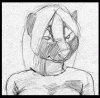
This was one of my earliest comics attempts. It's a fully written story based on a girl who follows her boyfriend into the Confederate army in 1864. Unfortunately she enlists in the wrong regiment, and ends up in Virginia while he's fighting in the west... I'm afraid the cover is the onlh finished piece -- I would have coloured it red fading to pale yellow in the background, and Dixie herself in butternut.
The following file is page one, which was penciled. Although I drew several portraits of Dixie later, this cover and page one are the only art done for the comic.
Incidently, I developed "Heart of Dixie" and did the art well before I ever drew Beatrix. In fact, I think Dix might be one reason Steve Gallacci asked me to collaborate on Bea -- I was already familiar with rabbits.
The following file is page one, which was penciled. Although I drew several portraits of Dixie later, this cover and page one are the only art done for the comic.
Incidently, I developed "Heart of Dixie" and did the art well before I ever drew Beatrix. In fact, I think Dix might be one reason Steve Gallacci asked me to collaborate on Bea -- I was already familiar with rabbits.
Category All / All
Species Unspecified / Any
Size 800 x 1081px
File Size 294.4 kB

It's called a kepi, and was worn by ordinary soldiers on both sides of the American civil war. The kepi was adopted by the American army before the Southern succession, and was modeled on a French headpiece. There were some variations.
The kepi looks to me to be a development of an earlier military cap, called the shako. You have to imagine the original hat of the early 1800's as a stiff felt cylander with a flat top, and a small front brim. Then you squash in down in such a way that the top tilts forward. If the cylander is taller, or if it narrows at the top, the kepi looks a little different too.
After the civil war, the kepi remained a part of the American uniform for only a few years. It was replaced then with a western "cowboy" style hat up until the 1890's. Then until WW I the American army wore something more like a boyscout hat, with a wide brim, and a crown that was pinched into a peak, with four dents. Marine drill instructors, park rangers, and some highway patrol officers still wear that style hat.
The kepi looks to me to be a development of an earlier military cap, called the shako. You have to imagine the original hat of the early 1800's as a stiff felt cylander with a flat top, and a small front brim. Then you squash in down in such a way that the top tilts forward. If the cylander is taller, or if it narrows at the top, the kepi looks a little different too.
After the civil war, the kepi remained a part of the American uniform for only a few years. It was replaced then with a western "cowboy" style hat up until the 1890's. Then until WW I the American army wore something more like a boyscout hat, with a wide brim, and a crown that was pinched into a peak, with four dents. Marine drill instructors, park rangers, and some highway patrol officers still wear that style hat.


This past weekend we had a coin show, so I went and picked up, along with a fistful of Canadian silver, a copy of the Nov 2008 issue of The Numismatist - and found a long article inside about Canadians who served in the American Civil War. What makes this topical here is Sarah Emma Edmonds of New Brunswick, "one of about 300 women who disguised themselves as men and enlisted." She was a private in the Michigan Volunteer Infantry under the name of Frank Thompson, and was a courier and "male" nurse - and at one point worked with the Secret Service as a spy behind Rebel lines. She wrote a book, Nurse and Spy in the Union Army which was a best seller, royalties being donated to soldiers' aid societies, and was a full member of the Grand Army of the Republic (Union soldier veterans' group), the only woman to do so.
I might have heard of her... there are a number of women who served on one side or the other, but I don't remember names. Canadians served with the Union Army in fairly large numbers -- one would presume a conviction that slavery should be ended, not any great concern over whether their neighbor to the south is one nation or two. I doubt any Canadians joined the Confederate Army, though stranger things have happened.
In fact the next person mentioned in the article was Dr Solomon Secord ("a relative of the famous Laura Secord, a Canadian heroine of the War of 1812") who served as a surgeon-major in the 20th Georgia Regiment, CSA - he was captured and escaped from a Union POW prison, but I don't know if he wrote a book about his experiences after the war.
We have a chain of candy stores named after Laura Second... sort of like your famous... um... er... I can't remember the name of your War of 1812 heroine who founded a candy company (or whatever). I wonder if Dr. Secord was living in Canada or the U.S? People wandered back and forth a lot in those days, without much concern for paperwork or being official immigrants.
(Did you know that Bat Masterson was born in Quebec?)
(Did you know that Bat Masterson was born in Quebec?)
Hm, in the Eastern Townships? A lot of Yankees crossed over during the early 19th century, aside from the Loyalists; among them a 4xgreat-grandpa of mine who fought in the Revolution in a Massachusetts unit, and eventually wound up in Missisqoui County or Parish, before making a u-turn back into New York state. A lot of to-ing and fro-ing back then and not a lot of official notice. Something like southern Texas and nortehrn Mexico used to be before the coyotes and druggers screwed things up for the residents.
Yeah, Bat was from the Eastern Townships, which had a large Anglophone population then and now.
It really wsn't until after WWII that the border between Canada and the US really became an obstacle ot people moving freely back and forth. Ironically, as it grows more and more impermeable -- with passports being necessary for the first time in either country's history -- many European nations are abolishing borders between the movement of goods and people in the EU. I don't think North America is as progressive as it likes to think it is, any more.
It really wsn't until after WWII that the border between Canada and the US really became an obstacle ot people moving freely back and forth. Ironically, as it grows more and more impermeable -- with passports being necessary for the first time in either country's history -- many European nations are abolishing borders between the movement of goods and people in the EU. I don't think North America is as progressive as it likes to think it is, any more.

I remember first finding out that you did wam and muddy artwork from this very character. It was a color image of her wading in some knee deep mud. I think it was on an issue of North American Fur, I think. been sooo long since I saw that image. Been into the furry wam arts ever since. I had no idea before that time that others were into this stuff like this. I thought I was the odd one, now I see that alot of furs are into this kinda fun. Great picture that brings back fond memories!
Oh... "The American Journal of Anthropomorphics" you mean. One of the worse titles for a magazine ever.
You might want to check out these WAM sties for a *lot* more of my stuff:
http://wamserver.com/taralwayne/index.html
http://www.dellamente.com/downunder.....wqsgallery.htm
You might want to check out these WAM sties for a *lot* more of my stuff:
http://wamserver.com/taralwayne/index.html
http://www.dellamente.com/downunder.....wqsgallery.htm
Yup thats the one! Yeah, It was an odd titled thing, but nobody would have suspected it as a furry book thus it would slip under the radar of some of the print houses that it would occasionally have to go through. I ran through the entire span of your gallery and scraps and Didn't see it throughout, but those two sites have it. Always one of those favorite works. Knew about the first site, didn't know about the second, thanks for the info!

Comments