
 FA+
FA+ Shop
Shop
1179
Views
Views
23
Favorites
Favorites
Category
Artwork (Digital) / All
Species Coyote
Size 1092 x 1280
File Size 342.9 kB
Report this content
More from Kraelsky


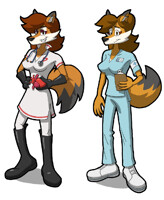



Suddenly, the tinted curved glass door opened before her. She blinked, as her eyes adjusted to the light levels beyond. She felt a rush of air go past her, as a cloud of cool steam emptied from her tiny chamber into the world outside. She took a deep breath-- the first breath that she could remember taking, in fact. Tentatively, but with no lack of stability, she stepped forward, over the threshold of the doorway. She found herself in a large room. The low hum of electrical equipment surrounded her, and rows of pods, identical to the one she had just emerged from, stood by her sides. However, her attention was focused solely on herself. Curiously, she looked down at her paws, flexing her fingers, rapt with wonder at their immediate response. She felt her tail flick behind her, and became aware of her heart beating in her chest. "This," she thought to herself, perfectly coherently, before several attendants stepped forward to usher her into the next room, "is what it must feel like to be alive..."
---
PETT. The word is an acronym that stands for Para-Engineered Trial and Test (subject). Para-engineering is a process by which a being is artificially created, fully biological in substance, but psychologically programmed with certain behavior characteristics in mind. PETTs are made by global biomedical conglomerate GeneTech, and are specifically created in a lab run by a division of that company called the Medical Research Committee, or MRC.
At their base level, PETTs are clones. They are conceived in test tubes and released in a mature adult state via biological acceleration. Through para-engineering, their behavior is dramatically programmed during this incubation process. In general, a PETT is designed to be incredibly obedient first and foremost. If a PETT is told to complete a task, it will do whatever it takes to complete that task, even if it means putting itself in harm's way. At the same time, PETTs are typically designed to have no particular concept of self-preservation, anyway. Although they are self-aware, they do not tend to fear for their existence. Nor do they long for freedom, which is just as well. Due to a loophole in the constitutional law, PETTs, as clones, do not count as "people," and as such are protected by no laws. Therefore it is not only convenient and easy, but technically legal as well, for MRC to keep PETTs confined and to use them for its own purposes as it sees fit (as explained further below). It is literally completely legal to walk up to a PETT and shoot it-- although this is not to say that such an action would be considered moral. The fact of the matter is, MRC is a rather underground organization, literally and figuratively, and GeneTech very much likes it that way. PETTs would likely have some interest group rallying for their rights and freedoms except for the fact that very few people even know or care that PETTs exist.
The only people who can really access PETTs are those with connections, which basically means the super rich, and the military. The super rich have been known to occasionally buy PETTs for servants, which, of course, is a role that suits PETTs just fine, since they literally don't mind being forced to work (in fact, PETTs have little concept of "force"). The military has been known to use PETTs for training and testing purposes-- for instance, to test new kinds of armor, or to simulate how "real" troops would react to physically dangerous environments. In short, PETTs can be used to test any military scenario that would be completely illegal to test using actual soldiers.
However, MRC itself remains the first and foremost user of PETTs. Since MRC IS the medical testing division of GeneTech, they regularly put PETTs through rigorous medical experiments, the results of which are used by GeneTech to develop new drugs, medical devices, and similar products and advancements. With no consequences attached to the life of a PETT, the limits that can be put on the experiments themselves are practically nonexistent-- and with anatomy that perfectly matches that found in normal people, PETTs are medically superior to any lab rat.
However-- although the life of a PETT seems cold and grim, and, by outside standards, is just that, no member of MRC's staff would ever be cruel to a PETT. MRC's PETTs are absolutely never tortured, abused, or humiliated. They are, in fact, treated cordially and with respect by all lab staff members, and are offered ample freedom during their down time to pursue idle leisures in a modest recreation center within the MRC labs. Without any inclination to ponder deeply their own fate or mortality, they are, essentially, "happy."
Finally, there is the matter of PETT identification. As clones, many PETTs look absolutely identical. PETTs are created in-- and identified by-- series. Each PETT is given a series and serial number-- the PETT illustrated above, for instance, is LE-446. That means that she is the 446th PETT produced in the LE-series, which happens to be a series of female coyotes. Since all members of a series appear identical, all PETTs have barcodes on their upper left chests, which can be scanned for quick identification. Most MRC staff are wise enough not to give a PETT a more personal nickname, lest they become attached to that PETT-- although they are treated with respect, PETTs remain, after all, disposable in the name of scientific testing.
I suspect that more works regarding PETTs will be produced in the future. ^^
---
PETT. The word is an acronym that stands for Para-Engineered Trial and Test (subject). Para-engineering is a process by which a being is artificially created, fully biological in substance, but psychologically programmed with certain behavior characteristics in mind. PETTs are made by global biomedical conglomerate GeneTech, and are specifically created in a lab run by a division of that company called the Medical Research Committee, or MRC.
At their base level, PETTs are clones. They are conceived in test tubes and released in a mature adult state via biological acceleration. Through para-engineering, their behavior is dramatically programmed during this incubation process. In general, a PETT is designed to be incredibly obedient first and foremost. If a PETT is told to complete a task, it will do whatever it takes to complete that task, even if it means putting itself in harm's way. At the same time, PETTs are typically designed to have no particular concept of self-preservation, anyway. Although they are self-aware, they do not tend to fear for their existence. Nor do they long for freedom, which is just as well. Due to a loophole in the constitutional law, PETTs, as clones, do not count as "people," and as such are protected by no laws. Therefore it is not only convenient and easy, but technically legal as well, for MRC to keep PETTs confined and to use them for its own purposes as it sees fit (as explained further below). It is literally completely legal to walk up to a PETT and shoot it-- although this is not to say that such an action would be considered moral. The fact of the matter is, MRC is a rather underground organization, literally and figuratively, and GeneTech very much likes it that way. PETTs would likely have some interest group rallying for their rights and freedoms except for the fact that very few people even know or care that PETTs exist.
The only people who can really access PETTs are those with connections, which basically means the super rich, and the military. The super rich have been known to occasionally buy PETTs for servants, which, of course, is a role that suits PETTs just fine, since they literally don't mind being forced to work (in fact, PETTs have little concept of "force"). The military has been known to use PETTs for training and testing purposes-- for instance, to test new kinds of armor, or to simulate how "real" troops would react to physically dangerous environments. In short, PETTs can be used to test any military scenario that would be completely illegal to test using actual soldiers.
However, MRC itself remains the first and foremost user of PETTs. Since MRC IS the medical testing division of GeneTech, they regularly put PETTs through rigorous medical experiments, the results of which are used by GeneTech to develop new drugs, medical devices, and similar products and advancements. With no consequences attached to the life of a PETT, the limits that can be put on the experiments themselves are practically nonexistent-- and with anatomy that perfectly matches that found in normal people, PETTs are medically superior to any lab rat.
However-- although the life of a PETT seems cold and grim, and, by outside standards, is just that, no member of MRC's staff would ever be cruel to a PETT. MRC's PETTs are absolutely never tortured, abused, or humiliated. They are, in fact, treated cordially and with respect by all lab staff members, and are offered ample freedom during their down time to pursue idle leisures in a modest recreation center within the MRC labs. Without any inclination to ponder deeply their own fate or mortality, they are, essentially, "happy."
Finally, there is the matter of PETT identification. As clones, many PETTs look absolutely identical. PETTs are created in-- and identified by-- series. Each PETT is given a series and serial number-- the PETT illustrated above, for instance, is LE-446. That means that she is the 446th PETT produced in the LE-series, which happens to be a series of female coyotes. Since all members of a series appear identical, all PETTs have barcodes on their upper left chests, which can be scanned for quick identification. Most MRC staff are wise enough not to give a PETT a more personal nickname, lest they become attached to that PETT-- although they are treated with respect, PETTs remain, after all, disposable in the name of scientific testing.
I suspect that more works regarding PETTs will be produced in the future. ^^
Category Artwork (Digital) / All
Species Coyote
Size 1092 x 1280px
File Size 342.9 kB



Comments