
 FA+
FA+ Shop
Shop
9322
Views
Views
173
Favorites
Favorites
Category
Artwork (Digital) / All
Species Unspecified / Any
Size 979 x 750
File Size 115.5 kB
Report this content
More from Valsalia


Listed in Folders

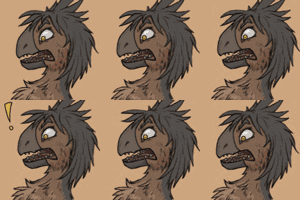
Here we see two extremes of the assertive/receptive spectrum of yinglet males, demonstrating the traits that define their "types."
Masculine/assertive:
-Long limbs and lean build; lithe dodginess is considered better for fighting, as it does them a lot more good an a bit of extra strength.
-Thick forearms/forelegs, indicating they're not fragile. Which is important, as a good 75%+ of all injuries they sustain are related to breaking those long, thin parts.
-Long and pointed snout, ears and tail, and a thin-furred appearance.
-Long, straight eyebrow-whiskers, considered better for hunting/tracking, although it really just means they get hit in the face slightly less.
-Long shelltooth, and a dental configuration with lots of teeth, which allows them to inflict more damage with a bite than the standard yinglet tooth-style. It's become a very popular trait among matriarchs to breed into their enclaves.
-An aggressive, fighty attitude. Often accompanied by a sense of adventurousness, and a desire to range far from the enclave in search for things to hunt and scavenge.
Feminine/receptive:
-Short limbs and a stocky, softer-bodied build.
-Thinner forearms, a shorter and rounder snout, as well as shorter and rounder ears. Thicker fur overall, and more pronounced tufts.
-Shorter, curved and/or curly eyebrow-whiskers, which are apparently delightful for other yinglets to look at, despite their limited practical uses.
-A shorter shelltooth and significant tail-tuft, both considered aspects that females possess.
-More preening, socially-oriented attitude, and a tendency to want to spend most of their time close to the enclave.
Masculine/assertive:
-Long limbs and lean build; lithe dodginess is considered better for fighting, as it does them a lot more good an a bit of extra strength.
-Thick forearms/forelegs, indicating they're not fragile. Which is important, as a good 75%+ of all injuries they sustain are related to breaking those long, thin parts.
-Long and pointed snout, ears and tail, and a thin-furred appearance.
-Long, straight eyebrow-whiskers, considered better for hunting/tracking, although it really just means they get hit in the face slightly less.
-Long shelltooth, and a dental configuration with lots of teeth, which allows them to inflict more damage with a bite than the standard yinglet tooth-style. It's become a very popular trait among matriarchs to breed into their enclaves.
-An aggressive, fighty attitude. Often accompanied by a sense of adventurousness, and a desire to range far from the enclave in search for things to hunt and scavenge.
Feminine/receptive:
-Short limbs and a stocky, softer-bodied build.
-Thinner forearms, a shorter and rounder snout, as well as shorter and rounder ears. Thicker fur overall, and more pronounced tufts.
-Shorter, curved and/or curly eyebrow-whiskers, which are apparently delightful for other yinglets to look at, despite their limited practical uses.
-A shorter shelltooth and significant tail-tuft, both considered aspects that females possess.
-More preening, socially-oriented attitude, and a tendency to want to spend most of their time close to the enclave.
Category Artwork (Digital) / All
Species Unspecified / Any
Size 979 x 750px
File Size 115.5 kB


I'm guessing the yinglett 'ze' sound replaces 'th' because their tongues can't rest on the tip of their shell tooth to create the 'th' right?
I ask because I've been doing some experimenting and I can create the 'th' sound by rolling the underside of my tongue off the roof of my mouth and off the back of my front teeth
I ask because I've been doing some experimenting and I can create the 'th' sound by rolling the underside of my tongue off the roof of my mouth and off the back of my front teeth
So I can guess my method might still work?
Maybe if a yinglett just rolls his tongue off the roof of his mouth... They do have very flexible tongues, right?
(Btw I'm putting in this research for Nova the yinglett cause I imagine he would do the same so he can be more presentable as a yinglett)
Maybe if a yinglett just rolls his tongue off the roof of his mouth... They do have very flexible tongues, right?
(Btw I'm putting in this research for Nova the yinglett cause I imagine he would do the same so he can be more presentable as a yinglett)






Peculiar thought:
How much of the gender dimorphism (even amongst "faux-females") between yinglets exists solely because they think they must HAVE gender dimorphism?
Do half the male yinglets become feminine simply because they think their race has to have equal parts male and female?
How much of the gender dimorphism (even amongst "faux-females") between yinglets exists solely because they think they must HAVE gender dimorphism?
Do half the male yinglets become feminine simply because they think their race has to have equal parts male and female?





There'll be some of that at some point!
Until then, this is a pretty good visualization: https://www.youtube.com/watch?v=uPQwNE4OsIE
Until then, this is a pretty good visualization: https://www.youtube.com/watch?v=uPQwNE4OsIE






You said "spectrum", which means that there exist many exceptions to these examples, right?
I mean, from the start Yinglets are so prone to mutation that consistency seems impossible on a genetic level.
So there would be assertive types who prefer other assertive types, and submissives who prefer other submissive types, and everything in between, yes?
I mean, from the start Yinglets are so prone to mutation that consistency seems impossible on a genetic level.
So there would be assertive types who prefer other assertive types, and submissives who prefer other submissive types, and everything in between, yes?


Comments