
 FA+
FA+ Shop
Shop
454
Views
Views
16
Favorites
Favorites
Category
All / All
Species Unspecified / Any
Size 918 x 660
File Size 36.7 kB
Report this content
More from Tragelaphus


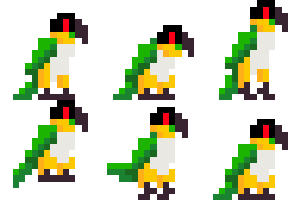
<waits>
<looks at watch impatiently>
<waits>
<rubs forehead>
<waits more>
<rolls a booger between the fingers>
<sighs>
<throws booger away>
<waits>
<inspects random scratches on the table>
<waits>
<waits>
<waits>
...
"F***in' inspiration. What's taking it so long? For Pete's sake, I have work to do."
<looks at watch impatiently>
<waits>
<rubs forehead>
<waits more>
<rolls a booger between the fingers>
<sighs>
<throws booger away>
<waits>
<inspects random scratches on the table>
<waits>
<waits>
<waits>
...
"F***in' inspiration. What's taking it so long? For Pete's sake, I have work to do."
Category All / All
Species Unspecified / Any
Size 918 x 660px
File Size 36.7 kB





>>"F***in' inspiration. What's taking it so long? For Pete's sake, I have work to do."
For me, inspiration is rarely a setback. Instead, I have to overcome the terror of confrontation... the fear that I won't be able to bring off the effect or the tone that I need. And so I procrastinate, on and on and on, until the day is almost wasted and I feel sick to my stomach.
It's an all-too frequent and pointless delay.
Mark
For me, inspiration is rarely a setback. Instead, I have to overcome the terror of confrontation... the fear that I won't be able to bring off the effect or the tone that I need. And so I procrastinate, on and on and on, until the day is almost wasted and I feel sick to my stomach.
It's an all-too frequent and pointless delay.
Mark
Oh, I can certainly relate. I get it all the time. Have you read the book Art and Fear? It sometimes helps with this problem. One of the most useful books I've read lately. It sounds like one of those cheap self-help books, but it actually has some good observations and ideas about art and artmaking in general, even if it fails to motivate, it's still useful.
From my little experience, I'd say writer's block is harder to overcome than the equivalent "lack of inspiration" for visual artists. Vith visual you can just slap random stuff together and look at it in a very retarded braindead way until you start seeing something. I'm not sure it works that way with writing.
From my little experience, I'd say writer's block is harder to overcome than the equivalent "lack of inspiration" for visual artists. Vith visual you can just slap random stuff together and look at it in a very retarded braindead way until you start seeing something. I'm not sure it works that way with writing.
"Writer's block" implies that you can't find anything to say. I know what I need to say; what I often cannot find is the courage to put that knowledge to the test. What holds me back is fear that the results on paper will seem unconvincing or, even worse, ridiculous and dull. And so I wait and wait and wait until the day is almost over... and in the meantime, I achieve nothing.
Yet once the first draft has been completed, I can't wait to begin revision; I'm eager to revise; at that point, I never procrastinate... because the worst is over, and I'm no longer struggling with the unknown, but with mere words.
Which I can handle. :)
Yet once the first draft has been completed, I can't wait to begin revision; I'm eager to revise; at that point, I never procrastinate... because the worst is over, and I'm no longer struggling with the unknown, but with mere words.
Which I can handle. :)
Yep, the situation sounds painfully familiar. Prolly many (if not all) artists experience it. Especially those who have high standards, view alot of art and think alot... As if just thinking about making better art should automatically result in better skills.
What i've found: sometimes entering "retard mode" helps start things, you just tell yourself that you're not serious, you're just fooling around, quality doesn't matter, noone will see it, and you do stuff just for the hell of it... After working for a bit you start noticing things that could be developed into something positive and you start getting more focused and serious. Tricky part is that you can't sit down and tell yourself "ok, I will make something awesome now, but first i'll pretend to be a retard to get things started" - the retard mode has to be genuine fun with no rush and judgement attached.
What i've found: sometimes entering "retard mode" helps start things, you just tell yourself that you're not serious, you're just fooling around, quality doesn't matter, noone will see it, and you do stuff just for the hell of it... After working for a bit you start noticing things that could be developed into something positive and you start getting more focused and serious. Tricky part is that you can't sit down and tell yourself "ok, I will make something awesome now, but first i'll pretend to be a retard to get things started" - the retard mode has to be genuine fun with no rush and judgement attached.
>>As if just thinking about making better art should automatically result in better skills.
Oh, if only it did. :)
But even if it never results in better skills automatically, thinking about art does, I believe, prepare you to stretch muscles that you never knew were there; otherwise, you would create the same basic thing, use the same basic elements, over and over again. It can challenge us to go beyond our "default modes," which can be a terrifying leap, or a fascinating adventure. (I usually end up with terror, myself.)
>>sometimes entering "retard mode" helps start things, you just tell yourself that you're not serious, you're just fooling around, quality doesn't matter, noone will see it, and you do stuff just for the hell of it... After working for a bit you start noticing things that could be developed into something positive and you start getting more focused and serious.
For exactly that reason, I often start with the most ridiculously pulpy title I can think of. It breaks the ice. :)
Or I start with music, as I did recently with Harry Somers and Frank Bridge. I let the structure and the mood of certain pieces influence my thinking as I plan, do research, take notes. Then I turn off the music, and write.
Or at least work up the courage to write. =D
Oh, if only it did. :)
But even if it never results in better skills automatically, thinking about art does, I believe, prepare you to stretch muscles that you never knew were there; otherwise, you would create the same basic thing, use the same basic elements, over and over again. It can challenge us to go beyond our "default modes," which can be a terrifying leap, or a fascinating adventure. (I usually end up with terror, myself.)
>>sometimes entering "retard mode" helps start things, you just tell yourself that you're not serious, you're just fooling around, quality doesn't matter, noone will see it, and you do stuff just for the hell of it... After working for a bit you start noticing things that could be developed into something positive and you start getting more focused and serious.
For exactly that reason, I often start with the most ridiculously pulpy title I can think of. It breaks the ice. :)
Or I start with music, as I did recently with Harry Somers and Frank Bridge. I let the structure and the mood of certain pieces influence my thinking as I plan, do research, take notes. Then I turn off the music, and write.
Or at least work up the courage to write. =D
Yes, certainly. Thinking about it is important and very rewarding, but as far as making art goes - it's all about balance: if one thinks too much but does too little, skills go rusty, if one only works but doesn't think, one becomes repetitive (like me on turbo-posting-sprees).
Yes, certainly. Thinking about it is important and very rewarding, but as far as making art goes - it's all about balance: if one thinks too much but does too little, skills go rusty, if one only works but doesn't think, one becomes repetitive (like me on turbo-posting-sprees).



Comments