
 FA+
FA+ Shop
Shop


1248 submissions


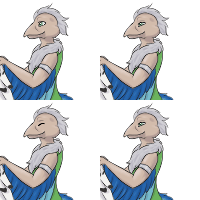
First piece of art I've done since September, accompanying a story I wrote over Christmas. This ties into the next Griffin Ranger book, in a small way. It helps if you've read the previous books so you would be familiar with some of the terminology and species, but it's not necessary. This is a sad story, but considering the way my life has been going recently, it's to be expected.
The Story of Sentinel Island
Hundreds of years ago, there was a small fishing village on the western shore of the Southern Continent. It doesn’t exist anymore—swallowed up by the vast desert that edges the shore of the Endless Ocean. No record exists of its name, if it even had any. Its inhabitants simply called it ‘home,’ or ‘the village.’ In its time it was a comfortable place to live. Several extended clans of hanz were there, along with a couple of griffin pairs and their chicks. Nomadic herders living in the surrounding hills came to trade meat and wool for fish, tools and other handicrafts. The griffins served as scouts for the fishing boats and protected the village and herders from roaming bands of wolfen.
One day a fishing boat went to sea. As a rule the sailors didn’t go far from land; they had no navigation tools beyond the sun and their griffin scout, and the waters were rich enough that they didn’t need to take the risk. Maybe this day they decided to go a little further out after a promising shoal, or they simply lost track of where they were. But they found themselves out of sight of the shore when a storm blew in.
It was one of those sudden, brutal storms that can lash the Endless Ocean. The winds were too dangerous for the griffin to fly in, and she had to huddle in the boat with the rest of the crew. The sails and mast were ripped to shreds, debris injuring some of the hanz. Sturdy hull construction and frantic bailing kept the boat from sinking, but they were so overwhelmed trying to survive they didn’t know how far or in what direction they were driven.
Dawn found them in pitiable condition. The boat was adrift, the sails ruined and the rudder torn off. One of the hanz crew had died from his injuries. Another was washed overboard and lost. Everyone else was banged up and bruised from the long battle against the storm. No matter how high she flew, the griffin couldn’t spot land. The crew knew if they went east that should take them back to the Southern Continent, but they had no way to steer the boat and were at the mercy of the currents.
The survivors consisted of five hanz, a herder and the griffin. The hanz quickly went to work trying to repair the sails, or, failing that, rig up some oars and a rudder. Luckily most of their fishing gear and bait was still stowed safely away, so they were able to get enough from the sea to keep from starving, at least at first. All the fishing boats were also equipped with a primitive solar still to get fresh water from sea, a valuable invention that was actually meant to help the crew survive if they ended up on shore far from the village. It didn’t produce a lot of water, but, carefully rationed, it kept them alive.
As the days passed their situation grew dire. The open ocean didn’t have the abundant fish that the coastal waters did, and some days they caught nothing at all. The griffin had to eat and drink more than all the others combined to keep up her strength, and it tore at her to take what the hanz and herder needed. They were able to piece together most of the sail, but the mast was shattered and gone, and they ended up using the sail cloth to shelter from the burning sun.
Finally the griffin couldn’t take any more. She vowed to fly back to the mainland and get help, or at the very least let their families know what happened. The hanz begged her not to go. They knew they were probably hundreds of miles from land—a distance no griffin could fly without stopping. But the griffin knew without her they’d have a much better chance of survival. She left, and the last sight they had of her was a vanishing speck heading east. They never saw her again, and there’s no record of her making it back to land.
The griffin’s sacrifice placed a pall over the remaining crew. Nobody knew how far the Endless Ocean stretched to the west, or whether there were any islands out there. Their little village was very isolated, and if other groups of hanz had explored further they didn’t know about it. Gradually they all lost weight as the limited food and water wore down their health. Their fur grew brittle and patchy, and constant exposure to the sun and salt water caused sores on their foot pads. The oldest male hanz developed an infection, lingering for almost two weeks before finally dying.
At that point the remaining crew was so hungry they debated whether they should cannibalize the body. The hanz couldn’t bring themselves to do it, but gave permission for the herder to eat if he wanted to. His comrade’s sparse meat and bones were enough to sustain him for a while, allowing the hanz to eat whatever they could glean from the barren water.
While one of the females had initially kept track of the days by marking a notch in the wood railing each morning, after the death she didn’t bother. So they had no way of knowing how long they drifted. Months, certainly. Towards the end all they could do was lie in the boat under the shade of the sail cloth, too weak and miserable to talk, fishing lines dragging in the water. Their original bait long gone, they used bits of the dead crewmember’s hide and fur as a lure.
It was the herder who spotted the birds in the air, flitting close to the water. White terns, gulls, and black frigate birds. He knew they stuck close to shore, and for the first time in weeks felt hope. He managed to rouse the four surviving hanz, and together they fashioned crude paddles from planks torn off the cabin. They were so weak they could barely hold the wood, but the sight of the birds gave them a desperate strength, and they slowly were able to move the boat in the direction the birds were heading.
When the island came into view they didn’t believe it at first. After so long, the hanz wept at the sight of waves breaking against the rocky shore. This wasn’t any part of the Southern Continent they were familiar with. Steep cliffs greeted them, and the land was densely forested with tall palms. Flocks of seabirds crowded the air and water around the land, feeding on abundant shoals of fish, and in the distance there were spouts from giant marine reptiles.
They circled the shore of the island until they found a smooth white sand beach perfect for landing. After weeks at sea they could barely stagger from the boat, their wasted legs unable to support their weight. The herder, who was a little stronger due to having eaten the dead hanz, was able to sniff out some fresh water. He also killed several small, flightless birds that he brought back to the rest of the crew—their first substantial meal in weeks.
Over the following days they explored the island from shore to shore. There was no trace of any hanz, herders or griffins. There were no land mammals at all, but the island teemed with birds. Two different types of parakeets, a heron, an owl and two species of flightless rail made up the land birds, while over a dozen kinds of seabirds used the island for breeding and resting. The land birds were completely unafraid of the castaways, walking right up to them and pecking curiously at their tails. After a few meals of the confiding birds as they built their strength back up, the guilt became too much and they agreed it was wrong to kill the innocents that lived there. From then on they got their food from the seabirds, palm fruits and shoreline.
They quickly got to work building a cabin for shelter. The temperature was much cooler there than the desert shore they were used to, and the wind blew constantly. It also rained, a novelty for people that had grown up along the edge of the world’s driest desert, where they were lucky to see rain a few times a year.
Despite needed adjustments to the local climate, the island was close to ideal. There was plenty of food and fresh water, and trees for building and firewood. They had nothing but time, and eventually the island was thoroughly explored. They estimated it was about 15 miles long and less than 10 wide. There were a number of extinct volcanoes; including a big one in the middle of the island and two smaller ones at each end. Lakes pooled in the craters, which were the haunt of the native heron. The herder was particularly interested in exploring the lava caves that honeycombed the island, and they used the caves for shelter during bad storms.
The two male hanz and herder wanted to repair the boat and try to return home, while the two females had no interest in ever getting back in the boat again. Lack of heavy tools for woodworking stymied the male’s attempts for a long time, until they were able to cobble together something from the volcanic rock that littered the island. Even then, it was a slow process, since building and maintaining their shelter was the first priority.
Months passed, then a year. The female who’d been originally keeping track of the days began doing so again, although she missed the initial weeks after arriving on the island. The village fishing boats were usually crewed by members of the same clan, so the survivors of that boat consisted of two sisters, and two brothers, who were cousins to the females. Being young, with no elders to rein in their behavior, when the females’ breeding time came they took their cousins to mate. Usually young adult hanz emigrated to other villages to find partners; mating with cousins was frowned upon but not completely taboo.
Soon the island was alive with the playful chirps and squeals of young kits, as the sisters had two youngsters each. The males delayed their leaving to help raise the young, then delayed again when the sisters became pregnant a second time. It was the herder who finally pressed the point of leaving. The boat was long repaired, and they’d been using it to fish around the island. The herder desperately missed his own kind, and wanted to try for home. The two brothers were restless, and also wanted to leave. The sisters would not bring their young kits on a dangerous voyage. They still had vivid memories of the nightmarish journey there, and did not want to leave their sanctuary.
Finally they left—the two male hanz, the herder, and one of the firstborn male kits that begged to come. The last sight anyone had of them was like the griffin—a slowly vanishing speck heading east into the Endless Ocean. They never came back, and nobody knows what happened to them. The sisters hoped they found land somewhere, and just couldn’t make the return trip with help. But nobody knows.
While most of the villagers were illiterate, a couple in each clan could read and write. It was used primarily for record-keeping, or, more rarely, for communication with distant clans via griffin messengers. One of the sisters had been training in the art, and she began writing down their story. She wrote on clay tablets that were baked in fire when completed. Back in the village they used parchment made from llama or snouter hide—rare and expensive. There were no animals large enough to make parchment there, so she improvised with a technique she’d seen potters use to decorate their creations.
Years passed, and then decades. The population grew as the kits had kits—mating with cousins, nieces and nephews, brothers and sisters. After 40 years their numbers swelled to thirty, and the sisters were nearing the end of their lives. But as the third and fourth generations were born, they noticed something disturbing. The kits were being born with problems. Some were stillborn. Others had facial deformities like a cleft pallet, or grew stunted and small. Worse were the ones who looked okay but were mentally defective.
The sister who was writing down their history had taught the art to her eldest female kit, and towards the end confided her greatest fear—that their population would eventually degenerate into something terrible. Before that happened, she said, they’d either need to leave the island or stop having kits and allow themselves a dignified end. That secret order was kept by her daughter, and passed down to subsequent matriarchs. The matriarchs also kept alive stories of the Southern Continent, and their griffin companions. They would still keep watch on the eastern edge of the island, hoping to see a boat or the soaring form of a griffin come to take them home.
Nearly a hundred years later, a young male became obsessed with the thought of griffins. He was one of the rare ones born without a physical deformity, although his obsession could be considered a mental problem. He thought that the griffins would just pass their island by because they would have no way of knowing anyone was there.
He started stacking rocks into towers, where he would light a fire at night. But he was dissatisfied with that. The griffins wouldn’t be impressed with a stack of rocks, he thought. He needed something stunning, that would get their attention and make them want to rescue the hanz there.
His first statue was crude, hacked out of volcanic rock. It looked more like an owl than a griffin, but no one there had ever seen a griffin. All they had were descriptions passed down for years, and the native owl as an example of a raptor. As his carving technique and skills improved, the statues got bigger. Soon he had a number of other young hanz helping with carving and moving his creations. Holes forming the eyes held fires, and at night they glowed like fierce beacons on top of the eastern cliffs.
The elders were bemused by the work, but it gave the youngsters something purposeful to do, and even the mentally and physically damaged ones could help. Eventually the statues were so big it took the entire village to move them. They tried different methods, including log rollers, but the one that worked best was using a system of three ropes and having the statues ‘walk’ into position. If they carved the base slightly convex they could have three teams on the ropes rock it forward surprisingly quickly.
By the time the male grew old they had over a dozen massive griffin heads perched on the eastern cliffs, looking out to sea for rescue. During the period of building their population continued to deteriorate. Many males had trouble fathering kits, or were completely sterile. More kits were born dead or deformed than not, and the number of healthy hanz able to do useful work around the village shrunk. The matriarch knew the time had come to put her ancestor’s edict into reality.
She gave the population a choice—leave the island and try for the Southern Continent, or stay but have no more kits. For many there was no choice—the mentally defective, the deformed, and the elderly would not be able to make the trip. Some of the young healthy hanz were excited at the idea, others were terrified. But they all had eyes, and could see what was happening. The promise of mates they could have healthy kits with was a strong incentive, and they set to work building a vessel that could hold them and make the trip.
They had small fishing boats, and adapted that design into something larger. They also lashed most of the fishing boats together into a second craft that could hold supplies for at least three months. Being young, they had no real idea of the size of the Endless Ocean, or how far away the Southern Continent was. They had experience in the waters around the island, but not on the open ocean, and the matriarch knew she was probably sending them to their deaths. But at least that way they had a chance, and if they died, it would be while trying to do something, rather than slowly wasting away on the island.
Fifty-two left—all the young and healthy, along with some of the more functional deformed and mentally defective. Twenty-seven remained on the island. Most of them were physically unable to make the trip, although several younger adults who were sterile decided to stay behind and help. Despite that, there were a few accidental pregnancies over the last years. Any kits were either dead or died shortly after birth. If the matriarch had anything to do with that, she never wrote it down.
Nobody knows what happened to the fifty-two that left. They never returned, and like the original brothers who left so long ago, there’s no record of them reaching the mainland. Maybe they perished at sea, or maybe they made it and got absorbed into another remote village that left no word. That period of history on the desert shore is not well documented.
Gradually the hanz left on the island died of old age or their congenital defects. A few committed suicide, mostly by jumping off the cliff where the griffin heads were. As long as someone was still able to make the trip up there, they lit the eye fires every night.
Nobody knows who the last one left alive on the island was, or when they died. The matriarch who kept the written record died ten years after the exodus, then there was no one left who could write. What is known is that the last survivors took the tablets, dozens of them, and hid them deep in one of the dry lava caves, away from the wind and rain. Among the final entries was the hope that someone would find the record, and know what happened there.
After the death of the last hanz the island returned to the native birds, as their village slowly collapsed and decayed. No other sentient visited the island until 75 years later, and it was not the hoped-for griffins or other hanz. These travelers came from the west, in large, well-built vessels intended for long ocean voyages. They’d been slowly expanding from their homeland, first traveling west and north to the Dry Continent and the island chains above it, then east into the scattered dots of land in the Endless Ocean. The hanz’s abandoned island would be one of the last stopping points before they reached the Southern Continent and started their decades-long conflict with the griffins and hanz there.
These were the sentient parrots who called themselves ‘builders,’ with their insatiable curiosity and mechanical bent. They were not content to stay on their beautiful home islands, but had to see and explore everything there was out there. They’d first encountered griffins on the Dry Continent—who were savage, wild creatures that attacked on sight. Further north the griffins of the tropical islands were more peaceful, and quickly subjugated. The islands of the Endless Ocean were devoid of sentient life, but had remarkable populations of unique birds and reptiles, which made the scientific savants very happy but were of no particular interest to the flock leaders.
When they reached the isolated island the hanz had been cast up on, they expected it to be like all the other places in the Endless Ocean. Imagine their astonishment when they found the ruins! But the decaying village huts were nothing like the roosts builders used, and they were far too small to be used by griffins.
And the surprise of finding the abandoned village was minor compared to their reaction when they flew up to the eastern ridge and found the massive griffin statues. They fled squawking in panic, certain the island was inhabited by monstrous griffins worse than the ones found on the Dry Continent. Eventually their curiosity won out, and the island received cautious exploration. It soon was clear that whoever had built the village and made the statues were long gone, and the only living things there now were birds.
The explorers named the island Sentinel Island, after the huge statues standing watch over the ocean. The initial visitors did not linger, but over the years the builders set up a small supply outpost there. The discovery of the Southern Continent and it’s hanz and griffin population solved the mystery of what creatures had built the village, but not what happened to them. It wasn’t until years later that the builders explored deep into the lava caves and discovered the stash of tablets.
At that point the war between invading builders and the Twin Continent’s hanz, griffins and herders had been going on for decades. The writing on the tablets was so archaic that none of the builder savants, even those who knew the hanz’s current writing system, could decipher them. It wasn’t until much later, after the war reached a stalemate and the griffins began allowing builders limited access to their lands, that the builder savants were able to make peaceful contact with their hanz and griffin counterparts to solve the mystery of Sentinel Island.
There were a few hanz savants that were familiar with the old writing style, and were able to tease out the tragic story of what happened there. The tale affected everyone deeply, and was soon written down in both modern script and the builder language for wide distribution in print form. With the wars over, the supply outpost on Sentinel Island was transformed into a research center and visitor hostel. Griffins, hanz and builders alike make the long boat trip there to marvel at the statues and see the village, restored to its former appearance by the industrious builders. No one who came there, no matter their species, could leave unaffected.
And that is the story of Sentinel Island.
The Story of Sentinel Island
Hundreds of years ago, there was a small fishing village on the western shore of the Southern Continent. It doesn’t exist anymore—swallowed up by the vast desert that edges the shore of the Endless Ocean. No record exists of its name, if it even had any. Its inhabitants simply called it ‘home,’ or ‘the village.’ In its time it was a comfortable place to live. Several extended clans of hanz were there, along with a couple of griffin pairs and their chicks. Nomadic herders living in the surrounding hills came to trade meat and wool for fish, tools and other handicrafts. The griffins served as scouts for the fishing boats and protected the village and herders from roaming bands of wolfen.
One day a fishing boat went to sea. As a rule the sailors didn’t go far from land; they had no navigation tools beyond the sun and their griffin scout, and the waters were rich enough that they didn’t need to take the risk. Maybe this day they decided to go a little further out after a promising shoal, or they simply lost track of where they were. But they found themselves out of sight of the shore when a storm blew in.
It was one of those sudden, brutal storms that can lash the Endless Ocean. The winds were too dangerous for the griffin to fly in, and she had to huddle in the boat with the rest of the crew. The sails and mast were ripped to shreds, debris injuring some of the hanz. Sturdy hull construction and frantic bailing kept the boat from sinking, but they were so overwhelmed trying to survive they didn’t know how far or in what direction they were driven.
Dawn found them in pitiable condition. The boat was adrift, the sails ruined and the rudder torn off. One of the hanz crew had died from his injuries. Another was washed overboard and lost. Everyone else was banged up and bruised from the long battle against the storm. No matter how high she flew, the griffin couldn’t spot land. The crew knew if they went east that should take them back to the Southern Continent, but they had no way to steer the boat and were at the mercy of the currents.
The survivors consisted of five hanz, a herder and the griffin. The hanz quickly went to work trying to repair the sails, or, failing that, rig up some oars and a rudder. Luckily most of their fishing gear and bait was still stowed safely away, so they were able to get enough from the sea to keep from starving, at least at first. All the fishing boats were also equipped with a primitive solar still to get fresh water from sea, a valuable invention that was actually meant to help the crew survive if they ended up on shore far from the village. It didn’t produce a lot of water, but, carefully rationed, it kept them alive.
As the days passed their situation grew dire. The open ocean didn’t have the abundant fish that the coastal waters did, and some days they caught nothing at all. The griffin had to eat and drink more than all the others combined to keep up her strength, and it tore at her to take what the hanz and herder needed. They were able to piece together most of the sail, but the mast was shattered and gone, and they ended up using the sail cloth to shelter from the burning sun.
Finally the griffin couldn’t take any more. She vowed to fly back to the mainland and get help, or at the very least let their families know what happened. The hanz begged her not to go. They knew they were probably hundreds of miles from land—a distance no griffin could fly without stopping. But the griffin knew without her they’d have a much better chance of survival. She left, and the last sight they had of her was a vanishing speck heading east. They never saw her again, and there’s no record of her making it back to land.
The griffin’s sacrifice placed a pall over the remaining crew. Nobody knew how far the Endless Ocean stretched to the west, or whether there were any islands out there. Their little village was very isolated, and if other groups of hanz had explored further they didn’t know about it. Gradually they all lost weight as the limited food and water wore down their health. Their fur grew brittle and patchy, and constant exposure to the sun and salt water caused sores on their foot pads. The oldest male hanz developed an infection, lingering for almost two weeks before finally dying.
At that point the remaining crew was so hungry they debated whether they should cannibalize the body. The hanz couldn’t bring themselves to do it, but gave permission for the herder to eat if he wanted to. His comrade’s sparse meat and bones were enough to sustain him for a while, allowing the hanz to eat whatever they could glean from the barren water.
While one of the females had initially kept track of the days by marking a notch in the wood railing each morning, after the death she didn’t bother. So they had no way of knowing how long they drifted. Months, certainly. Towards the end all they could do was lie in the boat under the shade of the sail cloth, too weak and miserable to talk, fishing lines dragging in the water. Their original bait long gone, they used bits of the dead crewmember’s hide and fur as a lure.
It was the herder who spotted the birds in the air, flitting close to the water. White terns, gulls, and black frigate birds. He knew they stuck close to shore, and for the first time in weeks felt hope. He managed to rouse the four surviving hanz, and together they fashioned crude paddles from planks torn off the cabin. They were so weak they could barely hold the wood, but the sight of the birds gave them a desperate strength, and they slowly were able to move the boat in the direction the birds were heading.
When the island came into view they didn’t believe it at first. After so long, the hanz wept at the sight of waves breaking against the rocky shore. This wasn’t any part of the Southern Continent they were familiar with. Steep cliffs greeted them, and the land was densely forested with tall palms. Flocks of seabirds crowded the air and water around the land, feeding on abundant shoals of fish, and in the distance there were spouts from giant marine reptiles.
They circled the shore of the island until they found a smooth white sand beach perfect for landing. After weeks at sea they could barely stagger from the boat, their wasted legs unable to support their weight. The herder, who was a little stronger due to having eaten the dead hanz, was able to sniff out some fresh water. He also killed several small, flightless birds that he brought back to the rest of the crew—their first substantial meal in weeks.
Over the following days they explored the island from shore to shore. There was no trace of any hanz, herders or griffins. There were no land mammals at all, but the island teemed with birds. Two different types of parakeets, a heron, an owl and two species of flightless rail made up the land birds, while over a dozen kinds of seabirds used the island for breeding and resting. The land birds were completely unafraid of the castaways, walking right up to them and pecking curiously at their tails. After a few meals of the confiding birds as they built their strength back up, the guilt became too much and they agreed it was wrong to kill the innocents that lived there. From then on they got their food from the seabirds, palm fruits and shoreline.
They quickly got to work building a cabin for shelter. The temperature was much cooler there than the desert shore they were used to, and the wind blew constantly. It also rained, a novelty for people that had grown up along the edge of the world’s driest desert, where they were lucky to see rain a few times a year.
Despite needed adjustments to the local climate, the island was close to ideal. There was plenty of food and fresh water, and trees for building and firewood. They had nothing but time, and eventually the island was thoroughly explored. They estimated it was about 15 miles long and less than 10 wide. There were a number of extinct volcanoes; including a big one in the middle of the island and two smaller ones at each end. Lakes pooled in the craters, which were the haunt of the native heron. The herder was particularly interested in exploring the lava caves that honeycombed the island, and they used the caves for shelter during bad storms.
The two male hanz and herder wanted to repair the boat and try to return home, while the two females had no interest in ever getting back in the boat again. Lack of heavy tools for woodworking stymied the male’s attempts for a long time, until they were able to cobble together something from the volcanic rock that littered the island. Even then, it was a slow process, since building and maintaining their shelter was the first priority.
Months passed, then a year. The female who’d been originally keeping track of the days began doing so again, although she missed the initial weeks after arriving on the island. The village fishing boats were usually crewed by members of the same clan, so the survivors of that boat consisted of two sisters, and two brothers, who were cousins to the females. Being young, with no elders to rein in their behavior, when the females’ breeding time came they took their cousins to mate. Usually young adult hanz emigrated to other villages to find partners; mating with cousins was frowned upon but not completely taboo.
Soon the island was alive with the playful chirps and squeals of young kits, as the sisters had two youngsters each. The males delayed their leaving to help raise the young, then delayed again when the sisters became pregnant a second time. It was the herder who finally pressed the point of leaving. The boat was long repaired, and they’d been using it to fish around the island. The herder desperately missed his own kind, and wanted to try for home. The two brothers were restless, and also wanted to leave. The sisters would not bring their young kits on a dangerous voyage. They still had vivid memories of the nightmarish journey there, and did not want to leave their sanctuary.
Finally they left—the two male hanz, the herder, and one of the firstborn male kits that begged to come. The last sight anyone had of them was like the griffin—a slowly vanishing speck heading east into the Endless Ocean. They never came back, and nobody knows what happened to them. The sisters hoped they found land somewhere, and just couldn’t make the return trip with help. But nobody knows.
While most of the villagers were illiterate, a couple in each clan could read and write. It was used primarily for record-keeping, or, more rarely, for communication with distant clans via griffin messengers. One of the sisters had been training in the art, and she began writing down their story. She wrote on clay tablets that were baked in fire when completed. Back in the village they used parchment made from llama or snouter hide—rare and expensive. There were no animals large enough to make parchment there, so she improvised with a technique she’d seen potters use to decorate their creations.
Years passed, and then decades. The population grew as the kits had kits—mating with cousins, nieces and nephews, brothers and sisters. After 40 years their numbers swelled to thirty, and the sisters were nearing the end of their lives. But as the third and fourth generations were born, they noticed something disturbing. The kits were being born with problems. Some were stillborn. Others had facial deformities like a cleft pallet, or grew stunted and small. Worse were the ones who looked okay but were mentally defective.
The sister who was writing down their history had taught the art to her eldest female kit, and towards the end confided her greatest fear—that their population would eventually degenerate into something terrible. Before that happened, she said, they’d either need to leave the island or stop having kits and allow themselves a dignified end. That secret order was kept by her daughter, and passed down to subsequent matriarchs. The matriarchs also kept alive stories of the Southern Continent, and their griffin companions. They would still keep watch on the eastern edge of the island, hoping to see a boat or the soaring form of a griffin come to take them home.
Nearly a hundred years later, a young male became obsessed with the thought of griffins. He was one of the rare ones born without a physical deformity, although his obsession could be considered a mental problem. He thought that the griffins would just pass their island by because they would have no way of knowing anyone was there.
He started stacking rocks into towers, where he would light a fire at night. But he was dissatisfied with that. The griffins wouldn’t be impressed with a stack of rocks, he thought. He needed something stunning, that would get their attention and make them want to rescue the hanz there.
His first statue was crude, hacked out of volcanic rock. It looked more like an owl than a griffin, but no one there had ever seen a griffin. All they had were descriptions passed down for years, and the native owl as an example of a raptor. As his carving technique and skills improved, the statues got bigger. Soon he had a number of other young hanz helping with carving and moving his creations. Holes forming the eyes held fires, and at night they glowed like fierce beacons on top of the eastern cliffs.
The elders were bemused by the work, but it gave the youngsters something purposeful to do, and even the mentally and physically damaged ones could help. Eventually the statues were so big it took the entire village to move them. They tried different methods, including log rollers, but the one that worked best was using a system of three ropes and having the statues ‘walk’ into position. If they carved the base slightly convex they could have three teams on the ropes rock it forward surprisingly quickly.
By the time the male grew old they had over a dozen massive griffin heads perched on the eastern cliffs, looking out to sea for rescue. During the period of building their population continued to deteriorate. Many males had trouble fathering kits, or were completely sterile. More kits were born dead or deformed than not, and the number of healthy hanz able to do useful work around the village shrunk. The matriarch knew the time had come to put her ancestor’s edict into reality.
She gave the population a choice—leave the island and try for the Southern Continent, or stay but have no more kits. For many there was no choice—the mentally defective, the deformed, and the elderly would not be able to make the trip. Some of the young healthy hanz were excited at the idea, others were terrified. But they all had eyes, and could see what was happening. The promise of mates they could have healthy kits with was a strong incentive, and they set to work building a vessel that could hold them and make the trip.
They had small fishing boats, and adapted that design into something larger. They also lashed most of the fishing boats together into a second craft that could hold supplies for at least three months. Being young, they had no real idea of the size of the Endless Ocean, or how far away the Southern Continent was. They had experience in the waters around the island, but not on the open ocean, and the matriarch knew she was probably sending them to their deaths. But at least that way they had a chance, and if they died, it would be while trying to do something, rather than slowly wasting away on the island.
Fifty-two left—all the young and healthy, along with some of the more functional deformed and mentally defective. Twenty-seven remained on the island. Most of them were physically unable to make the trip, although several younger adults who were sterile decided to stay behind and help. Despite that, there were a few accidental pregnancies over the last years. Any kits were either dead or died shortly after birth. If the matriarch had anything to do with that, she never wrote it down.
Nobody knows what happened to the fifty-two that left. They never returned, and like the original brothers who left so long ago, there’s no record of them reaching the mainland. Maybe they perished at sea, or maybe they made it and got absorbed into another remote village that left no word. That period of history on the desert shore is not well documented.
Gradually the hanz left on the island died of old age or their congenital defects. A few committed suicide, mostly by jumping off the cliff where the griffin heads were. As long as someone was still able to make the trip up there, they lit the eye fires every night.
Nobody knows who the last one left alive on the island was, or when they died. The matriarch who kept the written record died ten years after the exodus, then there was no one left who could write. What is known is that the last survivors took the tablets, dozens of them, and hid them deep in one of the dry lava caves, away from the wind and rain. Among the final entries was the hope that someone would find the record, and know what happened there.
After the death of the last hanz the island returned to the native birds, as their village slowly collapsed and decayed. No other sentient visited the island until 75 years later, and it was not the hoped-for griffins or other hanz. These travelers came from the west, in large, well-built vessels intended for long ocean voyages. They’d been slowly expanding from their homeland, first traveling west and north to the Dry Continent and the island chains above it, then east into the scattered dots of land in the Endless Ocean. The hanz’s abandoned island would be one of the last stopping points before they reached the Southern Continent and started their decades-long conflict with the griffins and hanz there.
These were the sentient parrots who called themselves ‘builders,’ with their insatiable curiosity and mechanical bent. They were not content to stay on their beautiful home islands, but had to see and explore everything there was out there. They’d first encountered griffins on the Dry Continent—who were savage, wild creatures that attacked on sight. Further north the griffins of the tropical islands were more peaceful, and quickly subjugated. The islands of the Endless Ocean were devoid of sentient life, but had remarkable populations of unique birds and reptiles, which made the scientific savants very happy but were of no particular interest to the flock leaders.
When they reached the isolated island the hanz had been cast up on, they expected it to be like all the other places in the Endless Ocean. Imagine their astonishment when they found the ruins! But the decaying village huts were nothing like the roosts builders used, and they were far too small to be used by griffins.
And the surprise of finding the abandoned village was minor compared to their reaction when they flew up to the eastern ridge and found the massive griffin statues. They fled squawking in panic, certain the island was inhabited by monstrous griffins worse than the ones found on the Dry Continent. Eventually their curiosity won out, and the island received cautious exploration. It soon was clear that whoever had built the village and made the statues were long gone, and the only living things there now were birds.
The explorers named the island Sentinel Island, after the huge statues standing watch over the ocean. The initial visitors did not linger, but over the years the builders set up a small supply outpost there. The discovery of the Southern Continent and it’s hanz and griffin population solved the mystery of what creatures had built the village, but not what happened to them. It wasn’t until years later that the builders explored deep into the lava caves and discovered the stash of tablets.
At that point the war between invading builders and the Twin Continent’s hanz, griffins and herders had been going on for decades. The writing on the tablets was so archaic that none of the builder savants, even those who knew the hanz’s current writing system, could decipher them. It wasn’t until much later, after the war reached a stalemate and the griffins began allowing builders limited access to their lands, that the builder savants were able to make peaceful contact with their hanz and griffin counterparts to solve the mystery of Sentinel Island.
There were a few hanz savants that were familiar with the old writing style, and were able to tease out the tragic story of what happened there. The tale affected everyone deeply, and was soon written down in both modern script and the builder language for wide distribution in print form. With the wars over, the supply outpost on Sentinel Island was transformed into a research center and visitor hostel. Griffins, hanz and builders alike make the long boat trip there to marvel at the statues and see the village, restored to its former appearance by the industrious builders. No one who came there, no matter their species, could leave unaffected.
And that is the story of Sentinel Island.
Category Artwork (Digital) / All
Species Avian (Other)
Size 1088 x 1227px
File Size 403.8 kB
Listed in Folders





It was bound to be discovered by greenies, dang these lil pests (with love) are everiwhere!!
And moreover with they constant and seemingly unstopable expansion...
Then, oh my, that story is touching <v< sad to see such a gene pool going wrong so quickly (but yes, you need a base of 128 different subjects to get a viable and expanding sane population's gene pool, estudied that in the University)
And moreover with they constant and seemingly unstopable expansion...
Then, oh my, that story is touching <v< sad to see such a gene pool going wrong so quickly (but yes, you need a base of 128 different subjects to get a viable and expanding sane population's gene pool, estudied that in the University)




Comments