
 FA+
FA+ Shop
Shop
223
Views
Views
4
Favorites
Favorites
Category
Designs / Abstract
Species Unspecified / Any
Size 750 x 527
File Size 109.7 kB
Report this content
More from Pr. Theodose


Listed in Folders


There are numerous refugee camps around the world, often based on short-term solutions like large tents but lasting much longer than anticipated. This leads to degraded living conditions and latent overcrowding. I wanted to design a longer-term method that could be quickly installed, focused on the ubiquitous shipping container. As furnished, this unit can house 12 persons in relative confort for at least several weeks on the original load of water and food. However the limited volume of water requires the use of dry composting toilets and glove washing, while the available food would be MREs or similar.
EDIT : Following comments by Avarus_Lux, I reduced the capacity from 12 to 8 people and toilets from 2 to 1, leaving enough place for a mist shower and additional storage.
EDIT : Following comments by Avarus_Lux, I reduced the capacity from 12 to 8 people and toilets from 2 to 1, leaving enough place for a mist shower and additional storage.
Category Designs / Abstract
Species Unspecified / Any
Size 750 x 527px
File Size 109.7 kB
Listed in Folders

i'll just hammer this one into to the dirt, my apologies in advance...
i assume measurements are for the internal volume.
the last two negatives should read "no privacy" and "very claustrophobic"
you'd at best be able to stack 2 people high, not three. and that is not "relative comfort" either.
240cm divided by four is 60cm per person. a human their shoulders alone are already 40cm average up to an excess of 60cm wide for many so that's already not enough space.
then you have to remove at least 15cm from that 60cm for the frame and the minuscule uncomfortable mattress... technically cardboard at that point. leaving at best 40~45cm. and seeing a head is about 30cm that leaves no room for movement at all. with two people, 240- 60=180 divided by 2 leaves 90cm per person, minus the 15cm leaving 75cm a person which is "okay" though not comfortable, at least one can move. 80cm wide beds is also doable, but not great. i assume with 6m long internally that a bed is 2m long which is fine for most. you can do 1.90 or 1.80 as well.
additionally this is outright dangerous.
80cm of floorspace for the central area in any sort of emergency situation, like fire, medical or otherwise is a hazard.
that container also better has some significant fans and ventilation as 12 people or even 8 with the more "generous" bunks in such a tiny room will deplete oxygen fast.
submarines have per bunk ventilation because of this.
leaving the doors or flaps open will work, but then there's no privacy at all and likely issues with the outside environment too.
i'd limit it to 6 people max with the exception of families with small children (up to 8 max) anything more and it becomes a socially unacceptable hellhole.
additionally if the ventilation isn't adequate this many people will raise humidity through the roof making moisture drip down the sides, the smell would be unbearable quick (even with ventilation) and temperatures would be not all that pleasant either.
any toilet, shower and wash basin related business should not be internal, but a separate unit for sanitation, hygienic and moisture reasons alone.
water and food should also not be held in the same unit, it can be argued for here, though should also be a separate unit for similar hygiene reasons as well as potential pests, spoiling and clutter. just like how the military or other emergency option do things. the only exceptions would be "rescue buoys(https://i.imgur.com/jNrHPcQ.png)" like they had in ww2 where space is at a premium. these had two bunk beds aka 4 people could sleep at any given time. supplies for 6 or 8 i believe.
also doubling up on wash basins and toilet is a waste of already very limited premium space, you don't have that luxury here. removing them could allow you to have extra beds up to 12 people (double bunks), but socially acceptable boundaries, hygiene, sanitation and ventilation are not your friends here.
in refugee camps remember that space on the ground is usually not a problem so you can easily have many separate units for everything that can easily be cleaned.
containers are also expensive and heavy compared to tents. while the benefit is that you can stack them, true, yet you very easily create unsanitary unhealthy "permanent" ghettos and extreme poverty that is less then temporary.
i assume measurements are for the internal volume.
the last two negatives should read "no privacy" and "very claustrophobic"
you'd at best be able to stack 2 people high, not three. and that is not "relative comfort" either.
240cm divided by four is 60cm per person. a human their shoulders alone are already 40cm average up to an excess of 60cm wide for many so that's already not enough space.
then you have to remove at least 15cm from that 60cm for the frame and the minuscule uncomfortable mattress... technically cardboard at that point. leaving at best 40~45cm. and seeing a head is about 30cm that leaves no room for movement at all. with two people, 240- 60=180 divided by 2 leaves 90cm per person, minus the 15cm leaving 75cm a person which is "okay" though not comfortable, at least one can move. 80cm wide beds is also doable, but not great. i assume with 6m long internally that a bed is 2m long which is fine for most. you can do 1.90 or 1.80 as well.
additionally this is outright dangerous.
80cm of floorspace for the central area in any sort of emergency situation, like fire, medical or otherwise is a hazard.
that container also better has some significant fans and ventilation as 12 people or even 8 with the more "generous" bunks in such a tiny room will deplete oxygen fast.
submarines have per bunk ventilation because of this.
leaving the doors or flaps open will work, but then there's no privacy at all and likely issues with the outside environment too.
i'd limit it to 6 people max with the exception of families with small children (up to 8 max) anything more and it becomes a socially unacceptable hellhole.
additionally if the ventilation isn't adequate this many people will raise humidity through the roof making moisture drip down the sides, the smell would be unbearable quick (even with ventilation) and temperatures would be not all that pleasant either.
any toilet, shower and wash basin related business should not be internal, but a separate unit for sanitation, hygienic and moisture reasons alone.
water and food should also not be held in the same unit, it can be argued for here, though should also be a separate unit for similar hygiene reasons as well as potential pests, spoiling and clutter. just like how the military or other emergency option do things. the only exceptions would be "rescue buoys(https://i.imgur.com/jNrHPcQ.png)" like they had in ww2 where space is at a premium. these had two bunk beds aka 4 people could sleep at any given time. supplies for 6 or 8 i believe.
also doubling up on wash basins and toilet is a waste of already very limited premium space, you don't have that luxury here. removing them could allow you to have extra beds up to 12 people (double bunks), but socially acceptable boundaries, hygiene, sanitation and ventilation are not your friends here.
in refugee camps remember that space on the ground is usually not a problem so you can easily have many separate units for everything that can easily be cleaned.
containers are also expensive and heavy compared to tents. while the benefit is that you can stack them, true, yet you very easily create unsanitary unhealthy "permanent" ghettos and extreme poverty that is less then temporary.
No apology needed, you criticism is constructive and your math checks out.
I am going to refine the design with double bunks (the upper bed could be folded against the wall during the day, in order to use the lower bed as a bench) and a single set of toilet and wash basin. The main limitation of the shipping container is its narrow width : you would need at least 2.80 m to implement a 'rail-car' configuration, with beds perpendicular to the length and separated into compartments.
I am going to refine the design with double bunks (the upper bed could be folded against the wall during the day, in order to use the lower bed as a bench) and a single set of toilet and wash basin. The main limitation of the shipping container is its narrow width : you would need at least 2.80 m to implement a 'rail-car' configuration, with beds perpendicular to the length and separated into compartments.

glad i am able to help a little.
a railcar setup could work though not in that exact sense. you'd be correct on that.
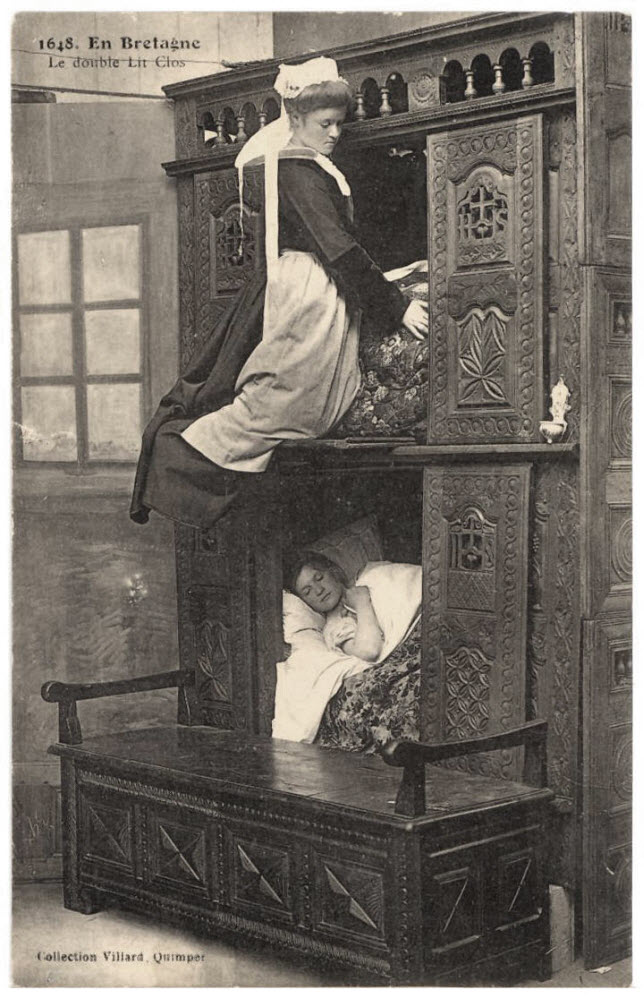
best to think more in the style of old fashioned box beds if you want to compartmentalize the beds.
https://2.bp.blogspot.com/--6kjTZG3...../box-bed-5.jpg
it would be a 80cm to 90cm(standard) bed with a wooden board and door bolted to it. submarines have curtains for such privacy needs instead of wood, cheaper too. just keep the (mechanical) ventilation and the few required ducts in mind especially if you want to stack these things sides and top. a few simple pipes and fans forcing air in or out (drawing air in from a grid at the front or so) would be enough and still leave plenty of room for everything else. with electrics can even add a heater to that grill which would be above the front door i bet.
for compartments, you could make a single enclosed compartment at the very back if you must have a toilet/wash basin, can even add a shower (shoilet) with ventilation pushing wet air in/out the back to prevent mould and such. such compartment is also easy to hose down if done right.
a door in the middle or one far side. taking the entire width for these utilities, the compartment should further take up no more then 1.5m lengthwise then. at the sides you should have enough length left with 4.5m for beds and storage. if you want a kitchenette and storage you can do 4 beds on one side, 2 on the other and in the middle a few cupboards though yeah, space is and will always be a premium.
there are options, especially with larger containers just... have to be realistic with sizes and demands. and sometimes sizes look realistic on paper, but in practice they'd be awful to use.
have fun designing, maybe take a look at caravans, campervans or tiny homes for inspiration.
a railcar setup could work though not in that exact sense. you'd be correct on that.
best to think more in the style of old fashioned box beds if you want to compartmentalize the beds.
https://2.bp.blogspot.com/--6kjTZG3...../box-bed-5.jpg
it would be a 80cm to 90cm(standard) bed with a wooden board and door bolted to it. submarines have curtains for such privacy needs instead of wood, cheaper too. just keep the (mechanical) ventilation and the few required ducts in mind especially if you want to stack these things sides and top. a few simple pipes and fans forcing air in or out (drawing air in from a grid at the front or so) would be enough and still leave plenty of room for everything else. with electrics can even add a heater to that grill which would be above the front door i bet.
for compartments, you could make a single enclosed compartment at the very back if you must have a toilet/wash basin, can even add a shower (shoilet) with ventilation pushing wet air in/out the back to prevent mould and such. such compartment is also easy to hose down if done right.
a door in the middle or one far side. taking the entire width for these utilities, the compartment should further take up no more then 1.5m lengthwise then. at the sides you should have enough length left with 4.5m for beds and storage. if you want a kitchenette and storage you can do 4 beds on one side, 2 on the other and in the middle a few cupboards though yeah, space is and will always be a premium.
there are options, especially with larger containers just... have to be realistic with sizes and demands. and sometimes sizes look realistic on paper, but in practice they'd be awful to use.
have fun designing, maybe take a look at caravans, campervans or tiny homes for inspiration.


Comments