
 FA+
FA+ Shop
Shop


215 submissions


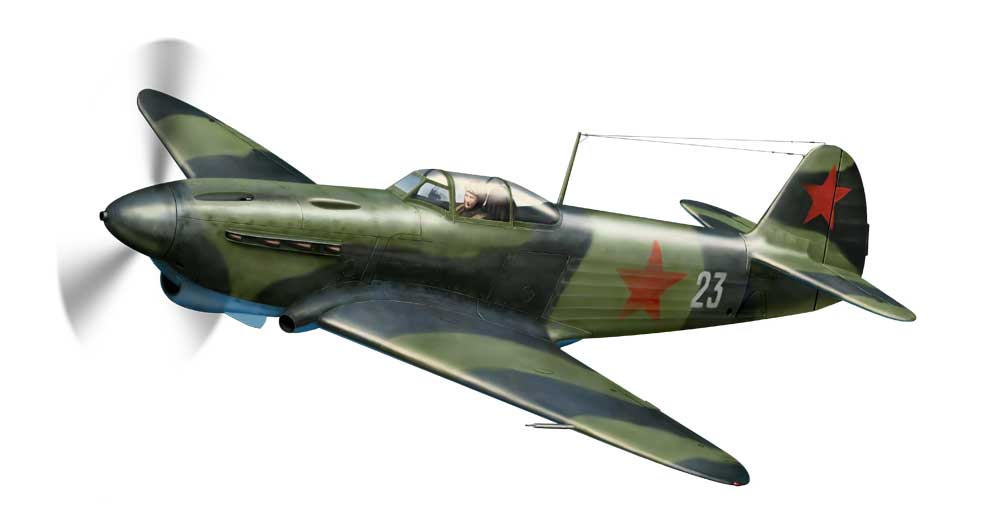
Bell P-39Q-15 Airacobra, 213 GIAP, 22 GIAD, VVS. Germany, Spring 1945
Largely rejected for service in Europe by the British and Americans, the P-39 served the Red Air Force (VVS) with great distinction, and in significant numbers. In all, 4,952 Airacobras were delivered to the VVS via the Lend-Lease programme, whether directly from the Bell factories or from the inventories of the RAF and USAAF. These were joined by some 300 machines voluntarily seconded to the Soviets from RAF units or removed from the inventory and replaced into VVS care.
Between 1942 and 1944, Soviet ferry pilots flew approximately 2,600 P-39s into the USSR from Fairbanks, Alaska. Another 2,000 were shipped (crated) to Iran, assembled, inspected, and flown to Soviet bases east of the Caucasus Mountains. The majority of the 4,600 P-39s shipped to the Soviet Union were the highly developed Q-models. Many of these, at Soviet request, lacked the two wing-mounted .50-caliber machine gun pods.
Slowly at first in the summer and fall of 1942, and then rapidly as more aircraft became available in the ensuing months, the Red Air Force transitioned both new and experienced fighter pilots to the P-39, forming or refitting fighter regiments of three squadrons, twelve aircraft per squadron. The mission of the Red Air Force was to support the Red Army, and in order to perform this mission air units at division level and above were subordinated to ground formation commanders. The Red Air Force employed the P-39 Airacobra in several roles: the most common role was to cover or protect ground forces. This entailed patrolling in a zone above a specific Red Army formation and preventing the penetration into that zone of German bombers and their accompanying fighters. A second mission for the P-39 was to escort Il-2 Shturmoviks or Pe-2 dive bombers to attack German troops and installations. In this role the P-39s were used to fend off German fighters or to suppress German AAA defenses.
A third mission for the P-39 was reconnaissance, both air and ground. A fourth mission was "free hunt", wherein pairs of experienced Soviet fighter pilots were permitted to conduct deep penetrations of German airspace over land or sea to search for air or ground targets. A fifth mission for the P-39 was ground attack, primarily of soft targets such as troop concentrations, road convoys or trains, and airfields. Contrary to popular myth, the P-39 was not employed as a "tank-buster" for two very good reasons: the M4 37mm cannon was slow-firing and only had 30 rounds of ammunition, and the Soviets never received M80 Armor Piercing Shot ammunition for this cannon through Lend-Lease. (Even had they received AP ammo, it was only capable of penetrating 1.0 inches of armor at 500 yards. After 1943 there weren't many German tanks that vulnerable, especially from the top quadrant.)
The marking for this picture was based on machines flown by 213 GIAP (Guard Air Fighter Regiment) circa Spring/Summer 1945. It has white propeller spinner and white diagonal lines on the vertical stabilizer but that's about it for the similarities. In reality, most machines of the 213 GIAP were left in US Olive drab colour with the roundels painted over with Soviet AMT-4 Green. One example was shown overpainted with lighter A-24m or A-21m camouflage which became the basis for this picture.
Instead, the machine pictured wore the early camouflage pattern of the VVS consisting of AMT-4 Green and AMT-6 Black. The scheme was mostly a homage to Lydia Litvyak's Yakovlev Yak-1B "White 23" from 1943
"The machine was new. Beautiful, impetuous, no scratches. The engine has gained only eight hours. Just yesterday we together with the mechanic painted - of course, using a stencil - a bright red star on the fuselage. And next - the number "50." I was destined to be with this plane and with this number until the end of the war."

- Konstantin V. Sukhov, 16 GIAP, VVS
"In October of 1942, I was thrilled to be flying it. It was unique, with its engine behind the cockpit, and the propeller drive shaft running between the pilot's legs. It had a tricycle landing gear, unlike anything in our arsenal except the P-38. And the cockpit was more like a car's, with a door instead of a swing-up or sliding canopy, and windows that actually rolled up and down with a crank. You could taxi the thing while resting your elbows on the sill, like cruising the boulevard on a Saturday night."
- Bud Anderson, 328th FG, USAAFLargely rejected for service in Europe by the British and Americans, the P-39 served the Red Air Force (VVS) with great distinction, and in significant numbers. In all, 4,952 Airacobras were delivered to the VVS via the Lend-Lease programme, whether directly from the Bell factories or from the inventories of the RAF and USAAF. These were joined by some 300 machines voluntarily seconded to the Soviets from RAF units or removed from the inventory and replaced into VVS care.
Between 1942 and 1944, Soviet ferry pilots flew approximately 2,600 P-39s into the USSR from Fairbanks, Alaska. Another 2,000 were shipped (crated) to Iran, assembled, inspected, and flown to Soviet bases east of the Caucasus Mountains. The majority of the 4,600 P-39s shipped to the Soviet Union were the highly developed Q-models. Many of these, at Soviet request, lacked the two wing-mounted .50-caliber machine gun pods.
Slowly at first in the summer and fall of 1942, and then rapidly as more aircraft became available in the ensuing months, the Red Air Force transitioned both new and experienced fighter pilots to the P-39, forming or refitting fighter regiments of three squadrons, twelve aircraft per squadron. The mission of the Red Air Force was to support the Red Army, and in order to perform this mission air units at division level and above were subordinated to ground formation commanders. The Red Air Force employed the P-39 Airacobra in several roles: the most common role was to cover or protect ground forces. This entailed patrolling in a zone above a specific Red Army formation and preventing the penetration into that zone of German bombers and their accompanying fighters. A second mission for the P-39 was to escort Il-2 Shturmoviks or Pe-2 dive bombers to attack German troops and installations. In this role the P-39s were used to fend off German fighters or to suppress German AAA defenses.
A third mission for the P-39 was reconnaissance, both air and ground. A fourth mission was "free hunt", wherein pairs of experienced Soviet fighter pilots were permitted to conduct deep penetrations of German airspace over land or sea to search for air or ground targets. A fifth mission for the P-39 was ground attack, primarily of soft targets such as troop concentrations, road convoys or trains, and airfields. Contrary to popular myth, the P-39 was not employed as a "tank-buster" for two very good reasons: the M4 37mm cannon was slow-firing and only had 30 rounds of ammunition, and the Soviets never received M80 Armor Piercing Shot ammunition for this cannon through Lend-Lease. (Even had they received AP ammo, it was only capable of penetrating 1.0 inches of armor at 500 yards. After 1943 there weren't many German tanks that vulnerable, especially from the top quadrant.)
The marking for this picture was based on machines flown by 213 GIAP (Guard Air Fighter Regiment) circa Spring/Summer 1945. It has white propeller spinner and white diagonal lines on the vertical stabilizer but that's about it for the similarities. In reality, most machines of the 213 GIAP were left in US Olive drab colour with the roundels painted over with Soviet AMT-4 Green. One example was shown overpainted with lighter A-24m or A-21m camouflage which became the basis for this picture.
Instead, the machine pictured wore the early camouflage pattern of the VVS consisting of AMT-4 Green and AMT-6 Black. The scheme was mostly a homage to Lydia Litvyak's Yakovlev Yak-1B "White 23" from 1943
Category All / All
Species Unspecified / Any
Size 2000 x 1251px
File Size 509.2 kB
Listed in Folders



From my Historical Furries folder: https://www.furaffinity.net/view/42910533/



Oh hell yes!! I could see her flying "The Yankee Cannon" , the Soviets made real good use of the 39 in air to air combat. Far better than the Americans did with the fighter in air to air combat. Numerous Soviet aces were made with it, even against far superior Luftwaffe aircraft.
Instant fav!!
Instant fav!!




Beautiful drawing of lend lease P39. The Airacobra will always hold a place in my heart as the city of Whitehorse, Yukon where I grew up as it was one of the places were they would pass though to refuel on their way to Fairbanks. Many of these planes that crashed in bad weather are still buried in lakes around the Yukon.


I read it was the Q-models with the Allison engine that was mostly given to the Soviets.
They applied it well to the aircraft's strengths but it really was more of an A functioning fighter (Attack) due to lack luster high altitude performance than a P (pursuit).
Either way, the 30 rounds of cannon went way too quickly.
They applied it well to the aircraft's strengths but it really was more of an A functioning fighter (Attack) due to lack luster high altitude performance than a P (pursuit).
Either way, the 30 rounds of cannon went way too quickly.



Comments