
 FA+
FA+ Shop
Shop


2846 submissions


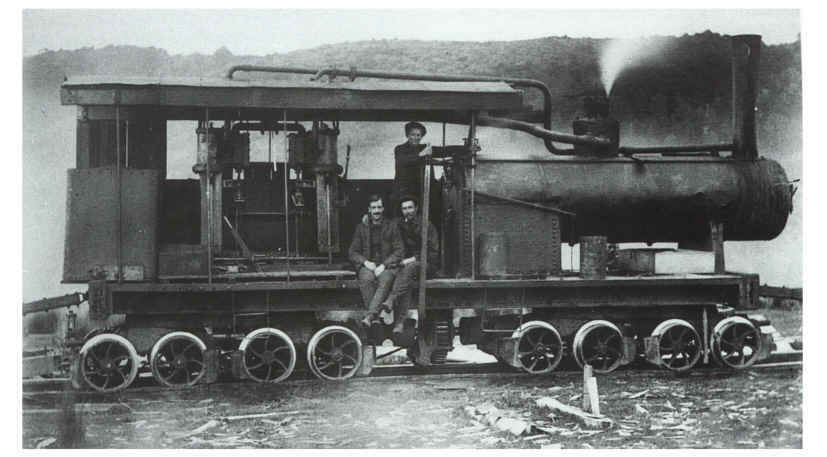
Although not intentional the motion blur of the Shay's crank turned out well IMHO.
I find it interesting that there are no counterweights.
Jamestown, CA.
I find it interesting that there are no counterweights.
Jamestown, CA.
Category Photography / Still Life
Species Unspecified / Any
Size 1280 x 857px
File Size 984.7 kB
Listed in Folders


The other pistons/cranks provide the counterweight - not nearly as efficient or elegant, but this means big weight savings. What amazes me is the 100% loss cooling system using water, again a weight savings measure but still very questionable in today's standard engineering practices.
I've seen other Shays with counterweights, ones built in a similar time frame to this one, 1922, so that's why it seemed peculiar. I may just have not seen enough class 'C' Shays.
Cooling like this wasn't uncommon on Shays so far as I've seen or read. Bladehorse will probably have more info if he happens to read this post.
Cooling like this wasn't uncommon on Shays so far as I've seen or read.
 Bladehorse will probably have more info if he happens to read this post.
Most likely this engine has hollow cored pistons. Piston is phisically 3" thick , but only actually a 1/2" shell. THis is the way our #15 engine is. Our 90 ton #10 has solid pistons and counterweights.
ANd Im curious as to why one would want to save weight on a locomotive, when more weight increases the tractive effort :P
THe water cooling I have to say works great. Saves a ton of grease.
Hmm I love the steps on the crankcase! Wishes ours had those!
ANd Im curious as to why one would want to save weight on a locomotive, when more weight increases the tractive effort :P
THe water cooling I have to say works great. Saves a ton of grease.
Hmm I love the steps on the crankcase! Wishes ours had those!
At the Westside Lumber CO that our engines came from, they ran on 60-70# rail. It is rather hard on it, but then again we are currently running on some sticks rolled in 1897. when the engine is 90 tons 300# isnt going to break the back either. Id say just kick the 12 sammich eatin conductor off the 90 ton pullman car. Same result in weight savings!

That’s quite a bit. As late as the 1970s there were considerable parts of the national rail network laid with 55# rails. Most logging railways used rails in the 30-40# range and the upper limit was about 7 tons per axel. The heaviest locomotive to run on a logging railway here was a 45 ton Alco mallet.
http://loggingmallets.railfan.net/l...../GV4-Dunn1.jpg
At the other extreme J. Johnston & Sons built about 15 16 wheelers which were designed to put only one ton on each wheel and could run on wooden rails.
http://www.trainweb.org/nzgearedloc.....ston_16w-2.jpg
http://loggingmallets.railfan.net/l...../GV4-Dunn1.jpg
At the other extreme J. Johnston & Sons built about 15 16 wheelers which were designed to put only one ton on each wheel and could run on wooden rails.
http://www.trainweb.org/nzgearedloc.....ston_16w-2.jpg
Yah, a three truck Shay pretty much can use all its weight for tractive effort so I think it's probably less of an issue for such an engine, and even an advantage!
Interesting about the piston types, that explains why I've seen both crank styles then.
And its cool to know those are steps, I'd wondered when I was looking at the photos what they were, I'd not looked closely without a camera in front of my eyes.
What is right below the steps, the bit of protruding square bar that almost looks like you turn it?
Interesting about the piston types, that explains why I've seen both crank styles then.
And its cool to know those are steps, I'd wondered when I was looking at the photos what they were, I'd not looked closely without a camera in front of my eyes.
What is right below the steps, the bit of protruding square bar that almost looks like you turn it?
The square at the bottom of the connecting rods and the main bearings is the screw to adjust the bearing wedge.turning the screw pulls the wedge in and the bearing closer together. the mains are opposite, and the screw pushes the wedge to tighten it. sadly the wedge is Very steep so 1/4 turn can fry an already snug bearing. makes adjusting them rather fun! If they need to be backed off they need to turn the screw about 6 turns before the wedge moves at all. SO you have no info on where ya started:p .


Comments