
 FA+
FA+ Shop
Shop
179
Views
Views
1
Favorites
Favorites
Category
Story / All
Species Original Species
Size 120 x 109
File Size 34.4 kB
Report this content
More from ZetaTheCoyote



Listed in Folders


CHAPTER SIX◄CHAPTER SEVEN►CHAPTER EIGHT
CHAPTER ARTWORK
In Sarat, the capital of Halaj Province, the atmosphere was one of jubilant celebration in the streets and countryside of the planet’s southern pole. Sivathi from all walks of life, their loyalties fierce to the Confederate controlled province, feasted, drank, danced and sang under the extended night of the pole in winter, as soon as the news had been delivered that the Crown Army had been beaten back in their offensive. Such massive victories against the Crown of Siva had been few and far between for the Confederacy of Liberation in its relatively short history, so there was little restriction to be had on the immensity of the festivity. The banners of the faction—three handpaws of gold, white, and gray joined in brotherhood, clasping a thunderbolt that shattered the links of a ball and chain—fluttered proudly. They could easily have been replaced with those of the Crown of Siva had defeat befallen them, but the Confederate forces had fought gallantly, preserving the lush polar farmlands to continue feeding their war effort for freedom. The harvest of the late polar autumn had been defended, yet questions remained on how many more years they could outlast the Crown.
The celebratory mood, however, was far more toned down within the Confederate Congress. It was housed in a former royal fortress that sat nestled in the heart of Sarat, its artillery, towers, guns, and walls now protected its members inside while the rest of the city rejoiced in victory. The representatives of the Confederacy—a mix of nobles disillusioned with Phaziah Ishigar, upper class Sivathi, middle class artisans and tradesmen, commoners who were fighting tooth and claw for their rights, and former slaves who crusaded for freedom—had all gathered to deliberate over the strategy needed for the Confederacy not just to survive, but to defeat the Crown of Siva. To coexist with them was out of the question.
The foundations of the fortress were ancient; a labyrinth of pylon gateways, colonnade supports upholding beautiful rooftops, hypostyle halls, and obelisks that towered into the heavens. The Crown of Siva’s first monarchs from antiquity established it to serve as a stronghold for maintaining control and order on the southern pole eons ago. Over time, it had begun to incorporate the advanced technological elements and metalworking structures alongside its stone framework, until it now stood as a balanced blend of past and present. Such was the case for much of Siva’s architecture, in fact, except for that of the commoner and slave. Perhaps it was all the more fitting that such a blend of the ancient and future world be put together and represent all Sivathi by housing the Confederate Congress; truly giving meaning to the purpose of the Confederacy of Liberation.
The distinct desert flair of the fortress, and by extension Sarat and all the cities of the Sivathi, stood out like a sore thumb in the oasis of the pole. The ancient warlords had been seemingly more interested in boasting the indestructibility of their fortresses and towns by building with desert stone instead of the plentiful wood of the polar regions. Ironically, in the hope of maintaining their grip permanently on the planet, their grasp had been loosened in the regions they had once held, and their own bastions were now a host for a faction that plotted their demise.
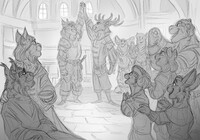
Deep inside the fortress was the meeting hall, housing the several hundred delegates of the Confederate Congress that sat before the debate floor. At present, the general in charge of having defended Halaj Province, a graying, battle hardened Sivathi by the name of General Zekiah Othor, stood before the quadrumvirate that was seated at the podium overlooking the entire Confederate Congress, delivering a testimony on the condition of the Confederate forces and the plans for future operations against the Crown of Siva.
The quadrumvirate sat in silence as it listened to Zekiah’s report, each member pondering the general’s words in their own meaningful way. Though united by a common cause in wishing to overthrow the Crown of Siva, it was clear that each member of the quadrumvirate harbored their own biases, which was to be expected considering that each member represented one of each class—noble and upper together, middle, commoner, and liberated slave. If the Confederacy was to emerge in victory, the need for the quadrumvirate was anticipated to be reduced to a triumvirate with the abolition of slavery altogether. It was hoped that their cause would be amalgamated into the commoner faction.
For each of the members of the quadrumvirate, one-hundred delegates apiece were present for the each of the classes. The hundred that represented the upper echelon of the Confederate Congress was, in reality, only made up of a dozen or so actual dukes and duchesses that were disillusioned with Phaziah Ishigar. The remainder were members of the upper class without noble titles, but their considerable financial wealth and political power was equally strong. In the quadrumvirate, they were represented by Duchess Zuleikha Jaasu. The golden-furred noblewoman, though having cast off much of her hereditary privileges, still carried herself with a regal air about her, if only for the power it meant wielding for the cause of the Confederacy, lest she appear weak. It was weak nobles that bowed to the likes of Phaziah Ishigar. Not her. The strong saw the crushing burden placed upon the subjects that they ruled, and had the wits about them to realize the horror that Crown of Siva enacted on its people. It was the strong nobles that had cast off the luxuries given to them by Phaziah Ishigar as an act of pacification, so that they may one day be seen as leaders worthy of respect that was earned, and not taken by force.
Even so, Zuleikha Jaasu hailed from a tiny province just above the south pole on the far side of the planet, and her strength as a noblewomen was slim compared to those compared to others. It was one reason she’d been elected to the quadrumvirate, for it was hoped that a noble of more modest standing would be a better representative of the Confederacy’s causes than somebody of equal standing to the High King. The only others who could rival Phaziah Ishigar were the figurehead duke of Halaj Province that had been installed when the Confederacy took over, and the same went for the Confederate-sponsored duke and duchess of the split northern polar provinces, respectively. The remainder were from other small provinces like hers, or from the distant colonies of the gas giant moons or one or two other star systems that had broken away from the Crown’s rule. They were all simple delegates, and they accepted those roles with humility, knowing that their course was just, pure, and above the titles and luxuries bestowed upon them otherwise.
The rest of the delegates for the highest of the Congress were made up of wealthy industrialists, businesspeople, and a small rogue faction of priests from the temples. For the first two, it was their incredible wealth and ability to conjure up industrial power that made the Confederacy such a thorn in the side of the Crown of Siva. It could be argued that some of them were they because they saw that supplying the Confederacy was more profitable than joining the side of the High King, but when facing the juggernaut that was Phaziah Ishigar, nobody was going to ask questions. At least, not yet. For the few clerics there, they’d come into the Confederacy with a new vision for the religious aspect of Sivathi society, no longer seeing the High Kings and Queens as being the sole arbiters of the Zaket suns. In spite of what the Crown of Siva would call blasphemous, not only had they truly lost their trust in Phaziah Ishigar, but they truly saw that such worship could no longer be directed at them as deities in their own right—only the suns could hold that title, and only the suns deserved worship. The monarchs, owing to their brutality as of late, had lost all legitimacy to act as the sons and daughters of the binary stars.
Beside Duchess Zuleikha Jaasu was the quadrumvirate representative for the commoners, a red furred Sivathi male named Sanak Teos. He had been the chief steward of several trade unions throughout his life, innately concerned with the wellbeing of all workers. As such, it was only natural that his allegiance be to the Confederacy of Liberation. It wasn’t just the slaves of Siva that were being oppressed. Even free workers that were not burdened with the yoke of bondage had long been mistreated by Phaziah Ishigar and the monarchs before him. While he and his minions basked in the luxuries of royalty, the standards of living for the common Sivathi had stagnated, often becoming little better than Sivathi slaves themselves, except that they were not beholden to the whims of a master or mistress. They were, however, beholden to the wealthy profiteers of the nobles and upper classes, and as the commoners wielded a significant power in numbers over their overlords, Sivathi such as Sanak Teos had come forward to represent their interests in a congress that would listen, where they had otherwise been ignored for so very long. Here, a select few nobles and aristocrats dared to listen to what they had to say.
The third member of the quadrumvirate was Doctor Ekta Daloh, representing the middle classes. A genetic engineer, she had abandoned her professorship at one of the most prestigious universities on the planet to come here and represent what she thought to be right. Though the universities were indeed places that spurred the bulk of scientific research that fueled the power of the Crown of Siva, the faculty within often found their loyalties torn between one side or the other. The doctor, unlike some of her colleagues, had sympathies with the Confederacy. She’d found it only natural that she take up their cause as a matter of principle when she’d discovered that much of her research had been used in attempts to genetically alter members of the slave class for nefarious ends, whether it meant subjecting them to testing to improve their endurance, strength, or just being more servile—and thinking that the latter could be “genetically engineered” was a pseudoscience, at best. She refused to participate in it, for she’d pursued her field in the hopes of improving the wellbeing of her whole species, not the select few at the top of it. As she listened to the report of Zekiah, she often found herself looking out into the crowd of delegates, gazing at the fellow professors, scientists, artisans, and more that made up the diverse sect that she represented.
The final representative was an old, hunched over Sivathi with jet black fur that still retained its onyx-like luster even in his elderly state, with few grays to be seen on his body. His physique, however, spoke of a lifetime of suffering that he had endured in slavery. What he lacked in influence and millions of talir like the nobles and upper class or the knowledge of the middle class was made up for in his experiences. For six decades, he had labored on one of the massive plantations on Siva’s northern pole when it was still firmly in control of the Crown. When the region finally fell under the governance of the Confederacy of Liberation, he was one of the most vocal to shout the cries of freedom, swearing that he would see the whole system of bondage dismantled not just on Siva, but on its colonies as well. The green beauty of the poles, a gem of fertility in the eternal oceans of sand, had been his to cultivate and nurture, but never for his benefit. Everything always went to the glory of the nobility and the upper classes. It was a beauty that shouldn’t have been theirs alone, but one his whole race should have experienced and flourished from. And he, the Sivathi known as simply as Ghamir, would see to it.
The old man had even gone so far as to voluntarily decline to have his collar removed from his neck when freedom finally came to him. It was still upon his body even at this very moment. He had chosen for it to remain so that not only his body—ailing from years of mistreatment—would serve as a reminder to others and to himself for what the Confederacy was fighting for.
And what the Confederacy was fighting for was why thousands of Sivathi had died in pushing back the offensive against Halaj Province. It had been a costly victory, and one that had left the rebellion scarcely able to push back a second time should such an occasion befall them. Maybe it was why such revelry was taking place outside the fortress; perhaps the people knew that there would be more occasions to enjoy such things. Zekiah Othor was making that abundantly clear as he spoke to the quadrumvirate.
“Casualties in defending against this latest assault number around 190,000 killed or wounded, 900 tanks and assault guns destroyed, 2,500 artillery and air defense pieces destroyed, and 400 aircraft downed,” he explained, gritting his teeth painfully as he read off the list from his holographic report. “Worse yet, the High King has returned from his journey to the Ibra system. The assault against us in these recent months wasn’t a cohesive, unified strike; Phaziah’s generals clumsily fought against us without his leadership. Now that he’s returned, I fear that we may not be so lucky a second time if another offensive is renewed against Halaj Province, and with so much of the deserts between here and the northern pole firmly in the paws of the Crown, it is proving extremely difficult to unify our forces.”
“But we still have our small garrisons in the deserts, yes?” the Duchess asked. “I’m told that a strike was carried out by one of our underground stations to secure the remains of a crashed troop transport in Lathga Province, not terribly far from here, but in the desert, nonetheless. I think you’re underestimating the strength of our troops working covertly in Crown-held provinces, General.”
“Strong as they may be, they are ill-suited to take on the full might of the Crown Army in those provinces,” he said. “There’s a reason they are limited to the underground and must resort to hit-and-run tactics, and it is for that reason that the provinces of the desert are still firmly under the control of Phaziah Ishigar. Our strengths are concentrated in the poles, and scattered across the rest of the planet. Without unity of those two fronts linked together, I don’t know how much longer we can continue fighting defensive struggles. I can’t magically snap my fingers and link the forces of the poles together and consolidate our strength.”
“The solution lies with the colonies that sympathize with us,” Sanak Teos said, beginning to propose some semblance of a solution. “It’s clear that we’re pinned down here on the planet, and Phaziah Ishigar has the means to keep it that way because geography and his naval might encompassing the planet keeps us from easily relocating our forces by way of outer space. Slower redeployment by air transport may be more realistic, but we still lack the aerial power to conduct such a massive logistical effort. I’m afraid that we must beckon to the colonies to muster the courage to go beyond just simple blockade runs and skirmish attacks like the one that brought down that troop transport.”
The general standing below the quadrumvirate sighed a bit as he clasped his handpaws behind his back. “Yes, we’ve tried doing so many times before,” he explained. “They know that to send proper reinforcements that could shift the balance of power in our favor would require a massive gamble in a battle they have slim odds of winning. A decisive battle against the Crown Navy over Siva would finally permit us to redeploy at will. But what they have is barely sufficient enough, sitting idle at dock for fear of losing the precious capital ships they’ve put together, for they are not easily replaceable. If the colonies with shipbuilding capacity that are loyal to us attack the Crown Navy and lose, then there goes the only thing keeping them safe from the High King staging an invasion and retaking those settlements for himself.”
“What good is the Confederate Navy if they only sit idle, too afraid to undertake the battles we’ve entrusted them with?” Ghamir said, slamming the palm of his paw down on the desk before him with as much force as his old body would permit. The pent up rage inside him from all the mistreatment he’d endured constantly bubbled to the surface like this, betraying what was outwardly the appearance of a feeble old Sivathi. “Are they too content with the freedom they gained by abolishing slavery on the colonies of the gas giants to the point that they’ve forgotten where this movement first began? On Siva itself? We cannot afford to see a so-called ally pour in their energies to a fighting force that will not do battle!”
“It isn’t that they won’t fight, nor are they selfish,” Zekiah Othor said, trying his best to calm the representative for the liberated slaves, the rest of his delegation rising up in thunderous applause for Ghamir. “They are too averse to the risk of losing the navy we do have in a decisive battle. It took years to cobble it together, and it would be impossible to rebuild it quickly enough to repel an attack on the colonies. And even if we were to miraculously defeat the Crown Navy in the heavens above Siva, we would need to quickly move on the opportunity on the ground below to secure victory. Within the span of only a year or two, the Crown could replenish their naval losses and we would be in a worse position than before. Our colonial allies would be at the mercy of the Crown, and we would soon be next.”
“I see little choice in the matter,” the Duchess said, closing her eyes as she leaned back in her seat, resting her chin on her fist in thought. “You made it clear enough that we may not be able to withstand another defensive struggle against the Crown. If that is so, then there can be no delay. We must move to convince the bulk of our navy at their moorings in the colonies to do battle with the Crown Navy. Only then can we hope to break Phaziah Ishigar’s grip over force deployment on the planet. If we can strike a decisive blow against him in the space around Siva, then perhaps a small window of opportunity will arise and reinforcements can be given from the same colonies housing our fleets. Only then can we hope to unify the north and south polar forces and close in on the royal capital of Shaleth, bringing this war to a close.”
“But how are we to convince the colonies to make their move and attack?” Doctor Daloh asked, her gaze turning over to several of the delegates in their seats down below that represented the colonial allies in question, spread throughout the multitude of classes. They were all murmuring amongst themselves, trying to put a solution into practice when they all knew that no matter what they tried, the admiralty in charge would still be too timid to wage a battle against the Crown Navy. “What can we possibly do here to convince our brethren on the moons of the gas giants?”
“Something daring of our own,” Sanak Teos said. “I’m no strategist. I’m only a simple union steward. But it doesn’t take a master of military science to realize what must be done to convince the colonies to act. We must strike at the heart of Phaziah Ishigar here on the ground with what we have. If we could demonstrate to our friends that he is capable of being harmed grievously, then maybe it would muster their courage enough to have them do battle with the Crown Navy. We must show them that we are not afraid of risk!”
“He has a point,” Zekiah Othor said. “Who are we to criticize the timid nature of the colonies and their navy when we wage only defensive struggles here on Siva? We have to be bold. Perhaps an excursion into territories held by the Crown is in order. It doesn’t have to be the grand prize of Shaleth, no, no. But it must be somewhere of significance to demonstrate that Phaziah is not invincible.”
Murmurs erupted amongst all the delegates and the quadrumvirate on their high perches as they immediately began to mull over where such a move was to be made. Lathga Province was the most immediate area firmly under the control of the crown, and the nearest, but it was too remote to stage an effective demonstration. Seizing the provincial capital would be meaningless. A grander prize needed to be snatched away from the Crown of Siva if the Confederacy of Liberation was to convince its colonial brethren to also attack.
“Yerusa Province,” exclaimed a voice among the murmurs, to which the voices died down as all Sivathi present turned to look at who had spoken. “The heart and soul of the slave trade on Siva, aside from the royal capital of Shaleth itself. The souls to be freed within its borders are many, and would bolster not only our own fighting strength here on the planet, but it similarly boost the confidence of our colonial brethren.”
The four members of the quadrumvirate all looked down at who had spoken, and all of them rolled their eyes at the suggestion, except Ghamir, who fervently nodded in agreement. The others all had their reasons to be dismissive of the suggestion, for Yerusa Province was home to the bulk of Phaziah Ishigar’s slave stock, and as such is was defended heavily, though not to the degree of the royal capital. Moreover, the delegate that had proposed the notion had always been putting forth such ideas of mass liberation, as if he had something to prove. He was none other than Yanat, a former captain of the High King’s household troops that had abandoned the cause of the Crown of Siva years ago for having committed a sin that he dared not speak of; now a delegate for the middle classes of Sivathi in the Confederate Congress. Whatever he’d done before, Yanat was trying to atone for his sins by being front and center in the efforts of the Confederacy to free as many souls as possible from the Crown’s oppression.
“Delegate Yanat,” the Duchess said. “We’ve heard your propositions many times before, which border on recklessness and strategic insanity—though they are admirable, indeed. What makes you think that we will entertain the very idea of conducting our offensive against Yerusa Province?”
“Your hesitations are exactly the reason why we have yet to take the fight offensively to the Crown, and why our colonial allies do nothing with the strength that they have!” Yanat said angrily, standing up from his seat and shaking his fist. He was not one to mince words. “Are we going to sit and dawdle debating where is best to strike when it is clear that Yerusa Province is the prize that would cripple Phaziah Ishigar and send a message to our friends off the planet?”
As Ghamir vehemently raised his voice in agreement with Yanat, Sanak Teos spoke up in continuation of the statement by the Duchess. “Even if it is to be our target, we cannot just attack it on a whim. We need a reason, and we need justification. Why there, Yanat? You know that the provincial capital of Yerusa Province is nearly on the equator—though the borders are near to us, the actual prize lies far away!”
“Your own province is nestled in the bosom of Yerusa’s southern fringes,” Yanat said to the Duchess, beginning to justify his reasoning for having the offensive strike at this location. “And it is still loyal to you. We use it as a springboard to take our assault northward, sweeping up through the desert wastes that make up the bulk of Yerusa Province and striking fear into the few defenders that are there. We shall drive them before our great host that marches forward, spreading word into the provincial capital of Vathora that we are coming to demoralize the Crown Army forces that hold it and invigorating the enslaved populace to take up arms against them. Our push can also be supported by the small underground garrisons we maintain in the deserts and wastelands, which have just been itching for a fight instead of hunkering down in hiding. If the Crown is bold enough to traverse and strike through the deserts to get to us, then why aren’t we?”
General Zekiah Othor spun around with a look of shock in his eyes, stupefied by what he took to be an insult. “Mind your tongue!” he blurted out. “Was it not bold enough of us to fight so hard to defend what we have? The fighting men and women of the Confederacy did not die in their thousands to have their memory besmirched by one of hundreds of delegates!”
“Gentlemen! Do not bicker!” Doctor Daloh shouted as she stood up from her seat, raising her voice to put an end to the quickly rising tension between Yanat and the General. “General, nobody is accusing the Confederate Army of cowardice, and I have no doubt that this was not the intention of Delegate Yanat with his statement. He merely wishes to emphasize that we must be even more daring than we have been thus far if we are grab the attention of our colonial brethren. Even so, I would remind you, Yanat,” she said, turning her gaze down to the former captain of the household troops. “That you conduct yourself and your statements with a sense of respect towards all the sacrifices our fighters have made up to this point. I would think a former military man such as yourself would understand that, yes?”
“It is understood,” Yanat said, composing himself a bit as he sat back down in his chair. “But I still stand by a notion that the Confederate Army undertakes an offensive into Yerusa Province with the utmost haste, before Phaziah Ishigar can consolidate his own forces for a crushing blow against us in the southern pole. If we wait too long, our window of opportunity will be shut for good, and we’ll soon find ourselves fighting for our lives once again in a battle that I do not think we will be able to win a second time.”
“Your urgency is warranted,” the Duchess said, looking down towards the General who leaned forward on his podium, weary of the debates within the meeting hall. “But you’re known for your penchant to propose unrealistic legislations and movements in the name of freeing as many souls as possible. We can’t conjure up freedom fighters from thin air, nor can we charge in blindly in a campaign of rage. These things take time. That being the case, it is not for you to decide the feasibility of this operation. It is for the whole Confederate Congress to vote upon, and only if the General sees it as realistic. Even so, I see the idea as our only chance to seize the initiative that we have while the Crown Army is retreating out of Halaj Province and into Lathga Province’s wastelands. What say you, Zekiah Othor?”
Rubbing the bridge between his eyes as if to relieve some of the immense stress that he was under, the General nodded as he continued looking down at the floor, still in thought even though the Duchess and the rest of the quadrumvirate gazed at him. “It would not be an impossible task, especially with our underground desert garrisons ready and waiting to join us as we moved northward,” he said, hating to give justification to the crazed schemes of somebody such as Yanat. “And even after defending against this thrust, we still have the force available to conduct such a maneuver all the way to Vathora, but just barely. If we cannot take the provincial capital of Yerusa Province, then we will not have the means to defend ourselves at all in the southern pole. And if we fall, then our allies in the northern pole will soon follow.”
“Sounds to me like it’s better to take a risk in attacking rather than waiting for inevitable doom in shoring up for another defensive action here,” the Duchess said. “We will be annihilated if we sit idle and try to play defense again, and we will also be destroyed if we attack and fail. We have nothing to lose, but everything to gain.”
“But it’s for the Congress to decide, as you said, Duchess” the more levelheaded Doctor Daloh said, turning her head this way and that as she gazed out amongst the delegates present, who were already busy starting to talk amongst their small respective cliques on whether or not the motion should be approved. “Thus, the notion for a military operation will be put to a—”
“Damn a vote!” Ghamir said, pounding his fist on the table angrily and sending his own faction into an uproar of agreement. “I’m with Yanat on this completely! He’s right, the timid nature of the navy and our own defensiveness only appear as weakness to others, and it is why we have not ever exacted a crushing blow of our own! The time to attack is now! Now, I say!”
“That is not procedure!” the Duchess said, standing up and casting out both her handpaws in a notion for the former slave and the delegates that represented them to pipe down before things got ugly. “We will vote, as we always have!” She turned her gaze to Sanak Teos, who had always been tasked with verbally calling out motions of voting as the middleman between nobility and slave classes.
Yanat sat back in his chair as he watched him stand up with his holographic display projecting up and over the quadrumvirate for all to see. Briefly staying silent to key in the motion, Sanak Teos then stood up, indicating for all the delegates to key their entries. “The motion is proposed by Delegate Yanat,” he said. “That the Confederate Congress endorses an offensive into Yerusa Province with the goal of seizing the provincial capital. With such a victory, it is hoped that our colonial allies shall commit more readily to such attacks against the Crown as well. All in favor?”
An uneasy silence finally descended upon the meeting hall as the soft tap of claws and paws against the entry devices of each delegate’s seat became the only emanating noise that echoed in the halls. The tallies soon began to add up, only to be revealed when all votes had been cost, but surely the overwhelming majority of the common and slave class delegates were throwing in their lot to support the offensive into Yerusa Province, with only a handful abstaining. A large chunk of the upper classes, nobility, and middle class all seemed keen to vote in favor of the attack as well.
“All those opposed?” Sanak Teos spoke back up, calling for the remainder to cast their choices. Only a few grumbling delegates—chiefly from the upper class who were pompous in their status and shared an uneasy alliance with those beneath them—voted against it.
With a few strokes of his stylus on his own display, Sanak Teos then keyed in the entry to display the results overhead. The outcry of joy was overpowering at the realization of the results, and the quadrumvirate member of the commoners and workers could hardly hear himself speak as he read the outcome. “The motion for an offensive against Yerusa Province is passed, with 344 in favor, 48 against, and 8 abstaining!”
Yanat smiled to himself as he clutched his fist victoriously, trying his hardest to keep a stern composure as Zekiah Othor turned his face to him. The look on the General’s face was one of fear and doubt. Yanat knew he was tired and weary of fighting this war that seemed to have no end, and that the Confederate Congress was asking a near impossible task of him in undertaking this operation. But he and the other delegates had selected him for the job because of his firm leadership in the face of overwhelming odds—and the odds against the Crown of Siva were insurmountable, indeed. This was to be the finest hour for the Confederacy of Liberation, for regardless of victory or defeat in this grand attack, all Sivathi would know that a stand was taken against a brutal tyrant.
But deep down, there was more in it for Yanat. He had to atone for what he’d done so many years ago. This war had to be won to honor the memory of the slave girl he’d been sent to execute at the behest of Phaziah Ishigar, and damning her daughter to be forgotten in slavery. Total victory—which could only be achieved by such feats of valor as a grand offensive or a strike at the Crown Navy by the Confederacy’s colonial allies—would be the only atonement for Talitha and Shiphra. Defeating the head the bore the twin-pronged Crown of Siva that did this to them would be the only retribution.
For this was Yanat’s secret, but he could not begin to fathom that a storm of slave and royal blood was soon to rear its head and show that it was not afraid of the High King. That was to be the standard for the Confederacy to be inspired to acts of heroism that would spell doom for the Ishigar dynasty.
CHAPTER ARTWORK
In Sarat, the capital of Halaj Province, the atmosphere was one of jubilant celebration in the streets and countryside of the planet’s southern pole. Sivathi from all walks of life, their loyalties fierce to the Confederate controlled province, feasted, drank, danced and sang under the extended night of the pole in winter, as soon as the news had been delivered that the Crown Army had been beaten back in their offensive. Such massive victories against the Crown of Siva had been few and far between for the Confederacy of Liberation in its relatively short history, so there was little restriction to be had on the immensity of the festivity. The banners of the faction—three handpaws of gold, white, and gray joined in brotherhood, clasping a thunderbolt that shattered the links of a ball and chain—fluttered proudly. They could easily have been replaced with those of the Crown of Siva had defeat befallen them, but the Confederate forces had fought gallantly, preserving the lush polar farmlands to continue feeding their war effort for freedom. The harvest of the late polar autumn had been defended, yet questions remained on how many more years they could outlast the Crown.
The celebratory mood, however, was far more toned down within the Confederate Congress. It was housed in a former royal fortress that sat nestled in the heart of Sarat, its artillery, towers, guns, and walls now protected its members inside while the rest of the city rejoiced in victory. The representatives of the Confederacy—a mix of nobles disillusioned with Phaziah Ishigar, upper class Sivathi, middle class artisans and tradesmen, commoners who were fighting tooth and claw for their rights, and former slaves who crusaded for freedom—had all gathered to deliberate over the strategy needed for the Confederacy not just to survive, but to defeat the Crown of Siva. To coexist with them was out of the question.
The foundations of the fortress were ancient; a labyrinth of pylon gateways, colonnade supports upholding beautiful rooftops, hypostyle halls, and obelisks that towered into the heavens. The Crown of Siva’s first monarchs from antiquity established it to serve as a stronghold for maintaining control and order on the southern pole eons ago. Over time, it had begun to incorporate the advanced technological elements and metalworking structures alongside its stone framework, until it now stood as a balanced blend of past and present. Such was the case for much of Siva’s architecture, in fact, except for that of the commoner and slave. Perhaps it was all the more fitting that such a blend of the ancient and future world be put together and represent all Sivathi by housing the Confederate Congress; truly giving meaning to the purpose of the Confederacy of Liberation.
The distinct desert flair of the fortress, and by extension Sarat and all the cities of the Sivathi, stood out like a sore thumb in the oasis of the pole. The ancient warlords had been seemingly more interested in boasting the indestructibility of their fortresses and towns by building with desert stone instead of the plentiful wood of the polar regions. Ironically, in the hope of maintaining their grip permanently on the planet, their grasp had been loosened in the regions they had once held, and their own bastions were now a host for a faction that plotted their demise.
Deep inside the fortress was the meeting hall, housing the several hundred delegates of the Confederate Congress that sat before the debate floor. At present, the general in charge of having defended Halaj Province, a graying, battle hardened Sivathi by the name of General Zekiah Othor, stood before the quadrumvirate that was seated at the podium overlooking the entire Confederate Congress, delivering a testimony on the condition of the Confederate forces and the plans for future operations against the Crown of Siva.
The quadrumvirate sat in silence as it listened to Zekiah’s report, each member pondering the general’s words in their own meaningful way. Though united by a common cause in wishing to overthrow the Crown of Siva, it was clear that each member of the quadrumvirate harbored their own biases, which was to be expected considering that each member represented one of each class—noble and upper together, middle, commoner, and liberated slave. If the Confederacy was to emerge in victory, the need for the quadrumvirate was anticipated to be reduced to a triumvirate with the abolition of slavery altogether. It was hoped that their cause would be amalgamated into the commoner faction.
For each of the members of the quadrumvirate, one-hundred delegates apiece were present for the each of the classes. The hundred that represented the upper echelon of the Confederate Congress was, in reality, only made up of a dozen or so actual dukes and duchesses that were disillusioned with Phaziah Ishigar. The remainder were members of the upper class without noble titles, but their considerable financial wealth and political power was equally strong. In the quadrumvirate, they were represented by Duchess Zuleikha Jaasu. The golden-furred noblewoman, though having cast off much of her hereditary privileges, still carried herself with a regal air about her, if only for the power it meant wielding for the cause of the Confederacy, lest she appear weak. It was weak nobles that bowed to the likes of Phaziah Ishigar. Not her. The strong saw the crushing burden placed upon the subjects that they ruled, and had the wits about them to realize the horror that Crown of Siva enacted on its people. It was the strong nobles that had cast off the luxuries given to them by Phaziah Ishigar as an act of pacification, so that they may one day be seen as leaders worthy of respect that was earned, and not taken by force.
Even so, Zuleikha Jaasu hailed from a tiny province just above the south pole on the far side of the planet, and her strength as a noblewomen was slim compared to those compared to others. It was one reason she’d been elected to the quadrumvirate, for it was hoped that a noble of more modest standing would be a better representative of the Confederacy’s causes than somebody of equal standing to the High King. The only others who could rival Phaziah Ishigar were the figurehead duke of Halaj Province that had been installed when the Confederacy took over, and the same went for the Confederate-sponsored duke and duchess of the split northern polar provinces, respectively. The remainder were from other small provinces like hers, or from the distant colonies of the gas giant moons or one or two other star systems that had broken away from the Crown’s rule. They were all simple delegates, and they accepted those roles with humility, knowing that their course was just, pure, and above the titles and luxuries bestowed upon them otherwise.
The rest of the delegates for the highest of the Congress were made up of wealthy industrialists, businesspeople, and a small rogue faction of priests from the temples. For the first two, it was their incredible wealth and ability to conjure up industrial power that made the Confederacy such a thorn in the side of the Crown of Siva. It could be argued that some of them were they because they saw that supplying the Confederacy was more profitable than joining the side of the High King, but when facing the juggernaut that was Phaziah Ishigar, nobody was going to ask questions. At least, not yet. For the few clerics there, they’d come into the Confederacy with a new vision for the religious aspect of Sivathi society, no longer seeing the High Kings and Queens as being the sole arbiters of the Zaket suns. In spite of what the Crown of Siva would call blasphemous, not only had they truly lost their trust in Phaziah Ishigar, but they truly saw that such worship could no longer be directed at them as deities in their own right—only the suns could hold that title, and only the suns deserved worship. The monarchs, owing to their brutality as of late, had lost all legitimacy to act as the sons and daughters of the binary stars.
Beside Duchess Zuleikha Jaasu was the quadrumvirate representative for the commoners, a red furred Sivathi male named Sanak Teos. He had been the chief steward of several trade unions throughout his life, innately concerned with the wellbeing of all workers. As such, it was only natural that his allegiance be to the Confederacy of Liberation. It wasn’t just the slaves of Siva that were being oppressed. Even free workers that were not burdened with the yoke of bondage had long been mistreated by Phaziah Ishigar and the monarchs before him. While he and his minions basked in the luxuries of royalty, the standards of living for the common Sivathi had stagnated, often becoming little better than Sivathi slaves themselves, except that they were not beholden to the whims of a master or mistress. They were, however, beholden to the wealthy profiteers of the nobles and upper classes, and as the commoners wielded a significant power in numbers over their overlords, Sivathi such as Sanak Teos had come forward to represent their interests in a congress that would listen, where they had otherwise been ignored for so very long. Here, a select few nobles and aristocrats dared to listen to what they had to say.
The third member of the quadrumvirate was Doctor Ekta Daloh, representing the middle classes. A genetic engineer, she had abandoned her professorship at one of the most prestigious universities on the planet to come here and represent what she thought to be right. Though the universities were indeed places that spurred the bulk of scientific research that fueled the power of the Crown of Siva, the faculty within often found their loyalties torn between one side or the other. The doctor, unlike some of her colleagues, had sympathies with the Confederacy. She’d found it only natural that she take up their cause as a matter of principle when she’d discovered that much of her research had been used in attempts to genetically alter members of the slave class for nefarious ends, whether it meant subjecting them to testing to improve their endurance, strength, or just being more servile—and thinking that the latter could be “genetically engineered” was a pseudoscience, at best. She refused to participate in it, for she’d pursued her field in the hopes of improving the wellbeing of her whole species, not the select few at the top of it. As she listened to the report of Zekiah, she often found herself looking out into the crowd of delegates, gazing at the fellow professors, scientists, artisans, and more that made up the diverse sect that she represented.
The final representative was an old, hunched over Sivathi with jet black fur that still retained its onyx-like luster even in his elderly state, with few grays to be seen on his body. His physique, however, spoke of a lifetime of suffering that he had endured in slavery. What he lacked in influence and millions of talir like the nobles and upper class or the knowledge of the middle class was made up for in his experiences. For six decades, he had labored on one of the massive plantations on Siva’s northern pole when it was still firmly in control of the Crown. When the region finally fell under the governance of the Confederacy of Liberation, he was one of the most vocal to shout the cries of freedom, swearing that he would see the whole system of bondage dismantled not just on Siva, but on its colonies as well. The green beauty of the poles, a gem of fertility in the eternal oceans of sand, had been his to cultivate and nurture, but never for his benefit. Everything always went to the glory of the nobility and the upper classes. It was a beauty that shouldn’t have been theirs alone, but one his whole race should have experienced and flourished from. And he, the Sivathi known as simply as Ghamir, would see to it.
The old man had even gone so far as to voluntarily decline to have his collar removed from his neck when freedom finally came to him. It was still upon his body even at this very moment. He had chosen for it to remain so that not only his body—ailing from years of mistreatment—would serve as a reminder to others and to himself for what the Confederacy was fighting for.
And what the Confederacy was fighting for was why thousands of Sivathi had died in pushing back the offensive against Halaj Province. It had been a costly victory, and one that had left the rebellion scarcely able to push back a second time should such an occasion befall them. Maybe it was why such revelry was taking place outside the fortress; perhaps the people knew that there would be more occasions to enjoy such things. Zekiah Othor was making that abundantly clear as he spoke to the quadrumvirate.
“Casualties in defending against this latest assault number around 190,000 killed or wounded, 900 tanks and assault guns destroyed, 2,500 artillery and air defense pieces destroyed, and 400 aircraft downed,” he explained, gritting his teeth painfully as he read off the list from his holographic report. “Worse yet, the High King has returned from his journey to the Ibra system. The assault against us in these recent months wasn’t a cohesive, unified strike; Phaziah’s generals clumsily fought against us without his leadership. Now that he’s returned, I fear that we may not be so lucky a second time if another offensive is renewed against Halaj Province, and with so much of the deserts between here and the northern pole firmly in the paws of the Crown, it is proving extremely difficult to unify our forces.”
“But we still have our small garrisons in the deserts, yes?” the Duchess asked. “I’m told that a strike was carried out by one of our underground stations to secure the remains of a crashed troop transport in Lathga Province, not terribly far from here, but in the desert, nonetheless. I think you’re underestimating the strength of our troops working covertly in Crown-held provinces, General.”
“Strong as they may be, they are ill-suited to take on the full might of the Crown Army in those provinces,” he said. “There’s a reason they are limited to the underground and must resort to hit-and-run tactics, and it is for that reason that the provinces of the desert are still firmly under the control of Phaziah Ishigar. Our strengths are concentrated in the poles, and scattered across the rest of the planet. Without unity of those two fronts linked together, I don’t know how much longer we can continue fighting defensive struggles. I can’t magically snap my fingers and link the forces of the poles together and consolidate our strength.”
“The solution lies with the colonies that sympathize with us,” Sanak Teos said, beginning to propose some semblance of a solution. “It’s clear that we’re pinned down here on the planet, and Phaziah Ishigar has the means to keep it that way because geography and his naval might encompassing the planet keeps us from easily relocating our forces by way of outer space. Slower redeployment by air transport may be more realistic, but we still lack the aerial power to conduct such a massive logistical effort. I’m afraid that we must beckon to the colonies to muster the courage to go beyond just simple blockade runs and skirmish attacks like the one that brought down that troop transport.”
The general standing below the quadrumvirate sighed a bit as he clasped his handpaws behind his back. “Yes, we’ve tried doing so many times before,” he explained. “They know that to send proper reinforcements that could shift the balance of power in our favor would require a massive gamble in a battle they have slim odds of winning. A decisive battle against the Crown Navy over Siva would finally permit us to redeploy at will. But what they have is barely sufficient enough, sitting idle at dock for fear of losing the precious capital ships they’ve put together, for they are not easily replaceable. If the colonies with shipbuilding capacity that are loyal to us attack the Crown Navy and lose, then there goes the only thing keeping them safe from the High King staging an invasion and retaking those settlements for himself.”
“What good is the Confederate Navy if they only sit idle, too afraid to undertake the battles we’ve entrusted them with?” Ghamir said, slamming the palm of his paw down on the desk before him with as much force as his old body would permit. The pent up rage inside him from all the mistreatment he’d endured constantly bubbled to the surface like this, betraying what was outwardly the appearance of a feeble old Sivathi. “Are they too content with the freedom they gained by abolishing slavery on the colonies of the gas giants to the point that they’ve forgotten where this movement first began? On Siva itself? We cannot afford to see a so-called ally pour in their energies to a fighting force that will not do battle!”
“It isn’t that they won’t fight, nor are they selfish,” Zekiah Othor said, trying his best to calm the representative for the liberated slaves, the rest of his delegation rising up in thunderous applause for Ghamir. “They are too averse to the risk of losing the navy we do have in a decisive battle. It took years to cobble it together, and it would be impossible to rebuild it quickly enough to repel an attack on the colonies. And even if we were to miraculously defeat the Crown Navy in the heavens above Siva, we would need to quickly move on the opportunity on the ground below to secure victory. Within the span of only a year or two, the Crown could replenish their naval losses and we would be in a worse position than before. Our colonial allies would be at the mercy of the Crown, and we would soon be next.”
“I see little choice in the matter,” the Duchess said, closing her eyes as she leaned back in her seat, resting her chin on her fist in thought. “You made it clear enough that we may not be able to withstand another defensive struggle against the Crown. If that is so, then there can be no delay. We must move to convince the bulk of our navy at their moorings in the colonies to do battle with the Crown Navy. Only then can we hope to break Phaziah Ishigar’s grip over force deployment on the planet. If we can strike a decisive blow against him in the space around Siva, then perhaps a small window of opportunity will arise and reinforcements can be given from the same colonies housing our fleets. Only then can we hope to unify the north and south polar forces and close in on the royal capital of Shaleth, bringing this war to a close.”
“But how are we to convince the colonies to make their move and attack?” Doctor Daloh asked, her gaze turning over to several of the delegates in their seats down below that represented the colonial allies in question, spread throughout the multitude of classes. They were all murmuring amongst themselves, trying to put a solution into practice when they all knew that no matter what they tried, the admiralty in charge would still be too timid to wage a battle against the Crown Navy. “What can we possibly do here to convince our brethren on the moons of the gas giants?”
“Something daring of our own,” Sanak Teos said. “I’m no strategist. I’m only a simple union steward. But it doesn’t take a master of military science to realize what must be done to convince the colonies to act. We must strike at the heart of Phaziah Ishigar here on the ground with what we have. If we could demonstrate to our friends that he is capable of being harmed grievously, then maybe it would muster their courage enough to have them do battle with the Crown Navy. We must show them that we are not afraid of risk!”
“He has a point,” Zekiah Othor said. “Who are we to criticize the timid nature of the colonies and their navy when we wage only defensive struggles here on Siva? We have to be bold. Perhaps an excursion into territories held by the Crown is in order. It doesn’t have to be the grand prize of Shaleth, no, no. But it must be somewhere of significance to demonstrate that Phaziah is not invincible.”
Murmurs erupted amongst all the delegates and the quadrumvirate on their high perches as they immediately began to mull over where such a move was to be made. Lathga Province was the most immediate area firmly under the control of the crown, and the nearest, but it was too remote to stage an effective demonstration. Seizing the provincial capital would be meaningless. A grander prize needed to be snatched away from the Crown of Siva if the Confederacy of Liberation was to convince its colonial brethren to also attack.
“Yerusa Province,” exclaimed a voice among the murmurs, to which the voices died down as all Sivathi present turned to look at who had spoken. “The heart and soul of the slave trade on Siva, aside from the royal capital of Shaleth itself. The souls to be freed within its borders are many, and would bolster not only our own fighting strength here on the planet, but it similarly boost the confidence of our colonial brethren.”
The four members of the quadrumvirate all looked down at who had spoken, and all of them rolled their eyes at the suggestion, except Ghamir, who fervently nodded in agreement. The others all had their reasons to be dismissive of the suggestion, for Yerusa Province was home to the bulk of Phaziah Ishigar’s slave stock, and as such is was defended heavily, though not to the degree of the royal capital. Moreover, the delegate that had proposed the notion had always been putting forth such ideas of mass liberation, as if he had something to prove. He was none other than Yanat, a former captain of the High King’s household troops that had abandoned the cause of the Crown of Siva years ago for having committed a sin that he dared not speak of; now a delegate for the middle classes of Sivathi in the Confederate Congress. Whatever he’d done before, Yanat was trying to atone for his sins by being front and center in the efforts of the Confederacy to free as many souls as possible from the Crown’s oppression.
“Delegate Yanat,” the Duchess said. “We’ve heard your propositions many times before, which border on recklessness and strategic insanity—though they are admirable, indeed. What makes you think that we will entertain the very idea of conducting our offensive against Yerusa Province?”
“Your hesitations are exactly the reason why we have yet to take the fight offensively to the Crown, and why our colonial allies do nothing with the strength that they have!” Yanat said angrily, standing up from his seat and shaking his fist. He was not one to mince words. “Are we going to sit and dawdle debating where is best to strike when it is clear that Yerusa Province is the prize that would cripple Phaziah Ishigar and send a message to our friends off the planet?”
As Ghamir vehemently raised his voice in agreement with Yanat, Sanak Teos spoke up in continuation of the statement by the Duchess. “Even if it is to be our target, we cannot just attack it on a whim. We need a reason, and we need justification. Why there, Yanat? You know that the provincial capital of Yerusa Province is nearly on the equator—though the borders are near to us, the actual prize lies far away!”
“Your own province is nestled in the bosom of Yerusa’s southern fringes,” Yanat said to the Duchess, beginning to justify his reasoning for having the offensive strike at this location. “And it is still loyal to you. We use it as a springboard to take our assault northward, sweeping up through the desert wastes that make up the bulk of Yerusa Province and striking fear into the few defenders that are there. We shall drive them before our great host that marches forward, spreading word into the provincial capital of Vathora that we are coming to demoralize the Crown Army forces that hold it and invigorating the enslaved populace to take up arms against them. Our push can also be supported by the small underground garrisons we maintain in the deserts and wastelands, which have just been itching for a fight instead of hunkering down in hiding. If the Crown is bold enough to traverse and strike through the deserts to get to us, then why aren’t we?”
General Zekiah Othor spun around with a look of shock in his eyes, stupefied by what he took to be an insult. “Mind your tongue!” he blurted out. “Was it not bold enough of us to fight so hard to defend what we have? The fighting men and women of the Confederacy did not die in their thousands to have their memory besmirched by one of hundreds of delegates!”
“Gentlemen! Do not bicker!” Doctor Daloh shouted as she stood up from her seat, raising her voice to put an end to the quickly rising tension between Yanat and the General. “General, nobody is accusing the Confederate Army of cowardice, and I have no doubt that this was not the intention of Delegate Yanat with his statement. He merely wishes to emphasize that we must be even more daring than we have been thus far if we are grab the attention of our colonial brethren. Even so, I would remind you, Yanat,” she said, turning her gaze down to the former captain of the household troops. “That you conduct yourself and your statements with a sense of respect towards all the sacrifices our fighters have made up to this point. I would think a former military man such as yourself would understand that, yes?”
“It is understood,” Yanat said, composing himself a bit as he sat back down in his chair. “But I still stand by a notion that the Confederate Army undertakes an offensive into Yerusa Province with the utmost haste, before Phaziah Ishigar can consolidate his own forces for a crushing blow against us in the southern pole. If we wait too long, our window of opportunity will be shut for good, and we’ll soon find ourselves fighting for our lives once again in a battle that I do not think we will be able to win a second time.”
“Your urgency is warranted,” the Duchess said, looking down towards the General who leaned forward on his podium, weary of the debates within the meeting hall. “But you’re known for your penchant to propose unrealistic legislations and movements in the name of freeing as many souls as possible. We can’t conjure up freedom fighters from thin air, nor can we charge in blindly in a campaign of rage. These things take time. That being the case, it is not for you to decide the feasibility of this operation. It is for the whole Confederate Congress to vote upon, and only if the General sees it as realistic. Even so, I see the idea as our only chance to seize the initiative that we have while the Crown Army is retreating out of Halaj Province and into Lathga Province’s wastelands. What say you, Zekiah Othor?”
Rubbing the bridge between his eyes as if to relieve some of the immense stress that he was under, the General nodded as he continued looking down at the floor, still in thought even though the Duchess and the rest of the quadrumvirate gazed at him. “It would not be an impossible task, especially with our underground desert garrisons ready and waiting to join us as we moved northward,” he said, hating to give justification to the crazed schemes of somebody such as Yanat. “And even after defending against this thrust, we still have the force available to conduct such a maneuver all the way to Vathora, but just barely. If we cannot take the provincial capital of Yerusa Province, then we will not have the means to defend ourselves at all in the southern pole. And if we fall, then our allies in the northern pole will soon follow.”
“Sounds to me like it’s better to take a risk in attacking rather than waiting for inevitable doom in shoring up for another defensive action here,” the Duchess said. “We will be annihilated if we sit idle and try to play defense again, and we will also be destroyed if we attack and fail. We have nothing to lose, but everything to gain.”
“But it’s for the Congress to decide, as you said, Duchess” the more levelheaded Doctor Daloh said, turning her head this way and that as she gazed out amongst the delegates present, who were already busy starting to talk amongst their small respective cliques on whether or not the motion should be approved. “Thus, the notion for a military operation will be put to a—”
“Damn a vote!” Ghamir said, pounding his fist on the table angrily and sending his own faction into an uproar of agreement. “I’m with Yanat on this completely! He’s right, the timid nature of the navy and our own defensiveness only appear as weakness to others, and it is why we have not ever exacted a crushing blow of our own! The time to attack is now! Now, I say!”
“That is not procedure!” the Duchess said, standing up and casting out both her handpaws in a notion for the former slave and the delegates that represented them to pipe down before things got ugly. “We will vote, as we always have!” She turned her gaze to Sanak Teos, who had always been tasked with verbally calling out motions of voting as the middleman between nobility and slave classes.
Yanat sat back in his chair as he watched him stand up with his holographic display projecting up and over the quadrumvirate for all to see. Briefly staying silent to key in the motion, Sanak Teos then stood up, indicating for all the delegates to key their entries. “The motion is proposed by Delegate Yanat,” he said. “That the Confederate Congress endorses an offensive into Yerusa Province with the goal of seizing the provincial capital. With such a victory, it is hoped that our colonial allies shall commit more readily to such attacks against the Crown as well. All in favor?”
An uneasy silence finally descended upon the meeting hall as the soft tap of claws and paws against the entry devices of each delegate’s seat became the only emanating noise that echoed in the halls. The tallies soon began to add up, only to be revealed when all votes had been cost, but surely the overwhelming majority of the common and slave class delegates were throwing in their lot to support the offensive into Yerusa Province, with only a handful abstaining. A large chunk of the upper classes, nobility, and middle class all seemed keen to vote in favor of the attack as well.
“All those opposed?” Sanak Teos spoke back up, calling for the remainder to cast their choices. Only a few grumbling delegates—chiefly from the upper class who were pompous in their status and shared an uneasy alliance with those beneath them—voted against it.
With a few strokes of his stylus on his own display, Sanak Teos then keyed in the entry to display the results overhead. The outcry of joy was overpowering at the realization of the results, and the quadrumvirate member of the commoners and workers could hardly hear himself speak as he read the outcome. “The motion for an offensive against Yerusa Province is passed, with 344 in favor, 48 against, and 8 abstaining!”
Yanat smiled to himself as he clutched his fist victoriously, trying his hardest to keep a stern composure as Zekiah Othor turned his face to him. The look on the General’s face was one of fear and doubt. Yanat knew he was tired and weary of fighting this war that seemed to have no end, and that the Confederate Congress was asking a near impossible task of him in undertaking this operation. But he and the other delegates had selected him for the job because of his firm leadership in the face of overwhelming odds—and the odds against the Crown of Siva were insurmountable, indeed. This was to be the finest hour for the Confederacy of Liberation, for regardless of victory or defeat in this grand attack, all Sivathi would know that a stand was taken against a brutal tyrant.
But deep down, there was more in it for Yanat. He had to atone for what he’d done so many years ago. This war had to be won to honor the memory of the slave girl he’d been sent to execute at the behest of Phaziah Ishigar, and damning her daughter to be forgotten in slavery. Total victory—which could only be achieved by such feats of valor as a grand offensive or a strike at the Crown Navy by the Confederacy’s colonial allies—would be the only atonement for Talitha and Shiphra. Defeating the head the bore the twin-pronged Crown of Siva that did this to them would be the only retribution.
For this was Yanat’s secret, but he could not begin to fathom that a storm of slave and royal blood was soon to rear its head and show that it was not afraid of the High King. That was to be the standard for the Confederacy to be inspired to acts of heroism that would spell doom for the Ishigar dynasty.
Category Story / All
Species Original Species
Size 120 x 109px
File Size 34.4 kB

Comments