
 FA+
FA+ Shop
Shop
188
Views
Views
62
Favorites
Favorites
Category
All / All
Species Unspecified / Any
Size 2000 x 1233
File Size 1.82 MB
Report this content
More from G. Wolfe


Listed in Folders

Curtiss Kittyhawk Mk. III (P-40K-15-CU), 42-10331/FR474/GA-Jinx, F/O Maurice Neville Matthias, No. 112 Squadron, No. 239 Wing Royal Air Force, Cutella, Italy Ca. April 1944.
The No. 112 Squadron RAF First formed on 30 July 1917 at Throwley Aerodrome in Kent for home defense roles. Equipped initially with Sopwith Pups, it received Sopwith Camels in 1918. One of its first commanding officers being Major Quintin Brand, who would become the No. 10 (Fighter) Group Commanders during the Battle of Britain. The squadron disbanded on 13 June 1919.
The squadron was reformed aboard the aircraft carrier HMS Argus, on 16 May 1939 and it arrived in Egypt ten days later. The Squadron won'treceived its Gloster Gladiators until the following month and were immediately in action following the Italian declaration of war on 10 June 1940. “B” flight of the No. 112 was also detached to the Sudan at this time but was taken over and became part of No. 14 Squadron on 30 June. The squadron joined British forces defending Greece in January 1941, first supplying air cover to and offensive support over Albania and later in the air defense of the Athens area. With the collapse of the Allied forces in Greece, the unit withdrew to Crete and then back to Egypt.
In September 1940, the Royal Air Force started receiving deliveries of the Tomahawk fighters, the British designation for US-built Curtiss P-40 Warhawk. The first production Tomahawks were, in fact, “Hawk 81” taken over from cancelled French order, therefore were built to French specification including having metric instrumentation and reverse-movement "French-fashion" throttles. Worst of all, these early Tomahawks lacked the cockpit armour and self-sealing fuel tanks, making them unfit for combat. Regardless, since the threat of German invasion was still clear and present at the time, the Tomahawks were issued to operational squadrons to bolster the island kingdom’s air defenses.
Thankfully, the dreaded “Operation Sealion” never materialized and the Tomahawks were relegated to training duties. Overseas, the No. 112 Squadron became the first Desert Air Force squadron to be equipped with the Tomahawk in July 1941, in exchange for their obsolescent Gloster Gladiators. Inspired by the unusually large air inlet on the P-40, the squadron copied the "shark's mouth" logo painted on some German Messerschmitt Bf 110s of Zerstörergeschwader 76 earlier in the war. The striking picture of No. 112’s shark-mouthed Tomahawk soon began circulating around allied publications.
About halfway around the world, an American Volunteer Group pilot, Charlie Bond, was visiting the home of Roy and Alice Klein, American Baptist missionaries in Toungoo, Burma. Bond noticed their copy of the Illustrated Weekly of India, dated 2 November 1941, had a picture of a Curtis Tomahawk with a shark's mouth decorating the nose. The aircraft belonged to the RAF No. 112 Squadron. The next day, 16 November 1941, Bond rode his bicycle into town, bought some paint, and by that afternoon, had marked his P-40B in the manner subsequently adopted by the AVG as the trademark of the "Flying Tigers."
The squadron had many personnel from the air forces of Poland, Australia, Canada and New Zealand. Another member was the British ace Neville Duke (later prominent as a test pilot). For most of 1942, it was commanded by the highest-scoring Australian ace of World War II, Clive Caldwell, the first Empire Air Training Scheme graduate to command a British unit. He was succeeded by Billy Drake, the highest-scoring RAF P-40 pilot and the second highest-scoring British Commonwealth P-40 pilot, behind Caldwell. Later in the war, an increasing number of South African pilots joined the unit.
The No. 112 Squadron would retain its signature shark mouth marking as they converted through Kittyhawk and later Mustangs Mk. III and IV, DeHavilland Vampire and Hawker Hunters post-war, until its final disbandment as Bristol Bloodhound SAM unit at the height of the Cold War in 1975.
Note that the British designation (Mk. I, II, IIA, etc.) did not have one-to-one correspondence to US designation (B, C, D, etc.), the Tomahawk Mk. IIA may refer to the B variants of the P-40 while the Kittyhawk Mk. III may refer to either K or M variants, with their many permutations of finned and short/long tailed airframes.
Moreover, British airframes received under the lend-lease program generally had USAAF serial numbers attached to them before being taken on charge with RAF serials. However, those procured by direct purchase from the Curtiss-Wright company may or may not have USAAF serials. Therefore, care must be exercised when researching individual airframes.
That being said, I was smitten by the depiction of a particular Kittyhawk Mk. III (Hawk 87 or P-40K/M). The airframe was adorned with shark mouth, a hallmark of No. 112 Squadron, with its code, GA-J, extended to read “Jinx” underneath its serial number, FR474. There are many profile drawings of said airframe but none of its actual photo, even the profile varied from short/long-tailed K variant to the M with cooling vents in front of the exhaust.
So, I started tracing its history starting from No.112’s tribute website, which noted:
FR474, GA-Jinx flown by Capt. Matt Mathias, Curtiss P-40K-15-CU, 42-10331 to RAF as Kittyhawk III FR474. SOC [Struck off Charge] Mar 29, 1945
Then, I crosschecked the data to, as usual, Joe Baugher’s serial number list; the serial checks out.
The No.112 site also feature, by far, the only period picture of the FR474:
http://raf-112-squadron.org/112_photos_page_6.html
“Flt Lt Maurice Neville Matthias, 119867, RAFVR, Kittyhawk Mk. III FR474/GA-Jinx, after the last aerial battle of 112 Sqdn over Rieti 7 August [sic, April] 1944, note what appears to be an overlay or cut out repair for the roundal [sic]”
The picture is, unfortunately, inconclusive, showing none of distinguishing tail section or front of the exhaust of the FR474. The next page, thankfully, featured many of her stablemates:
http://raf-112-squadron.org/112_photos_page_4.html
“1943, Kittyhawk Mk III, GA-V FR440 (42-10061 to RAF as Kittyhawk III FR440. DBR [Damaged Beyond Repair] when belly landed S of Fayid after engine failed during overshoot), GA-L FR472, (Curtiss P-40K-15-CU, 42-10329 to RAF as Kittyhawk III FR472. SOC May 31, 1944) and possibly GA-D, FR412 or GA-C, FR452 warm up for take off”
FR472/GA-L, showing lack of nose cooler vent and dorsal fin, and the presence of tail extension aft of the elevator hinge. The airframe seems to be the same production batch as FR474 according to Joe Baugher’s site.
For such an iconic color scheme, little was known of the pilot, F/L (then F/O) Matthias. He was born in Lamuria, Kenya (then British East Africa) on 17 May 1922, and joined the fight under the RAF Volunteer Reserve (RAFVR). On the report of 7 April action over Rieti, “112 Sqn “Shark Squadron” 1942-1945” by Andre Zbiegniewski noted:
Just after the commander’s order to engage in combat, Flying Officer Matthias rushed in the direction of three Fw 190s [of 10 SKG] circling over Rieti. He unsuccessfully shot all of his ammunition at them, but the enemy was not passive. Matthias’s GA-Jinx returned to base with its upper fuselage ripped apart by a 30-milimeter bullet.
From Ghostbombers.com :
Already that morning, No. 112 had sunk an auxiliary vessel of 500–1,000 tons at Porto Civitanova, F/O Matt Matthias scoring a direct hit.
On 2 April 1945 he was killed when his Mustang IV KM135/GA-V was hit by flak over Graz, Austria. He was buried in the Klagenfurt War Cemetery, Austria.
http://raf-112-squadron.org/images/.....7_May_1944.JPG
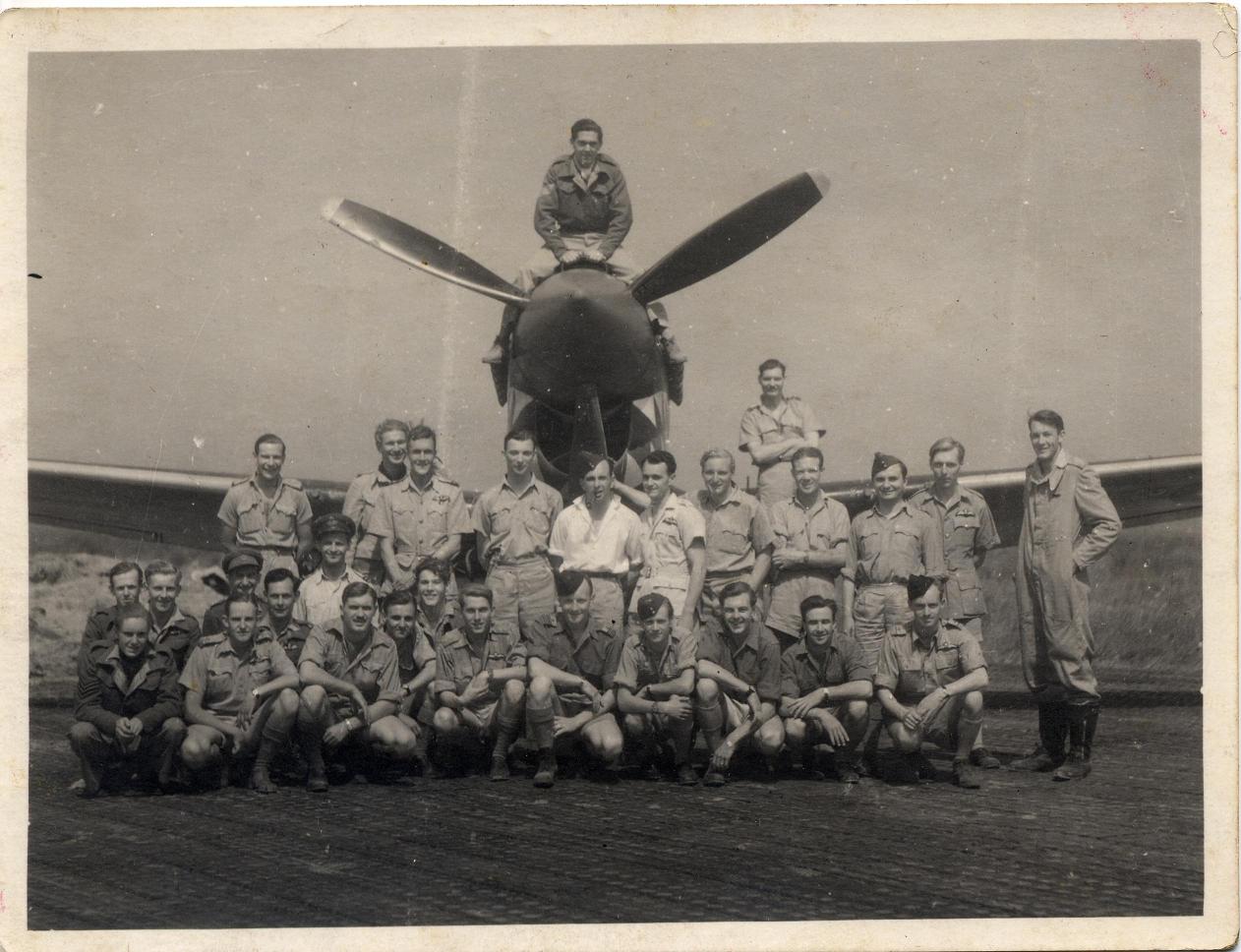
Group photo on the squadron’s fifth birthday, 17 May 1944. F/O Matthias standing third from the left.
https://commons.wikimedia.org/wiki/.....42._COL196.jpg
F/L A.R. Costello (any relation?) of No. 112 Squadron, standing in front of his Kittyhawk with “Buzz” the monkey, No. 3 Squadron RAAF’s mascot.
The No. 112 Squadron RAF First formed on 30 July 1917 at Throwley Aerodrome in Kent for home defense roles. Equipped initially with Sopwith Pups, it received Sopwith Camels in 1918. One of its first commanding officers being Major Quintin Brand, who would become the No. 10 (Fighter) Group Commanders during the Battle of Britain. The squadron disbanded on 13 June 1919.
The squadron was reformed aboard the aircraft carrier HMS Argus, on 16 May 1939 and it arrived in Egypt ten days later. The Squadron won'treceived its Gloster Gladiators until the following month and were immediately in action following the Italian declaration of war on 10 June 1940. “B” flight of the No. 112 was also detached to the Sudan at this time but was taken over and became part of No. 14 Squadron on 30 June. The squadron joined British forces defending Greece in January 1941, first supplying air cover to and offensive support over Albania and later in the air defense of the Athens area. With the collapse of the Allied forces in Greece, the unit withdrew to Crete and then back to Egypt.
In September 1940, the Royal Air Force started receiving deliveries of the Tomahawk fighters, the British designation for US-built Curtiss P-40 Warhawk. The first production Tomahawks were, in fact, “Hawk 81” taken over from cancelled French order, therefore were built to French specification including having metric instrumentation and reverse-movement "French-fashion" throttles. Worst of all, these early Tomahawks lacked the cockpit armour and self-sealing fuel tanks, making them unfit for combat. Regardless, since the threat of German invasion was still clear and present at the time, the Tomahawks were issued to operational squadrons to bolster the island kingdom’s air defenses.
Thankfully, the dreaded “Operation Sealion” never materialized and the Tomahawks were relegated to training duties. Overseas, the No. 112 Squadron became the first Desert Air Force squadron to be equipped with the Tomahawk in July 1941, in exchange for their obsolescent Gloster Gladiators. Inspired by the unusually large air inlet on the P-40, the squadron copied the "shark's mouth" logo painted on some German Messerschmitt Bf 110s of Zerstörergeschwader 76 earlier in the war. The striking picture of No. 112’s shark-mouthed Tomahawk soon began circulating around allied publications.
About halfway around the world, an American Volunteer Group pilot, Charlie Bond, was visiting the home of Roy and Alice Klein, American Baptist missionaries in Toungoo, Burma. Bond noticed their copy of the Illustrated Weekly of India, dated 2 November 1941, had a picture of a Curtis Tomahawk with a shark's mouth decorating the nose. The aircraft belonged to the RAF No. 112 Squadron. The next day, 16 November 1941, Bond rode his bicycle into town, bought some paint, and by that afternoon, had marked his P-40B in the manner subsequently adopted by the AVG as the trademark of the "Flying Tigers."
The squadron had many personnel from the air forces of Poland, Australia, Canada and New Zealand. Another member was the British ace Neville Duke (later prominent as a test pilot). For most of 1942, it was commanded by the highest-scoring Australian ace of World War II, Clive Caldwell, the first Empire Air Training Scheme graduate to command a British unit. He was succeeded by Billy Drake, the highest-scoring RAF P-40 pilot and the second highest-scoring British Commonwealth P-40 pilot, behind Caldwell. Later in the war, an increasing number of South African pilots joined the unit.
The No. 112 Squadron would retain its signature shark mouth marking as they converted through Kittyhawk and later Mustangs Mk. III and IV, DeHavilland Vampire and Hawker Hunters post-war, until its final disbandment as Bristol Bloodhound SAM unit at the height of the Cold War in 1975.
Note that the British designation (Mk. I, II, IIA, etc.) did not have one-to-one correspondence to US designation (B, C, D, etc.), the Tomahawk Mk. IIA may refer to the B variants of the P-40 while the Kittyhawk Mk. III may refer to either K or M variants, with their many permutations of finned and short/long tailed airframes.
Moreover, British airframes received under the lend-lease program generally had USAAF serial numbers attached to them before being taken on charge with RAF serials. However, those procured by direct purchase from the Curtiss-Wright company may or may not have USAAF serials. Therefore, care must be exercised when researching individual airframes.
That being said, I was smitten by the depiction of a particular Kittyhawk Mk. III (Hawk 87 or P-40K/M). The airframe was adorned with shark mouth, a hallmark of No. 112 Squadron, with its code, GA-J, extended to read “Jinx” underneath its serial number, FR474. There are many profile drawings of said airframe but none of its actual photo, even the profile varied from short/long-tailed K variant to the M with cooling vents in front of the exhaust.
So, I started tracing its history starting from No.112’s tribute website, which noted:
FR474, GA-Jinx flown by Capt. Matt Mathias, Curtiss P-40K-15-CU, 42-10331 to RAF as Kittyhawk III FR474. SOC [Struck off Charge] Mar 29, 1945
Then, I crosschecked the data to, as usual, Joe Baugher’s serial number list; the serial checks out.
The No.112 site also feature, by far, the only period picture of the FR474:
http://raf-112-squadron.org/112_photos_page_6.html
“Flt Lt Maurice Neville Matthias, 119867, RAFVR, Kittyhawk Mk. III FR474/GA-Jinx, after the last aerial battle of 112 Sqdn over Rieti 7 August [sic, April] 1944, note what appears to be an overlay or cut out repair for the roundal [sic]”
The picture is, unfortunately, inconclusive, showing none of distinguishing tail section or front of the exhaust of the FR474. The next page, thankfully, featured many of her stablemates:
http://raf-112-squadron.org/112_photos_page_4.html
“1943, Kittyhawk Mk III, GA-V FR440 (42-10061 to RAF as Kittyhawk III FR440. DBR [Damaged Beyond Repair] when belly landed S of Fayid after engine failed during overshoot), GA-L FR472, (Curtiss P-40K-15-CU, 42-10329 to RAF as Kittyhawk III FR472. SOC May 31, 1944) and possibly GA-D, FR412 or GA-C, FR452 warm up for take off”
FR472/GA-L, showing lack of nose cooler vent and dorsal fin, and the presence of tail extension aft of the elevator hinge. The airframe seems to be the same production batch as FR474 according to Joe Baugher’s site.
For such an iconic color scheme, little was known of the pilot, F/L (then F/O) Matthias. He was born in Lamuria, Kenya (then British East Africa) on 17 May 1922, and joined the fight under the RAF Volunteer Reserve (RAFVR). On the report of 7 April action over Rieti, “112 Sqn “Shark Squadron” 1942-1945” by Andre Zbiegniewski noted:
Just after the commander’s order to engage in combat, Flying Officer Matthias rushed in the direction of three Fw 190s [of 10 SKG] circling over Rieti. He unsuccessfully shot all of his ammunition at them, but the enemy was not passive. Matthias’s GA-Jinx returned to base with its upper fuselage ripped apart by a 30-milimeter bullet.
From Ghostbombers.com :
Already that morning, No. 112 had sunk an auxiliary vessel of 500–1,000 tons at Porto Civitanova, F/O Matt Matthias scoring a direct hit.
On 2 April 1945 he was killed when his Mustang IV KM135/GA-V was hit by flak over Graz, Austria. He was buried in the Klagenfurt War Cemetery, Austria.
http://raf-112-squadron.org/images/.....7_May_1944.JPG
Group photo on the squadron’s fifth birthday, 17 May 1944. F/O Matthias standing third from the left.
https://commons.wikimedia.org/wiki/.....42._COL196.jpg
F/L A.R. Costello (any relation?) of No. 112 Squadron, standing in front of his Kittyhawk with “Buzz” the monkey, No. 3 Squadron RAAF’s mascot.
Category All / All
Species Unspecified / Any
Size 2000 x 1233px
File Size 1.82 MB


Neat video about the P-40: https://www.youtube.com/watch?v=NewgE0xbRDU

These two have all you need to know about Hawk Family:
https://www.youtube.com/watch?v=zyq.....PU&t=1248s
https://www.youtube.com/watch?v=D22.....04&t=2281s
An underappreciated workhorse. Poor high-altitude performance, poor climb rate, but an ace maker when flown to its strength. Its resilient airframe could resist even direct 30 mm hits, very useful in the hands of red air force where ramming seems to be their national sport.
https://www.youtube.com/watch?v=zyq.....PU&t=1248s
https://www.youtube.com/watch?v=D22.....04&t=2281s
An underappreciated workhorse. Poor high-altitude performance, poor climb rate, but an ace maker when flown to its strength. Its resilient airframe could resist even direct 30 mm hits, very useful in the hands of red air force where ramming seems to be their national sport.
And an Australian pilot took out five German planes in North Africa - an "ace in a day" flying the Hawk.
Yep, that's "Killer" Caldwell all right, did that feat while being with No. 112.
https://commons.wikimedia.org/wiki/.....d_War_CF90.jpg
How to tell an Aussie without telling.
Yep, that's "Killer" Caldwell all right, did that feat while being with No. 112.
https://commons.wikimedia.org/wiki/.....d_War_CF90.jpg
How to tell an Aussie without telling.

Curtiss-Wright practically was among the oldest aviation company in the world, after 1929 merger of Curtiss Aeroplane and Wright Aeronautical; itself the descendant of the original Wright company, founded by the Wright brothers in 1909.
The company still existed today, based in NC, though haven't built any aircrafts since the 1960s
The company still existed today, based in NC, though haven't built any aircrafts since the 1960s
*laughs... probably not. The DC-9 was a great aircraft, by the way, and the only reason they stopped making them was Boeing bought the company and killed the competition. Of note: there was no hydraulics operating the elevators - there was only the control tabs. There was a hydraulic emergency kick down feature for stalls, but that was it.
Vix
Vix
There's no denying that DC-9 was great aircraft, as does DC-10 despite its shortcomings, but they're purely Douglas' designs. When Boeing bought McDD in 1997, McDD accountants took over Boeing's engineering and the company has been slowly in decline engineering-wise ever since. It was said that McDD bought Boeing with Boeing's own money.
777 being the last airliner purely designed by Boeing, "working together" with several airlines to which gave their inputs to the new design. Phil Condit and Alan Mullaly (bonafide aerospace engineers, mind you) still served on Boeing helm at that time before replaced briefly by McDD's James McNerney and later Dennis Muillenburg aaand... we got 737MAX and 787
Mind you all McDD done to that point were regurgitating old designs like MD80 and MD11.
Of course i'm talking solely about their commercial business, the military side is a completely different animal altogether *cough*Northrop F-18L*cough*
777 being the last airliner purely designed by Boeing, "working together" with several airlines to which gave their inputs to the new design. Phil Condit and Alan Mullaly (bonafide aerospace engineers, mind you) still served on Boeing helm at that time before replaced briefly by McDD's James McNerney and later Dennis Muillenburg aaand... we got 737MAX and 787
Mind you all McDD done to that point were regurgitating old designs like MD80 and MD11.
Of course i'm talking solely about their commercial business, the military side is a completely different animal altogether *cough*Northrop F-18L*cough*
YES! and they with 767 had the same engines as well. GE CF6-80C2A/B/D designations stand for Airbus(A300/A310), Boeing(747/767), and Douglas(MD11)
https://www.aircraft-commerce.com/w.....xt=It,engines.
Thankfully A300/A310 had been phased out long before MD11. When I saw the footage of UPS MD11, with its nacelle detached and flew over the wings, AA191 instantly came to mind (Turned out AA maintenance crew had previously held the nacelle with a forklift during routine pylon inspection and hammered the aft pin while out of alignment, resulting in a crack). That kind of accident SHOULDN'T have happened twice; God rest the souls of 3 aircrews and 12 people on the ground.
Since the resulting AD didn't cover the beluga fleet (Based off A300) I assume Airbus did some improvement towards its nacelle.
https://www.aircraft-commerce.com/w.....xt=It,engines.
Thankfully A300/A310 had been phased out long before MD11. When I saw the footage of UPS MD11, with its nacelle detached and flew over the wings, AA191 instantly came to mind (Turned out AA maintenance crew had previously held the nacelle with a forklift during routine pylon inspection and hammered the aft pin while out of alignment, resulting in a crack). That kind of accident SHOULDN'T have happened twice; God rest the souls of 3 aircrews and 12 people on the ground.
Since the resulting AD didn't cover the beluga fleet (Based off A300) I assume Airbus did some improvement towards its nacelle.


Thanks!
Shark mouth motif has been around ever since military aviation existed, the lineage of the 1st AVG is now carried on by 23rd Fighter Group flying A-10 Thunderbolts.
https://archive.org/details/sharkmo.....0ward/mode/1up
Now this is a "real" shark
https://commons.wikimedia.org/wiki/.....ump-to-license
Shark mouth motif has been around ever since military aviation existed, the lineage of the 1st AVG is now carried on by 23rd Fighter Group flying A-10 Thunderbolts.
https://archive.org/details/sharkmo.....0ward/mode/1up
Now this is a "real" shark
https://commons.wikimedia.org/wiki/.....ump-to-license

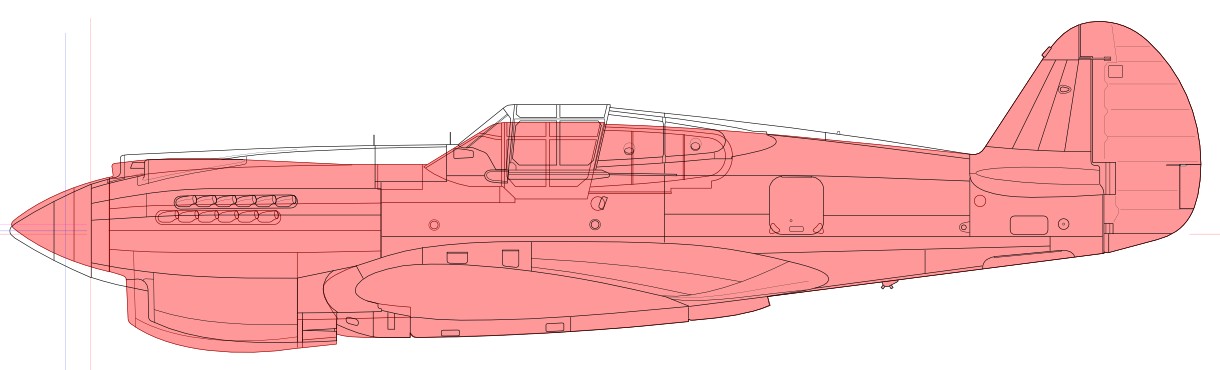
Thanks! Tomahawk/P-40B/C generally have larger, more sloped down nose than Kittyhawk, which have those classic big-mouth cooler intakes.
https://soyuyo.main.jp/p40b/p40b002.jpg
https://soyuyo.main.jp/p40b/p40b002.jpg



_taken_from_walking_bridge.JPG#mw-jump-to-license)
Comments