
 FA+
FA+ Shop
Shop
444
Views
Views
19
Favorites
Favorites
Category
Artwork (Traditional) / All
Species Unspecified / Any
Size 1280 x 1684
File Size 4.13 MB
Report this content
More from Heywulf


Listed in Folders


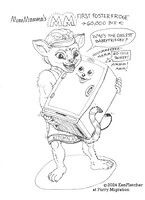
Green Hat (A Fur-Elf Magic User)...Larry's DUNGEON setting.
A view of my impression of Larry Brommer's Fantasy Role-Playing setting in 1976. The DUNGEONs I played in were variant games, freebooted, & in each dungeon-master's style. Our dungeon looters traditionally started from a "General Store",much like the old store in the image, rather than from a bar in a town. In 1974, the local dungeonmasters were reasonably tolerant of my slight warp of Elf-characters into families of "Fur-Elves" (with Elf-stats). The DMs allowed me to draw my characters as I imagined them, as long as I kept well within the "Elf" stats for the die-rolls.
My gaming was within a science fiction club in Minneapolis/Saint Paul. The club members included some that also went to the very large miniatures gaming club that had events at several colleges. That club was the one where David Wesely & Dave Arneson (among others) discovered refereed miniatures battles, which led to many in that club play-testing variations on role-playing during battles. The play-testing of a fantasy-setting role playing game in 1973 (with Gary Gygax's input) turned into "Dungeons & Dragons" by late 1973, early 1974. (Published by TSR in Wisconsin.) A couple of the sf club members attended some of the 1974 play-tests. They became the dungeon masters for the sf club's variant RPGs. So, furry-folk: There were "fur-elves" by at least early 1974. 🐺
This sketch is an impression of this RPG setting. It was very High Energy, and seemed High Inflation. Other local game settings were a bit more low key. (Although the sf fans liked their puns and story quotes.) The rough colorful image was printed on a 1960-era office copy machine: Officially a "spirit duplicator" or sometimes a "Ditto" brand, it would often be confused with a "Mimeograph" copier. This copier was more often seen with purple typing on white paper, and slightly smelling of alcohol fumes. The picture was mostly done with purple ink, but it was printed on orange paper. Having been adjusted in a graphics scan, it appears dark red. The green ink was applied separately. The texture is from the ink being applied with a soft pencil. ("Ringtail O'Reily" wants to wish you all a safe journey home, from 51 years ago....) 🦝
My gaming was within a science fiction club in Minneapolis/Saint Paul. The club members included some that also went to the very large miniatures gaming club that had events at several colleges. That club was the one where David Wesely & Dave Arneson (among others) discovered refereed miniatures battles, which led to many in that club play-testing variations on role-playing during battles. The play-testing of a fantasy-setting role playing game in 1973 (with Gary Gygax's input) turned into "Dungeons & Dragons" by late 1973, early 1974. (Published by TSR in Wisconsin.) A couple of the sf club members attended some of the 1974 play-tests. They became the dungeon masters for the sf club's variant RPGs. So, furry-folk: There were "fur-elves" by at least early 1974. 🐺
This sketch is an impression of this RPG setting. It was very High Energy, and seemed High Inflation. Other local game settings were a bit more low key. (Although the sf fans liked their puns and story quotes.) The rough colorful image was printed on a 1960-era office copy machine: Officially a "spirit duplicator" or sometimes a "Ditto" brand, it would often be confused with a "Mimeograph" copier. This copier was more often seen with purple typing on white paper, and slightly smelling of alcohol fumes. The picture was mostly done with purple ink, but it was printed on orange paper. Having been adjusted in a graphics scan, it appears dark red. The green ink was applied separately. The texture is from the ink being applied with a soft pencil. ("Ringtail O'Reily" wants to wish you all a safe journey home, from 51 years ago....) 🦝
Category Artwork (Traditional) / All
Species Unspecified / Any
Size 1280 x 1684px
File Size 4.13 MB
Listed in Folders


Slight alcohol smell??? We often became semi-drunk from the fumes. Teachers never understood who so many boys volunteered to run the mimeograph... A few weeks ago I ran across a collection of filk songs that had been run off one of those machines, early 80's in Lubbock Texas.
The old days, when an adventure didn't start out with everyone arguing about what rule three really meant but who brought the rope this time.
The old days, when an adventure didn't start out with everyone arguing about what rule three really meant but who brought the rope this time.
There was a control to change the amount of alcohol that thinly-coated the sheets of paper. Some teachers doing the printing didn't remember about how to do the setting. The vapors smelled odd -- there was flavoring added to the supplied cans of "spirit" alcohol, that would effectively keep people from drinking the alcohol from the can.
And you've "Got it in one!": Having a referee to moderate "The Rules" was something that was rediscovered by groups of the miniature army gamers in the 1960s. Maybe the energy from disputing the details of a rules booklet went more into immersing everyone into energizing a referee-moderated game-play.
And you've "Got it in one!": Having a referee to moderate "The Rules" was something that was rediscovered by groups of the miniature army gamers in the 1960s. Maybe the energy from disputing the details of a rules booklet went more into immersing everyone into energizing a referee-moderated game-play.
Blind Axis and Allies... Now there in a hair puller of a game. One 'umpire' who's sole job was to tell the players what they see when entering a new area. Game info like "Cuba'';s radio now transmits solely in Japanese" or "Your Normandy invasion has just been sunk by the Japanese" (Now there was a "WHAT?" moment for Mike Critafoli.)
MC: "How did they get there?"
"Ah" says the umpire, "A little known route called the Cape of Good Hope."
MC: "Reese, I'm going to kill you."
"By the way, England has just been invaded by Japanese forces, have fun."
Me: (giggles.)
You only knew where everything was at the first turn, after that it was Balls Up madness.
Then came Majik, the Addiction and almost all other gaming died. This was at Toss of the Dice which was gaming only. No machine, you wanted to run a game and paid the room rent. Then someone wold bring in Mimeographed rules or wet photocopies so you unassed the room until the stench passed.
Am I dating myself? Nahh, I cost too much.
MC: "How did they get there?"
"Ah" says the umpire, "A little known route called the Cape of Good Hope."
MC: "Reese, I'm going to kill you."
"By the way, England has just been invaded by Japanese forces, have fun."
Me: (giggles.)
You only knew where everything was at the first turn, after that it was Balls Up madness.
Then came Majik, the Addiction and almost all other gaming died. This was at Toss of the Dice which was gaming only. No machine, you wanted to run a game and paid the room rent. Then someone wold bring in Mimeographed rules or wet photocopies so you unassed the room until the stench passed.
Am I dating myself? Nahh, I cost too much.

Classical: Also simple & effective, on a very small scale. But not every human is comfortable getting info from text-only displays. By 2025, every kid can use a phone to send a small info-dump of text, video, audio, art & animation to one friend on the other side of our world. And also, that one message can be harvested by a huge data-harvesting factory and deliberately shared (out of context) with millions of carefully selected recipients who have just clicked a dot on a screen.


I agree with your *Rhetorical Question*. That does happen, and it is something Fantasy Role-Playing gaming can do: People can get together in person to do something social that is very personalized & geeky & fun.
I think our communication culture has recently evolved from "mass-market" entertainment, to mass-market entertainment that is designed to be pushed to customers. And the less competition choices pushed, the better it is for the entertainment/information industries. And if some people get annoyed at the lack of choices, info-companies can use tech to manufacture the imitation of choices. That is what "AI" is: The imitation of unlimited choices. It is imitation because it is based on programming-generated rules. And the base programming can contain rules and restrictions that the user is not supposed to know. That is baked into having programming manufacturing the creativity. Even if the programming is 'innocent' data, the bosses of the programmers are not necessarily 'innocent'.
It may be that some mass communicators might see small-group social personal-participation role-playing as a threat. Could that be why there are large-audience imitations of fantasy-role-playing that are actually pre-scripted improvisational theater?
I think our communication culture has recently evolved from "mass-market" entertainment, to mass-market entertainment that is designed to be pushed to customers. And the less competition choices pushed, the better it is for the entertainment/information industries. And if some people get annoyed at the lack of choices, info-companies can use tech to manufacture the imitation of choices. That is what "AI" is: The imitation of unlimited choices. It is imitation because it is based on programming-generated rules. And the base programming can contain rules and restrictions that the user is not supposed to know. That is baked into having programming manufacturing the creativity. Even if the programming is 'innocent' data, the bosses of the programmers are not necessarily 'innocent'.
It may be that some mass communicators might see small-group social personal-participation role-playing as a threat. Could that be why there are large-audience imitations of fantasy-role-playing that are actually pre-scripted improvisational theater?

E. FRIT & SONS
I think I have an Ifrit in the house...
Anyway, this brings back some memories. I was in college (the first time through) in those days, and unfortunately, didn't have time for game playing. I still have no idea how the Wargames Society guys pulled of going to school full time, studying and blowing up/saving the world.
I think I have an Ifrit in the house...
Anyway, this brings back some memories. I was in college (the first time through) in those days, and unfortunately, didn't have time for game playing. I still have no idea how the Wargames Society guys pulled of going to school full time, studying and blowing up/saving the world.
Hello from the Twin Cities! You will know local references. Something happened with that gaming club. I'm guessing that they were so needing game opponents, that they started informal branches or alliances of game players in multiple colleges & pop-culture social groups. Some sources said that by about 1970 they had a phone-list of over 100 members. At that time, there were also a lot of pop-culture media fan groups starting up in the Twin Cities, too.

I was not enough of a researcher/reporter in the 60s & 70s. Much of what I thought I knew about fan socializing was from some sf fan social groups. What I heard in the 70s about gaming clubs was fan-types telling me that the major cities had game clubs that were big enough to rent rooms for (maybe) monthly or weekly meetings. In the 1970s I was actually told that the Twin Cities didn't have that. People would have frequent apartment parties to play games, and would keep the same members for years, since high school! No inclination to add to the group. I was told it might be from background cultures! (Scandinavian or German immigrants in the 19th century.) I later did hear of a Chess club that had a meeting room in the second floor of a small shop building in Saint Paul. And I had heard of the college game clubs, but I didn't realize there was the potential of overlap between the clubs. I've met some of the people involved, but never thought to ask them about the real-world setting of how they evolved out to fantasy role-playing.




Comments